
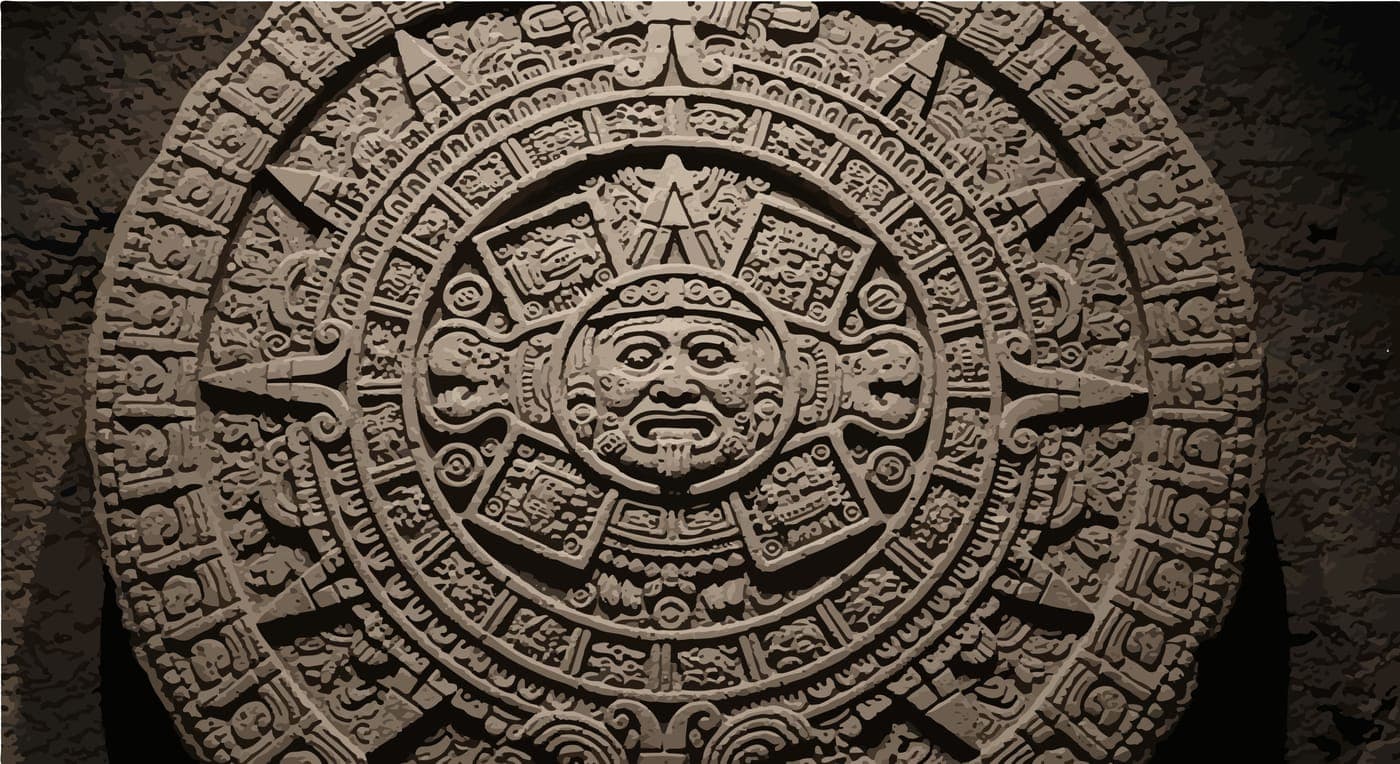
There is a massive carved stone disk sitting in Mexico's National Museum of Anthropology that has been called the Aztec Calendar for over 200 years. It appears in textbooks, documentaries, and gift shops worldwide. There's just one problem: it isn't a calendar. It never was. And archaeologists have known this for decades.
The stone — properly called the Piedra del Sol, or Sun Stone — was carved sometime in the late 15th century and depicts the Aztec cosmological creation myth. At its center is the face of Tonatiuh, the sun god. The rings surrounding him show the four previous world ages the Aztecs believed had existed before the current one, along with various celestial and ritual symbols. It is a representation of the universe and its history — a theological statement carved in stone, not a device for tracking days.
The misidentification happened in 1790, when the stone was unearthed during construction work in Mexico City's main plaza. Early Spanish colonial scholars, unfamiliar with Aztec cosmology and working without proper context, interpreted the circular structure and symbolic imagery as a timekeeping device. The label "calendar" stuck — and 230 years of repetition made it feel like fact.
The Aztecs did have actual calendars — two of them, in fact, running simultaneously. One was a 365-day solar calendar called the xiuhpohualli, used for agricultural and civic life. The other was a 260-day ritual calendar called the tonalpohualli, used for religious ceremonies and divination. When the two calendars aligned — which happened every 52 years — it was considered a moment of cosmic significance. Neither of these systems is what's depicted on the Sun Stone.
What makes the error particularly embarrassing is how widely it has been corrected in academic circles — and how completely those corrections have failed to reach popular culture. Museum gift shops still sell "Aztec calendar" replicas. Travel documentaries still call it a calendar. It remains one of the most successfully persistent misidentifications in the history of archaeology.
The actual story of what the stone depicts — a creation mythology involving multiple destroyed worlds, a sun god who demands blood to keep moving across the sky, and a civilization that genuinely believed the universe could end at any moment — is significantly stranger and more interesting than a calendar. It always was. The label just made it easier to sell souvenirs.