
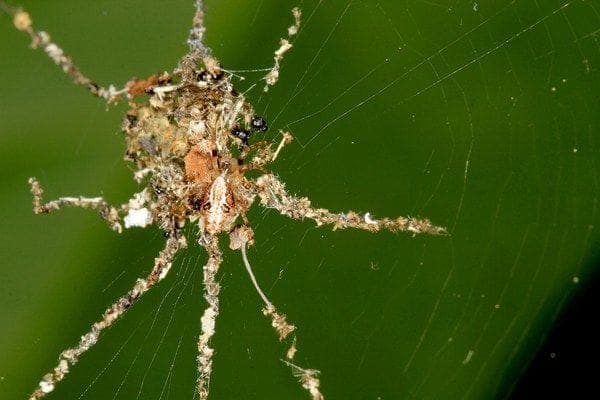
In 2012, a researcher hiking through the Peruvian Amazon noticed something strange in a spider's web. Sitting at the center was what appeared to be a large spider — but something about it looked off. On closer inspection, it wasn't a spider at all. It was a life-size replica, constructed entirely from dead insects, debris, and silk, positioned with uncanny accuracy in the exact spot a real spider would sit. The actual spider was hiding nearby, watching.
A spider had built a decoy of itself. The discovery, published in the journal Scientific Reports, described a previously unknown species of orb weaver — now called Cyclosa mulmeinensis — that constructs elaborate dummy spiders and strings them up in its web as decoys. The replicas include body segments, leg-like extensions, and the general silhouette of a spider large enough to deter predators.
What makes this behavior extraordinary is what it implies about the spider's cognitive process. To build an effective decoy, the spider must have some internal model of its own appearance that it can reproduce in external material. This is not the kind of behavior scientists expected to find in an animal with a brain smaller than a pinhead.
The decoys aren't static. Researchers observed the spiders actively vibrating the web when predators approached, causing the dummy to shake — mimicking the defensive behavior of a live spider. The decoy wasn't just a disguise. It was a puppet. The spider was performing through it.
Since the initial discovery, similar decoy-building behavior has been documented in other Cyclosa species across Southeast Asia and South America. Each uses locally available materials — plant matter, insect carcasses, egg sacs — to construct replicas adapted to its specific environment. The behavior appears to have evolved independently in multiple locations, which suggests it works well enough to be worth the significant energy cost of building it.
Science has spent decades arguing about where animal intelligence begins and ends. The decoy spider didn't wait for that debate to resolve. It was out there in the rainforest, building sculptures of itself and operating them like marionettes, completely indifferent to what we thought was possible.