
The Ghost Particles Under the Ice
This morning in Stockholm, the Royal Swedish Academy of Sciences awarded the 2026 Nobel Prize in Physics to Francis Halzen, a Belgian-born physicist at the University of Wisconsin–Madison, for his decisive contributions to the IceCube Neutrino Observatory and the discovery of high-energy neutrinos from beyond our galaxy. It is the first physics Nobel given to a single person since 1992, and it honors an idea that sounded almost absurd when he first proposed it: that the ice beneath the South Pole could be turned into a detector.
A Telescope Made of Ice
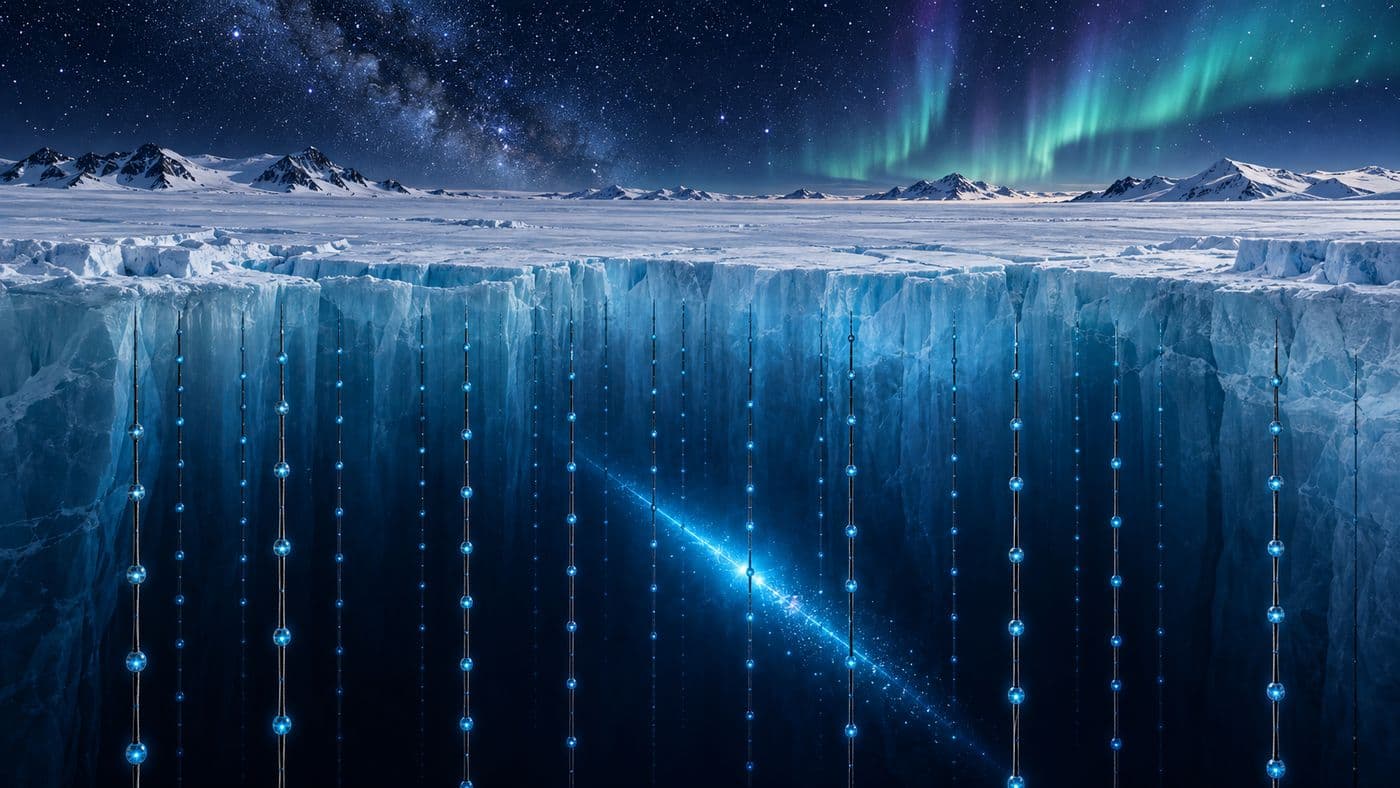
Neutrinos are among the strangest particles in nature: they carry almost no mass and no electric charge, and trillions pass through your body every second without leaving a trace. That makes them nearly impossible to catch, but also makes them valuable messengers, because unlike light they travel straight from their source, unbent by magnetic fields and unblocked by dust. Halzen's insight, first presented in 1988, was that clear Antarctic ice could serve as the detector. When a rare neutrino collides with an atom in the ice, it produces a faint flash of blue light. Catch enough flashes, and you can work out where the particle came from.
Turning that idea into reality took decades. Funding for IceCube was approved by the National Science Foundation in 2002, and the finished detector, completed in 2011, consists of 5,160 light sensors strung on 86 cables lowered into holes melted a mile and a half deep into the ice with hot water. In 2013, the international IceCube team announced the first evidence of high-energy neutrinos from outside our solar system. Then, in 2017, a single neutrino was traced to a flaring galaxy called TXS 0506+056, about four billion light-years away, the first time scientists had pointed to a likely source of such a particle. Nobel committee chair Mark Pearce said Halzen's vision paved the way for "a new kind of astronomy." Reached by phone in Italy after the announcement, Halzen called the news a great surprise.
For most of human history, astronomy meant looking up and collecting light. In the last century, that expanded to radio waves, X-rays, and gravitational waves, each opening a view the one before could not. Neutrino astronomy is the newest of these windows, and it began with a physicist willing to bet that a frozen continent could hold a detector the size of a small mountain. The prize carries 12 million Swedish kronor, about $1.2 million, and will be presented in Stockholm on December 10, the anniversary of Alfred Nobel's death. The real reward may be what comes next: every neutrino IceCube catches is a message from some extreme corner of the cosmos, still waiting to be read.