
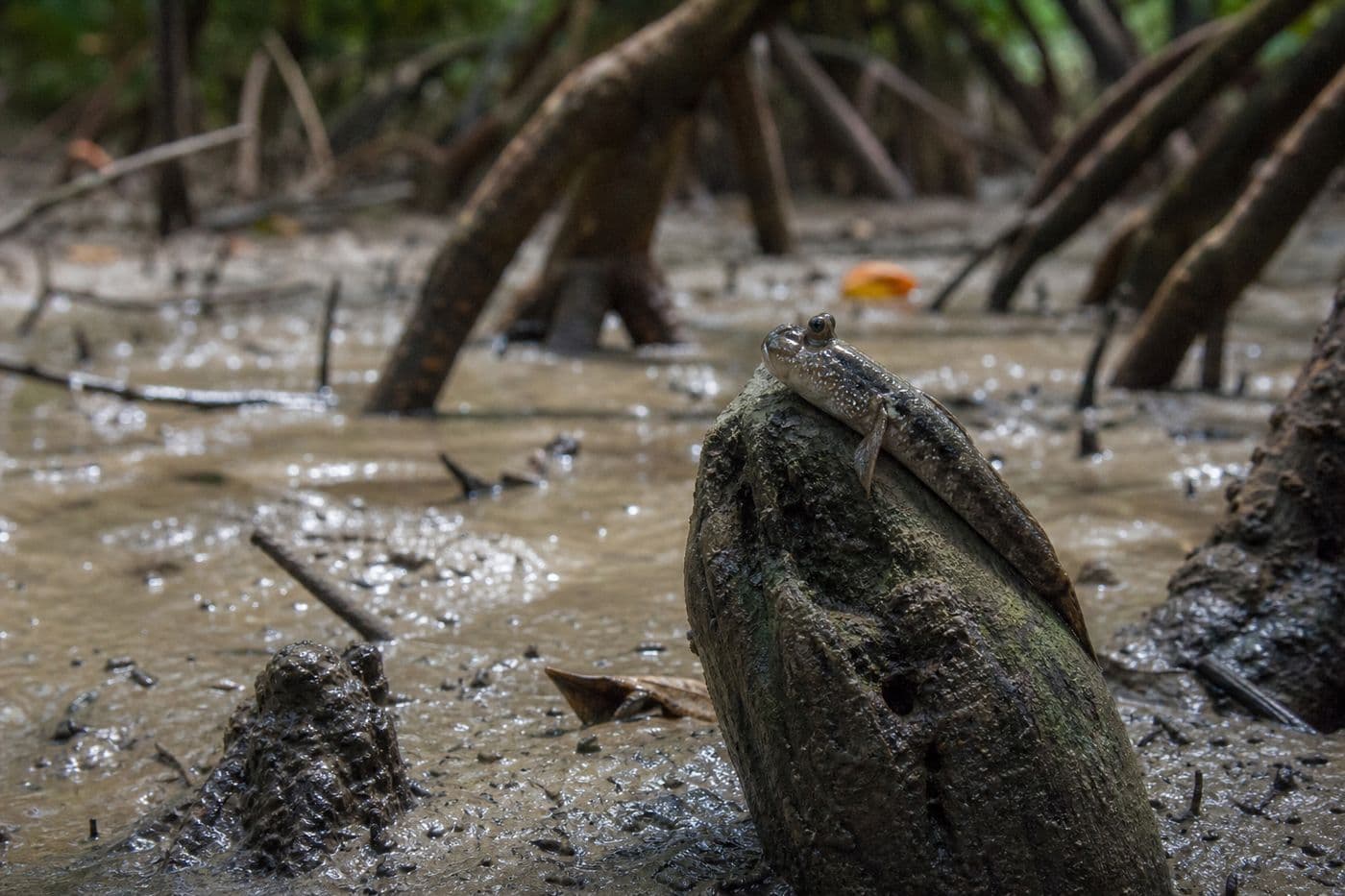
Along the muddy coastlines of West Africa and the Indo-Pacific, there's a fish that seems to have forgotten it's supposed to live in water. It spends up to 90% of its time on land, hopping across mudflats like it owns the place.
Meet the mudskipper, a small, bug-eyed fish that looks like it lost a bet with evolution. Its pectoral fins have adapted into something closer to stubby little arms, letting it prop itself up and skitter across exposed mud at low tide.
Most fish would suffocate the moment they left water, but mudskippers breathe through their skin and the lining of their mouth and throat, as long as those surfaces stay moist. They basically carry their own oxygen supply around with them.
To keep from drying out, mudskippers roll around in puddles and mud like tiny hydration breaks, then head right back to foraging on land. They eat insects, algae, and small crustaceans, and they'll defend a patch of mud with real aggression against rival mudskippers.
Here's where it gets stranger: some mudskipper species can actually climb. They use their fused pelvic fins as a suction-cup grip to scale mangrove roots and low branches, hunting or escaping predators several feet above the ground.
Mudskippers can survive out of water longer than they can survive fully submerged, which flips the usual definition of a fish on its head. Keep one in a tank with no dry perch and it will actually struggle.
Scientists studying mudskippers have pointed to them as a living snapshot of what the transition from sea to land might have looked like hundreds of millions of years ago. Somewhere in a mangrove swamp, evolution's rough draft is still splashing around, half fish, half something else entirely.