
The standard story of how money was invented goes something like this: early humans bartered — trading chickens for grain, labor for shelter — and eventually the inconvenience of matching what you had with what someone else wanted became too complicated. So someone invented a universal medium of exchange: money. It's a clean, logical story. It also appears to be almost entirely fabricated.
The barter-to-money narrative was popularized by Adam Smith in 1776 and has been repeated in economics textbooks ever since. There's just one problem: no anthropologist or archaeologist has ever found a society that actually operated this way. Researchers have studied hundreds of pre-monetary societies across human history, and what they consistently find isn't barter — it's complex systems of credit, obligation, and gift exchange. "I owe you one" came long before coins. The primitive trading post where strangers swapped goods appears to be a story economists invented to explain something they hadn't actually studied.
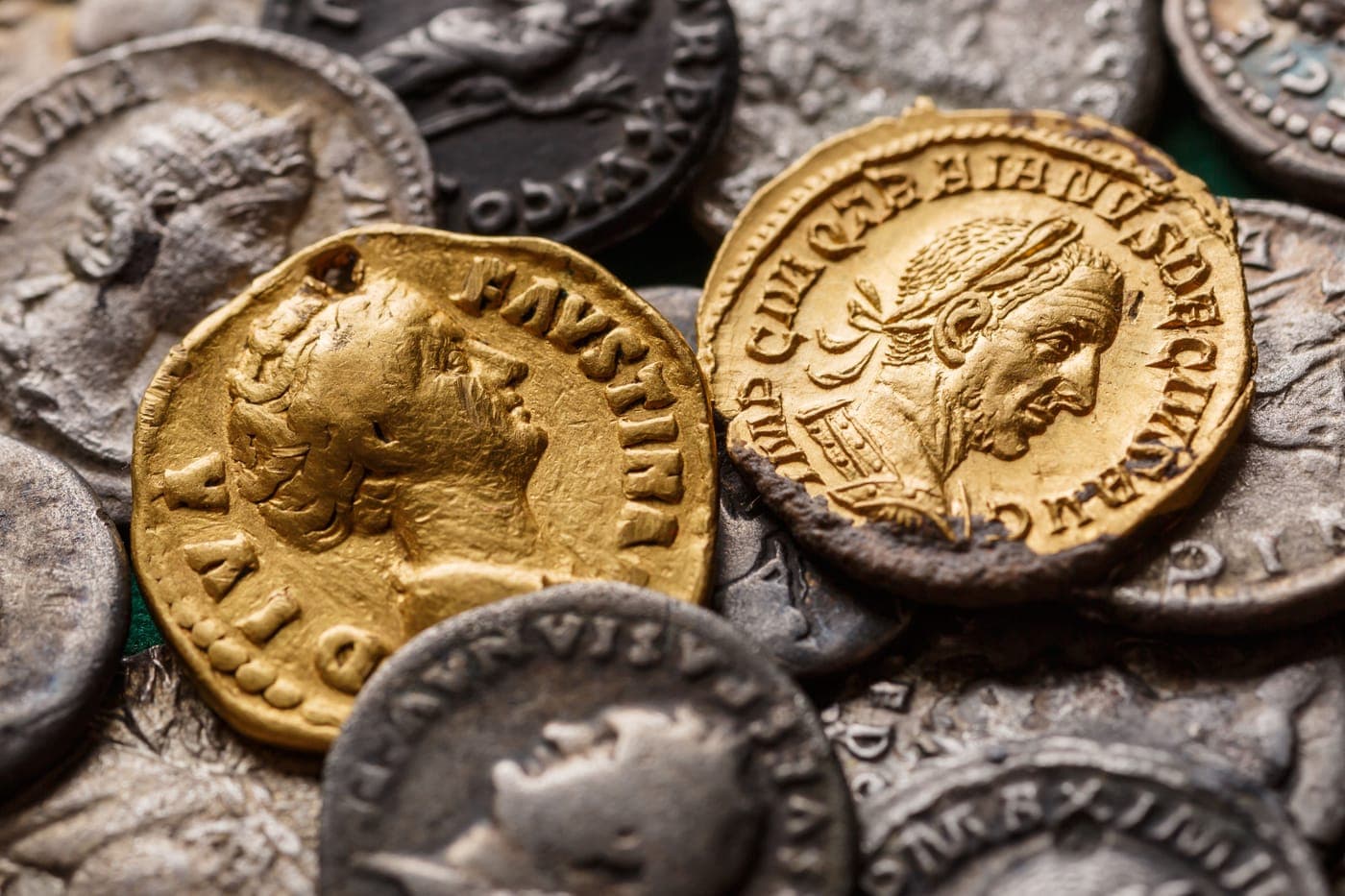
So where did money actually come from? The earliest standardized coins appeared around 600 BCE in the kingdom of Lydia, in what is now Turkey — and the historical evidence for why they were created points in a specific direction. The leading theory, developed by anthropologist David Graeber and supported by a significant body of historical research, is that coins were invented to pay soldiers. Rulers needed a way to compensate large armies of mercenaries who had no personal loyalty to them and no interest in receiving payment in grain or cattle. A standardized coin solved the problem: it was portable, durable, and universally recognizable.
But inventing a coin doesn't create a monetary economy on its own. Soldiers might have coins, but that doesn't mean anyone else will accept them. The mechanism that made coins circulate through the broader population was taxation. Rulers issued coins to pay their armies, then demanded that taxes be paid back to the state in those same coins. Suddenly, every farmer, merchant, and craftsperson in the kingdom needed to acquire coins — not to trade with each other, but to settle their debt to the government. Markets developed not because money made trade easier, but because people needed a way to earn the coins that would keep them out of trouble with the state.
This pattern appears to have emerged almost simultaneously in several regions. Around the same period, similar coin-based systems developed in India and China — all linked to military expansion and state taxation. The parallel timing across civilizations that had no contact with each other suggests this wasn't coincidence. Whenever a state needed to supply a large mobile army efficiently, coins followed. The market economy, in this reading, is a byproduct of military logistics rather than a natural evolution of human trade.
The implications reach further than ancient history. Credit and debt — not coins and trade — appear to be the original foundation of economic life. Mesopotamian records from as far back as 3,000 BCE show sophisticated systems of interest-bearing loans, debt contracts, and credit arrangements — all recorded in clay tablets — nearly 2,500 years before standardized coinage appeared. People weren't trading chickens for grain. They were running tabs, taking loans, and settling debts in a unit of account that rarely changed physical hands.
When monetary systems collapse — as happened during the fall of the Roman Empire, or in Russia in 1998 — the barter that emerges isn't a return to a primitive state. It's a new behavior that people invent under pressure, which is the opposite of what the standard story would predict. Barter, it turns out, comes after money fails — not before money exists.
The story of money as a neutral, practical invention to make trade easier is a comfortable one. The actual story — coins invented to pay soldiers, circulated through taxation, spreading markets as a side effect of state power — is considerably less flattering to the economic systems most of us live inside. Which may be exactly why the simpler version has been taught in classrooms for 250 years.