September 8: A Masterpiece Unveiled, a Pardon Granted, and a Warrior at the Gates of Paris
September 8 is a day for audacity — for human beings doing things that were considered impossible, or unwise, or both. In 1504, a twenty-nine-year-old sculptor in Florence drew back the curtain on a seventeen-foot figure carved from a block of marble that two previous artists had abandoned as unworkable, and presented to the city something so far beyond what anyone had expected that it immediately redefined what sculpture could be and established its maker as the greatest practitioner of the form who had ever lived. Four hundred and seventy years later, in the Oval Office, a president who had been in office for thirty days issued a blanket pardon to the man he had replaced — a decision made with sincere intent to spare the country further anguish that instead produced a political storm that may have cost him the next election. And in 1429, a nineteen-year-old girl who had been hearing voices since childhood and had already lifted a siege and gotten a king crowned led an assault on the most heavily fortified city in France — and failed, and was wounded, and pulled back, and began the long decline that ended at the stake in Rouen. Three September eighths. Three encounters with the outer edge of what any one person can do.
David
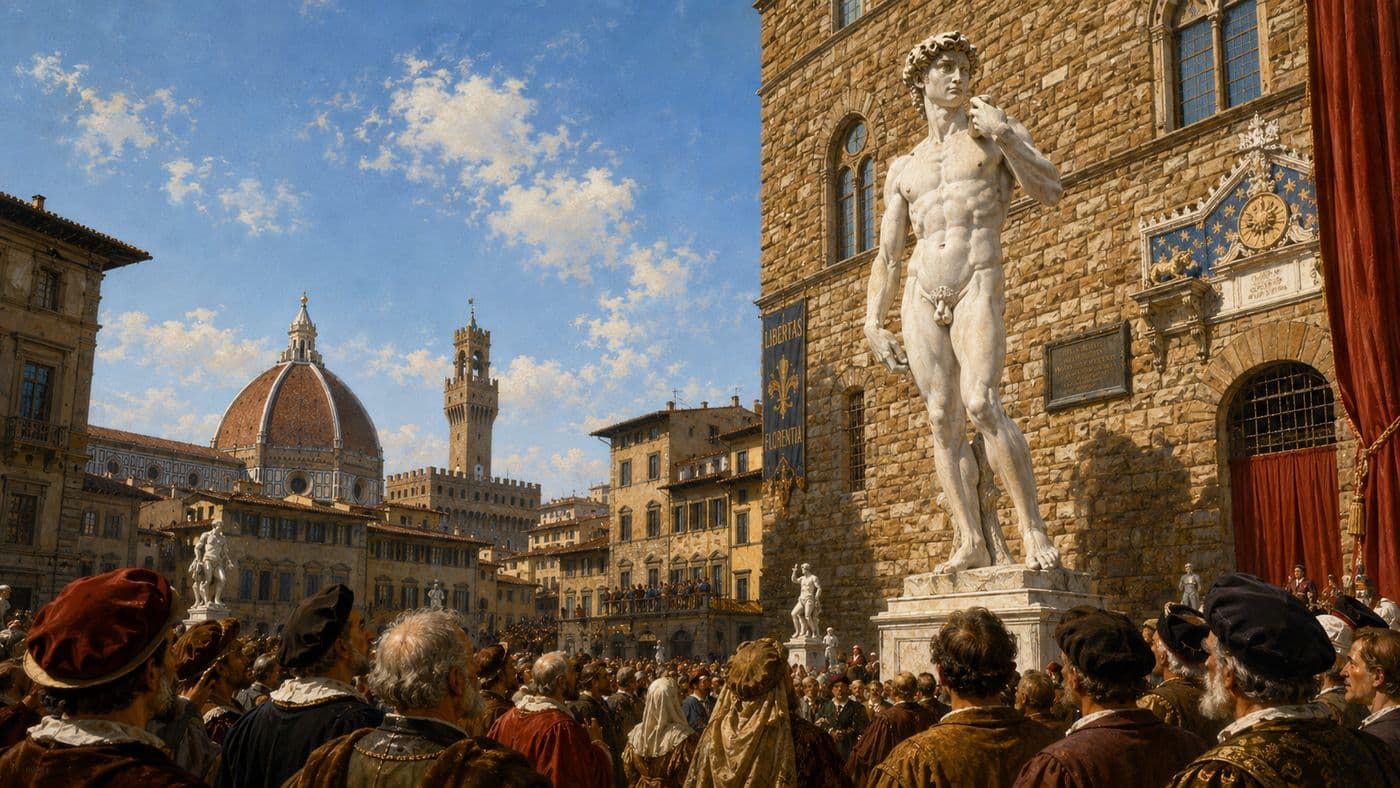
On September 8, 1504, Michelangelo's statue of David was installed in the Piazza della Signoria in Florence — the civic heart of the Florentine Republic — after a four-day journey from the workshop where it had been carved, during which workers had carefully disassembled the door of the building to extract it and built a special wooden frame to move the seventeen-foot figure through the city streets. Michelangelo had been commissioned in 1501 to carve a figure of David from a large block of Carrara marble that had been sitting in the workshop of the cathedral for twenty-five years, previously attempted by two other sculptors who had found the block too narrow and too deeply flawed with a crack to be workable. He was twenty-six years old when he received the commission and twenty-nine when he completed the work. What he made from the abandoned block was not the triumphant David of the moment after Goliath's defeat — the figure most previous Davids had depicted — but the David of the moment before: tense, watchful, gathering himself, the sling already over his shoulder and his gaze fixed on an enemy not yet engaged.
The David installed in Florence's Piazza della Signoria on September 8, 1504, was understood from the moment of its unveiling as something without precedent in the history of sculpture. Its combination of technical mastery — the anatomy rendered with a precision and subtlety that had no equal in the Western tradition — with psychological intensity and political allegory produced a work that was simultaneously a religious image, a civic symbol, and a declaration of what the human body and the human spirit were capable of. For Florentines who associated David with the city's own repeated defiance of larger powers, the symbolism was immediate and personal. For subsequent centuries of viewers, the statue has functioned as the definitive statement of Renaissance humanism — the fullest possible expression of the conviction that human beings, at their best, are beautiful and capable of extraordinary things. David stood in the Piazza until 1873, when it was moved to the Galleria dell'Accademia to protect it from weather damage and a copy installed in the square. Approximately eight million people visit the original each year — still encountering, more than five centuries after September 8, 1504, a twenty-nine-year-old sculptor's answer to an abandoned block of marble.
The Pardon
On September 8, 1974 — thirty-one days after Richard Nixon became the first American president to resign from office — President Gerald Ford appeared on national television and announced that he was granting Nixon "a full, free, and absolute pardon" for any crimes he had committed or might have committed during his presidency. Ford's press secretary, Jerald terHorst, resigned in protest the same day. Public reaction was immediate and overwhelmingly negative: Ford's approval rating dropped seventeen percentage points in a single week, from 71 percent to 50 percent, one of the steepest single-week drops in presidential approval polling history. The suspicion that Ford and Nixon had made a deal — that Nixon had agreed to resign in exchange for a guaranteed pardon — was widespread and was fueled by the abruptness of the announcement, which came without warning and without any requirement that Nixon admit guilt. Ford denied any prior arrangement categorically and consistently for the rest of his life.
The pardon that Ford issued on September 8, 1974, is among the most debated single acts in the history of the American presidency — debated both for its immediate political consequences and for its longer-term judgment. Its immediate consequence was almost certainly Ford's defeat by Jimmy Carter in the 1976 presidential election, in which the pardon was a central issue and Carter's margin of victory was narrow enough that the pardon's effect on Ford's standing plausibly determined the outcome. Its longer-term judgment has been more favorable: in 2001, the John F. Kennedy Library Foundation awarded Ford its Profile in Courage Award, citing his willingness to take a politically disastrous action that he believed served the country's interest in moving beyond Watergate. Nixon himself never admitted to any wrongdoing; the pardon's acceptance was legally interpreted as an implicit acknowledgment of guilt, though Nixon disputed that interpretation. Gerald Ford, a decent man placed in an impossible position, issued the pardon on September 8, 1974, believing it was right, and paid for it with his political career.

The Gates of Paris
On September 8, 1429, Joan of Arc led a French assault on the walls of Paris — then held by the Burgundian allies of England during the Hundred Years' War — in what would prove to be her most ambitious military operation and one of her most significant failures. Joan had arrived in the service of the French crown in early 1429, claiming to hear the voices of saints directing her to help drive the English from France and have the Dauphin crowned king. Her impact in the months that followed was extraordinary: she helped lift the siege of Orléans in May, won a series of battles in the Loire Valley, and escorted Charles VII to Reims, where he was crowned on July 17, 1429. Paris was the logical next objective — the capital, held by the enemy — and Joan attacked its northern walls on September 8 with a force that found the defenses stronger than expected and was repulsed after a day of fighting in which Joan was wounded in the thigh by a crossbow bolt.
The failure at Paris on September 8, 1429, marked a turning point in Joan's fortunes. Charles VII, whose cautious political instincts had always sat uneasily with Joan's insistence on aggressive military action, ordered a withdrawal and began negotiating with Burgundy rather than fighting. Joan continued to campaign through the winter and spring, but without the momentum or the royal support that had made her earlier victories possible. In May 1430 she was captured by Burgundian forces at Compiègne, sold to the English, and put on trial for heresy — a politically motivated prosecution that used questions about her voices, her male dress, and her apparent willingness to claim direct divine authority rather than submitting to church hierarchy. She was convicted and burned at the stake in Rouen on May 30, 1431, at the age of approximately nineteen. She was canonized by the Catholic Church in 1920. The assault on Paris on September 8, 1429, was the high-water mark of her campaign — the moment when the possible and the impossible were closest together, before the tide turned and the forces against her proved, in the end, too strong.