September 4: A Saint Made, a Nation Connected, and a Star Born on Television
September 4 is a day for the making of icons — through ecclesiastical authority, through technology, and through the accumulated votes of a television audience. In 2016, Pope Francis stood in St. Peter's Square before 100,000 pilgrims and declared an Albanian nun who had spent her adult life caring for the dying poor of Calcutta to be a saint — completing a process that had begun nineteen years after her death and that formalized what millions had already decided for themselves. Sixty-five years earlier, Harry Truman spoke from a conference in San Francisco and his image and voice arrived simultaneously in living rooms from coast to coast for the first time — a moment that demonstrated what television could do and that was, in retrospect, the opening of an era. And in 2002, a twenty-year-old from Texas named Kelly Clarkson stood on a stage and learned she had won a new kind of competition that was about to become one of the most influential franchises in entertainment history. Three September fourths. Three arrivals, each announcing something new about how fame and meaning get made.
Saint Teresa of Calcutta
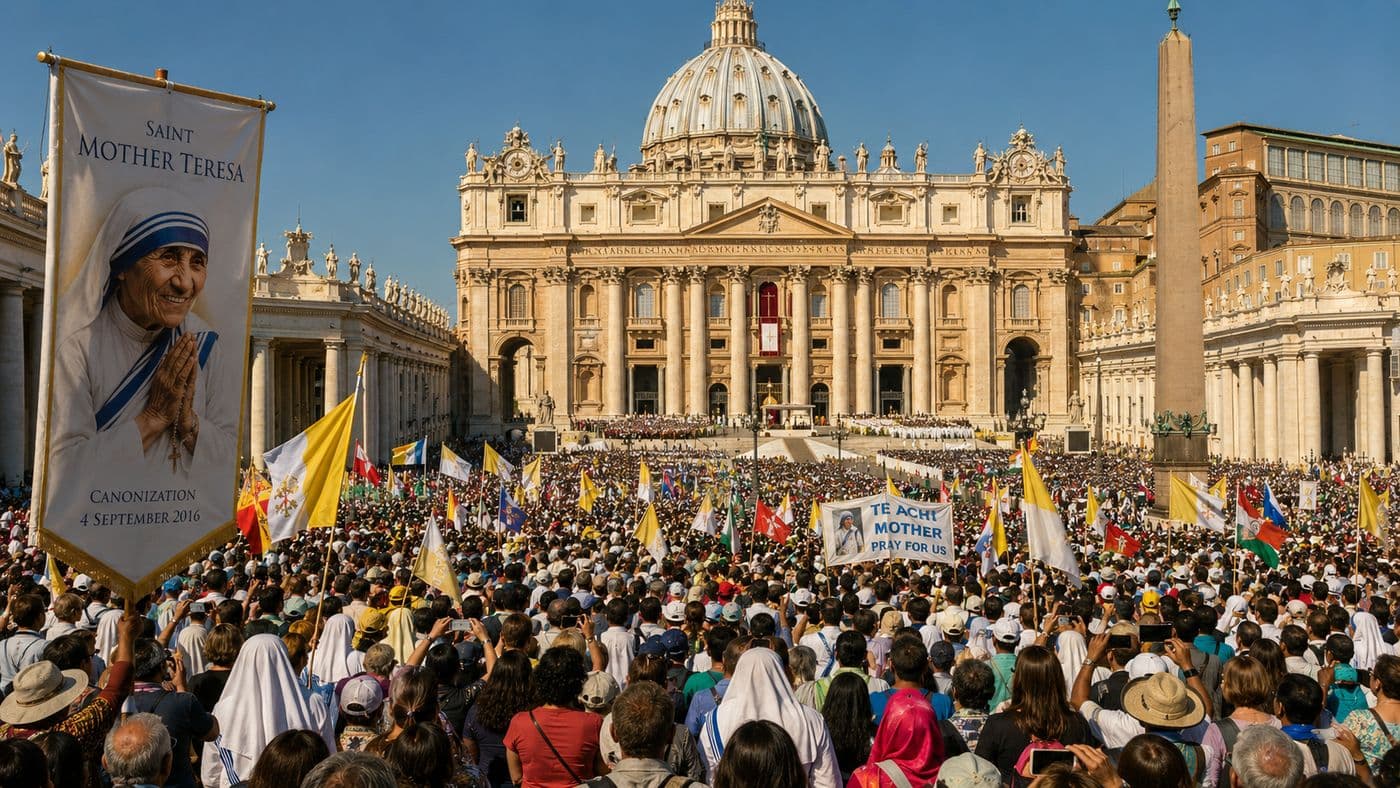
On September 4, 2016, Pope Francis canonized Mother Teresa as Saint Teresa of Calcutta in a ceremony at St. Peter's Square attended by more than 100,000 pilgrims, dignitaries, and faithful from around the world. Born Anjezë Gonxhe Bojaxhiu in 1910 in Skopje, in what is now North Macedonia, she joined the Sisters of Loreto in Ireland in 1928 and was sent to Calcutta in 1929, where she taught at a girls' school for nearly two decades. In 1946, she reported experiencing what she described as a call within a call — a summons to leave her convent and live and work among the poorest of the poor of Calcutta. In 1950, she founded the Missionaries of Charity, a congregation dedicated to serving the sick, dying, orphaned, and destitute, beginning with a small group in the slums of Calcutta that would grow to operate in more than 130 countries by the time of her death in 1997. She received the Nobel Peace Prize in 1979 and was one of the most recognized women in the world by the time of her death, at the age of eighty-seven, in Calcutta on September 5, 1997.
The canonization on September 4, 2016, came after one of the fastest beatification processes in modern Catholic history — Pope John Paul II had waived the standard five-year waiting period after death to open her cause in 1999, just two years after her passing — and concluded a formal process that required the verification of two miracles attributed to her intercession. Mother Teresa's legacy has been the subject of genuine and serious debate: critics including Christopher Hitchens argued that the conditions in her homes for the dying were inadequate, that she prioritized the spiritual dimension of suffering over its alleviation, and that she accepted donations from donors whose methods should have disqualified the gifts. Her defenders pointed to the scale of the need she served, the thousands she sheltered and cared for, and the moral witness of a life spent in proximity to suffering that most people preferred not to acknowledge. The letters published posthumously revealed that she had spent much of her interior life in what she described as spiritual darkness — a private experience of God's absence that the Church treated as mystically significant and that many readers found humanizing and profound. The woman canonized on September 4, 2016, was more complex than either her admirers or her critics have fully allowed.
Coast to Coast
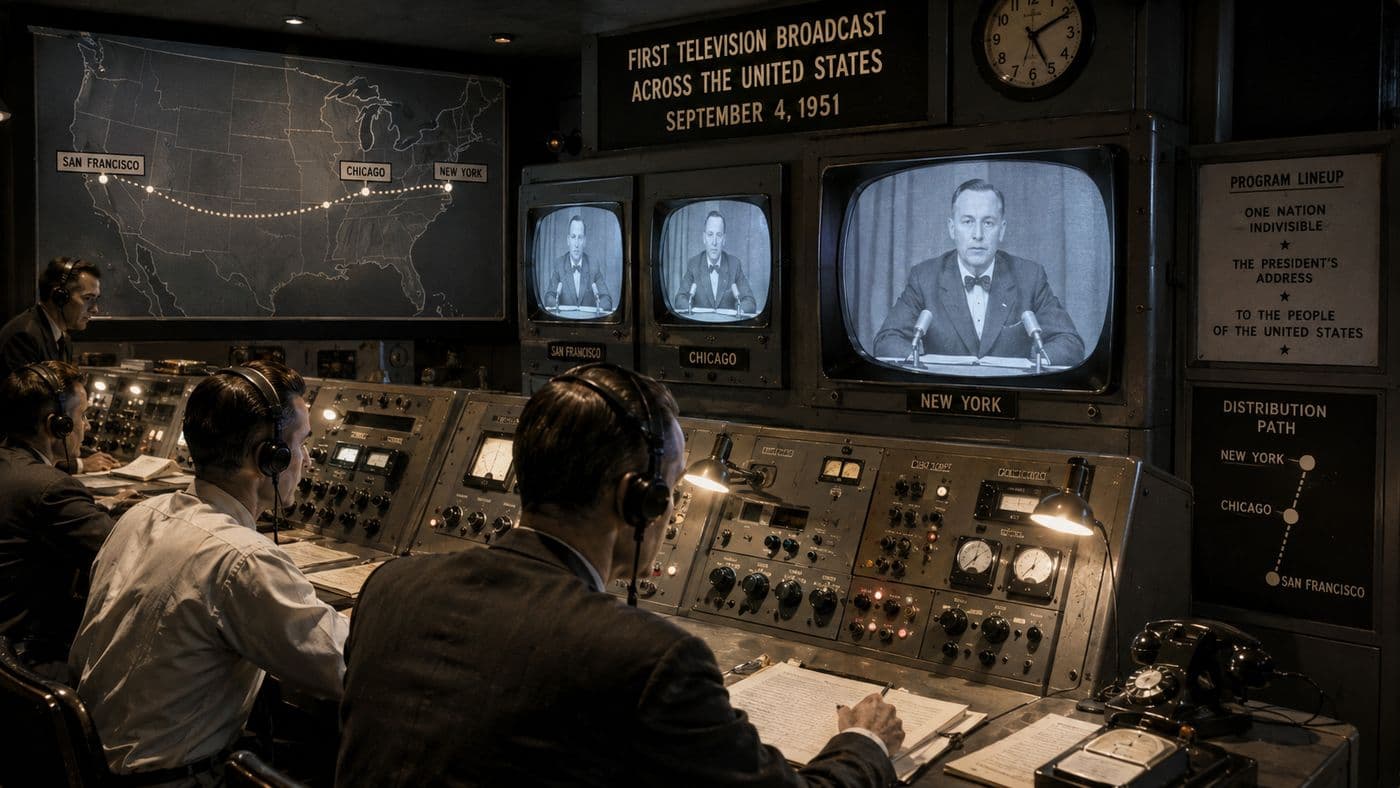
On September 4, 1951, President Harry S. Truman delivered remarks at the Japanese Peace Treaty Conference in San Francisco — and his image and voice were transmitted simultaneously to television audiences in cities across the United States, from the West Coast to New York, in the first live transcontinental television broadcast in American history. The transmission was made possible by AT&T's new coaxial cable and microwave relay network, which had just been completed across the continent and which allowed a live television signal to travel from San Francisco to the East Coast without the delay of physical film transport that had previously been the only option. Approximately 94 million Americans — about sixty percent of the national population — watched the broadcast, making it the largest television audience in American history to that point. Truman's remarks at the conference, which formally ended the American occupation of Japan and restored Japanese sovereignty, were the content; the technology that delivered them was the event.
The first transcontinental television broadcast of September 4, 1951, marked the moment that television ceased to be a regional medium and became a genuinely national one. Before that date, television stations in different parts of the country operated independently, broadcasting local programming to local audiences; the ability to transmit live from San Francisco to New York changed what the medium could do and what it would become. The political implications were immediate: if a president could speak simultaneously to audiences in every American city, the relationship between political leadership and the public was fundamentally altered. The broadcast of September 4, 1951, was the beginning of television's role as the primary medium of American political life — the medium through which subsequent presidents would speak to the nation in moments of crisis, through which elections would be won and lost, and through which the visual culture of American politics would be constructed. The AT&T engineers who completed the transcontinental cable in time for Truman's San Francisco address had, without quite intending to, built the infrastructure for everything that followed.
The First Idol
On September 4, 2002, Kelly Clarkson — a twenty-year-old waitress and aspiring singer from Burleson, Texas, who had driven to Dallas to audition for a new television competition — stood on the stage of the Kodak Theatre in Hollywood and learned she had won the first season of American Idol, defeating Justin Guarini in a finale watched by more than 22 million viewers. The show, adapted from the British format Pop Idol and hosted by Ryan Seacrest and Brian Dunkleman, had premiered in June 2002 and had grown steadily through its first season as its combination of auditions, judges' evaluations, and audience telephone voting proved compelling to a prime-time audience that was invited to participate in the outcome rather than merely watch it. Clarkson's victory was the result of both genuine talent — her voice, powerful and technically secure, was clearly the most formidable of the contestants — and the accumulated votes of an audience that responded to her warmth and authenticity across a summer of live broadcasts.
American Idol went on to become the highest-rated television program in the United States for multiple seasons, establishing the template for the reality talent competition format that spawned The Voice, The X Factor, America's Got Talent, and dozens of international versions and imitators. Kelly Clarkson's career since her September 4, 2002 victory is the most successful of any American Idol winner: multiple Grammy Awards, a string of platinum albums, and a successful transition to daytime television as the host of her own talk show. The finale of September 4 proved that the format could produce genuine stars rather than merely temporary celebrities — a validation that justified the enormous investment networks subsequently made in the genre. The twenty-year-old from Texas who won the first season of American Idol turned out to be exactly what the show had claimed it would find: someone who could actually sing, and who actually mattered.