September 3: A Revolution Ends, a Flag Goes to War, and a Pope Steps Into the Chaos
September 3 is a day for the formal acknowledgment of things that have already happened. In 1783, the American Revolutionary War had been effectively over for two years — Cornwallis had surrendered at Yorktown in 1781, and no significant fighting had occurred since — but it took until September 3, 1783, for the parties to sign the treaty in Paris that made American independence a matter of international law rather than just military fact. Six years earlier, on September 3, 1777, the Stars and Stripes flew over an American battlefield for the first time, two months after Congress had adopted it as the national flag — transforming a legislative resolution into something that soldiers were willing to carry and to die under. And in 1914, a conclave of cardinals elected a new pope in Rome just weeks after the First World War had begun, choosing a man who would spend the entire war attempting — unsuccessfully, but with extraordinary moral persistence — to bring the killing to an end. Three September thirds. Three institutions confronting the world as it actually was, with the tools they had.
Paris, 1783
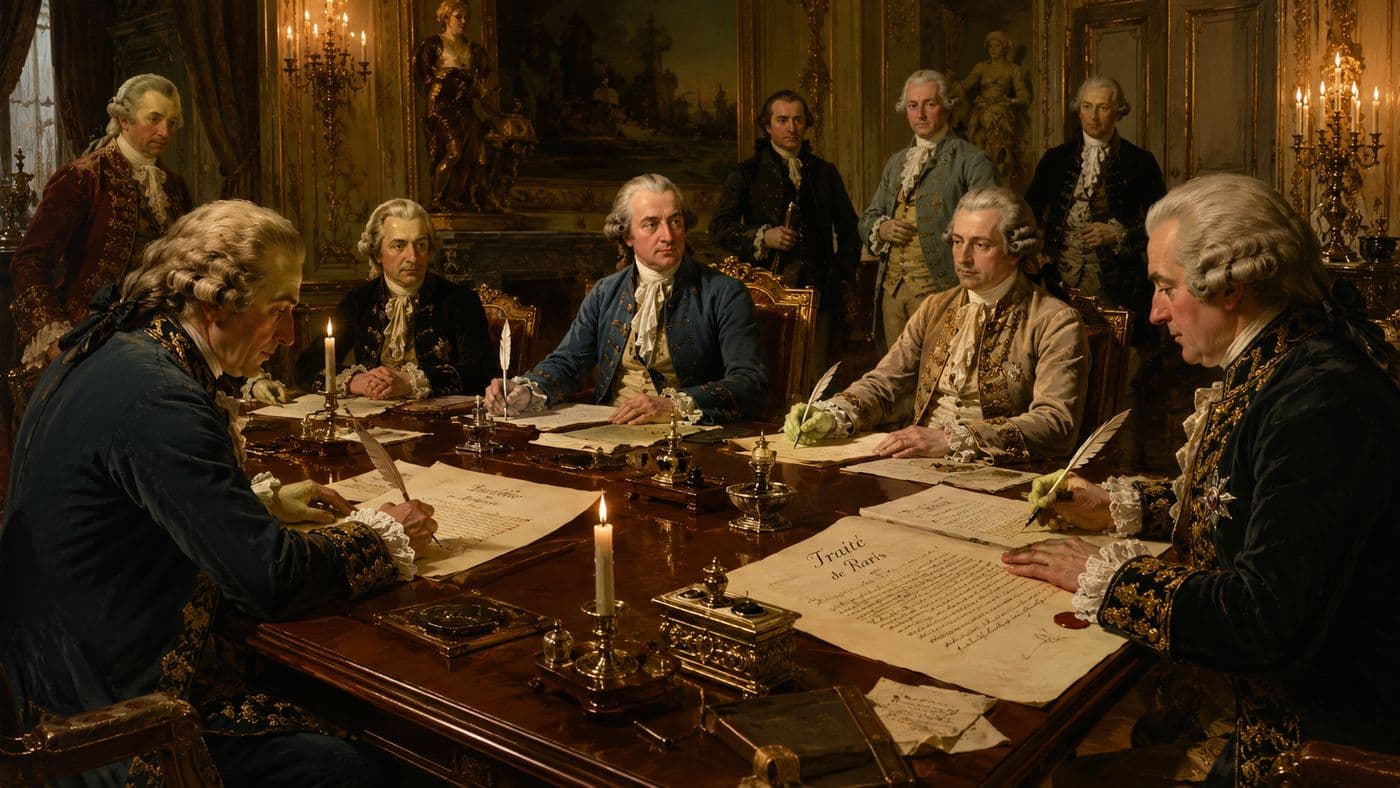
On September 3, 1783, American commissioners Benjamin Franklin, John Adams, and John Jay signed the Treaty of Paris with British representative David Hartley in the Hôtel d'York in Paris, formally ending the American Revolutionary War and establishing the United States as a fully sovereign and internationally recognized nation. The treaty's terms were remarkably favorable to the United States — more favorable than the French, whose alliance had been indispensable to the American victory, had hoped for: Britain recognized American sovereignty over all territory east of the Mississippi River, south of the Great Lakes, and north of Florida, effectively granting the new nation a vast territorial domain far beyond the original thirteen colonies. The Americans had negotiated separately from France, contrary to their alliance commitments, by communicating directly with the British — a diplomatic maneuver that drew French complaints but produced terms that the American commissioners correctly judged they could not have achieved through joint negotiation.
The Treaty of Paris signed on September 3, 1783, was the legal birth certificate of the United States — the document by which the most powerful nation in the world conceded that the republic its former colonies had declared in 1776 was real, permanent, and sovereign. The negotiations that produced it had been conducted by three of the most capable diplomats in American history: Franklin, whose genius for cultivating French support had made the alliance that won the war; Adams, whose legal precision and stubborn independence shaped the treaty's terms; and Jay, whose instincts about British intentions had guided the decision to negotiate separately. The boundaries they secured have largely survived to the present, shaping the territorial framework within which the United States has grown and changed for more than two centuries. The signing on September 3, 1783, closed a chapter that had opened with the Declaration of Independence seven years and two months earlier — and opened the entirely different chapter of actually building the country those documents had described.
Cooch's Bridge
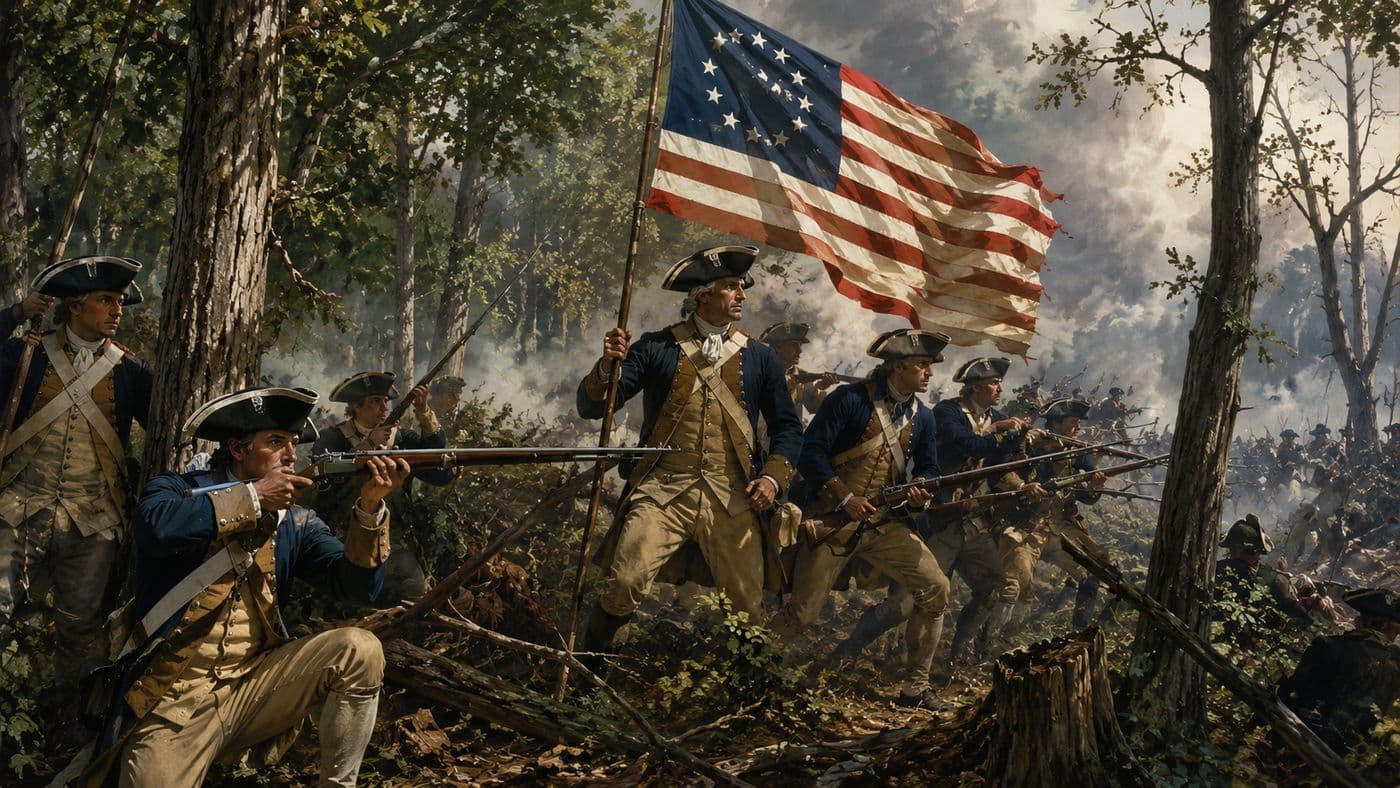
On September 3, 1777, during the Battle of Cooch's Bridge in Delaware, the Stars and Stripes flew over an American battlefield for the first time — two months and nineteen days after the Continental Congress had officially adopted it as the flag of the United States on June 14, 1777. The battle itself was a rearguard action fought by a division of the Continental Army under General William Maxwell against a British advance force moving toward Philadelphia, the rebel capital. Maxwell's forces fought skillfully but were eventually pushed back, and the British won the engagement — but the flag that flew over the American lines that day had made its first appearance in combat, and the image of the new nation's symbol over a battlefield, even a losing one, carried its own kind of significance. The Battle of Cooch's Bridge is the only Revolutionary War battle fought in Delaware and is relatively minor in the larger arc of the conflict, but the flag that flew there gave it a place in history it would otherwise not have held.
The Stars and Stripes that appeared at Cooch's Bridge on September 3, 1777, had itself been the product of the Continental Congress's effort to give the new nation a visual symbol distinct from the colonial flags and variations it had used in the early years of the war. The flag resolution of June 14, 1777 — now celebrated as Flag Day — specified thirteen stripes alternating red and white, and thirteen stars on a blue field, representing a new constellation. It did not specify the arrangement of the stars or the proportions of the flag, leaving considerable variation in early American flags. The story of Betsy Ross sewing the first flag at George Washington's request is a popular tradition that lacks documentary corroboration — no contemporary evidence supports it, and it appears to derive from family accounts given decades after the event. What is documented is the flag's first battle appearance on September 3, 1777, at a modest Delaware crossroads, against a British force that won the day but could not prevent the flag from going on to outlast everything that opposed it.
A Pope for the War
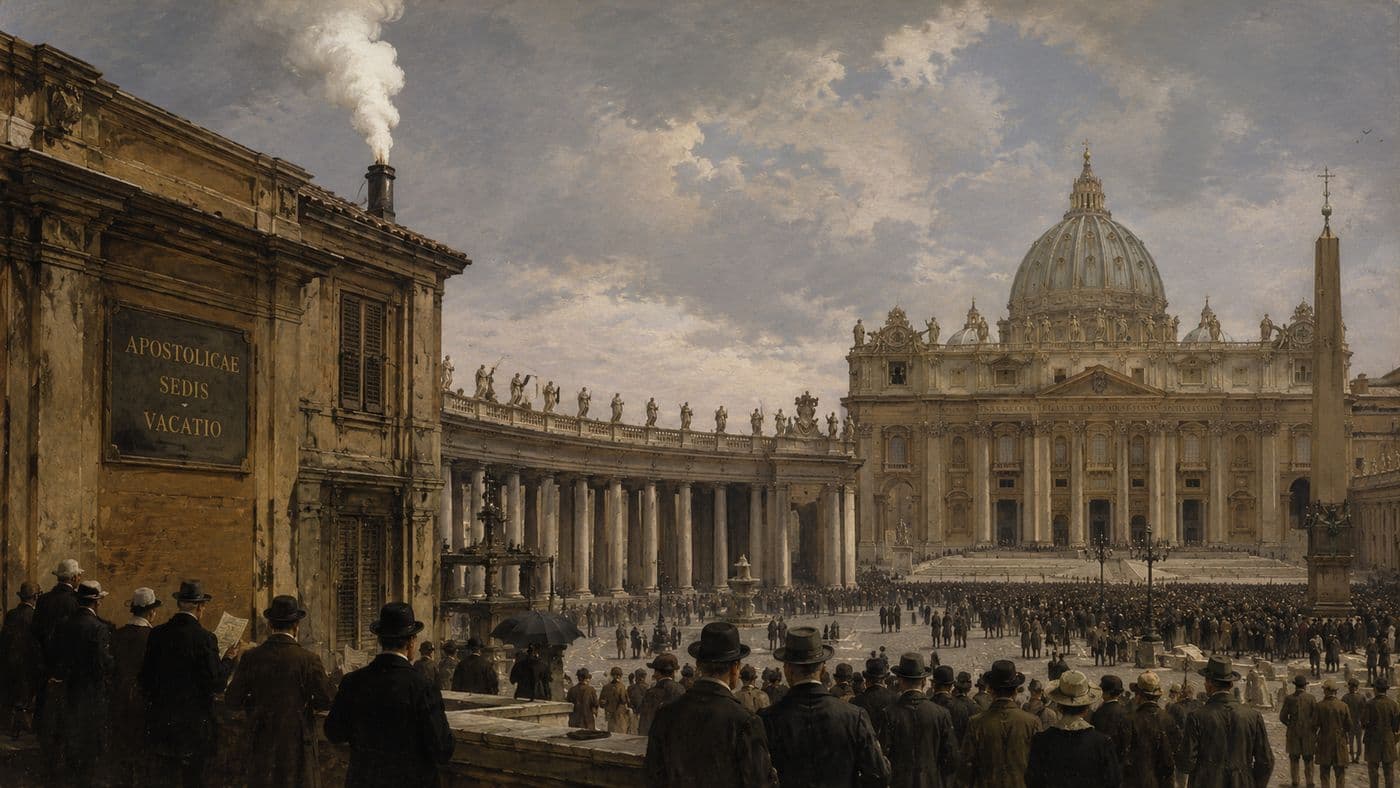
On September 3, 1914, the College of Cardinals elected Cardinal Giacomo della Chiesa as Pope Benedict XV — the 258th pope of the Roman Catholic Church — in a conclave held just weeks after the outbreak of the First World War. The new pope was sixty years old, a former Vatican diplomat of considerable skill, and the cardinal-archbishop of Bologna, where he had served for seven years. The conclave that elected him was itself shadowed by the war: several cardinal-electors from countries now at war with each other arrived in Rome under unusual circumstances, and the white smoke signaling the election rose over the Sistine Chapel on the same day that German forces entered France and the Western Front was taking its first terrible shape. Benedict XV would spend the entirety of his pontificate — from September 1914 until his death in January 1922 — attempting to end a war that the major Catholic powers on both sides showed no interest in letting the Church mediate.
Benedict XV's response to the First World War was one of the most sustained and morally serious efforts by any religious leader during any major conflict of the modern era. He declared the Holy See strictly neutral, refused to assign blame to either side, called the war "the suicide of Europe," and organized extensive Vatican humanitarian efforts — prisoner of war exchanges, the return of civilian internees, and a bureau that processed hundreds of thousands of requests for information about missing soldiers and prisoners from families across Europe. In August 1917 he issued a seven-point peace proposal — calling for disarmament, arbitration, freedom of the seas, and a restoration of occupied territories — that the Allied and Central Powers alike rejected. Both sides accused him of favoring the other; the Germans called his proposal a Papal peace; the French called him "le pape boche" — the German pope. His proposal anticipated many of the principles that Woodrow Wilson would articulate in his Fourteen Points six months later, without attribution. Benedict XV died in 1922, having failed to end the war but having built a humanitarian record that the Church would take decades to fully appreciate. He was elected on September 3, 1914, into a world that did not want what he was offering, and he offered it anyway for eight years.