
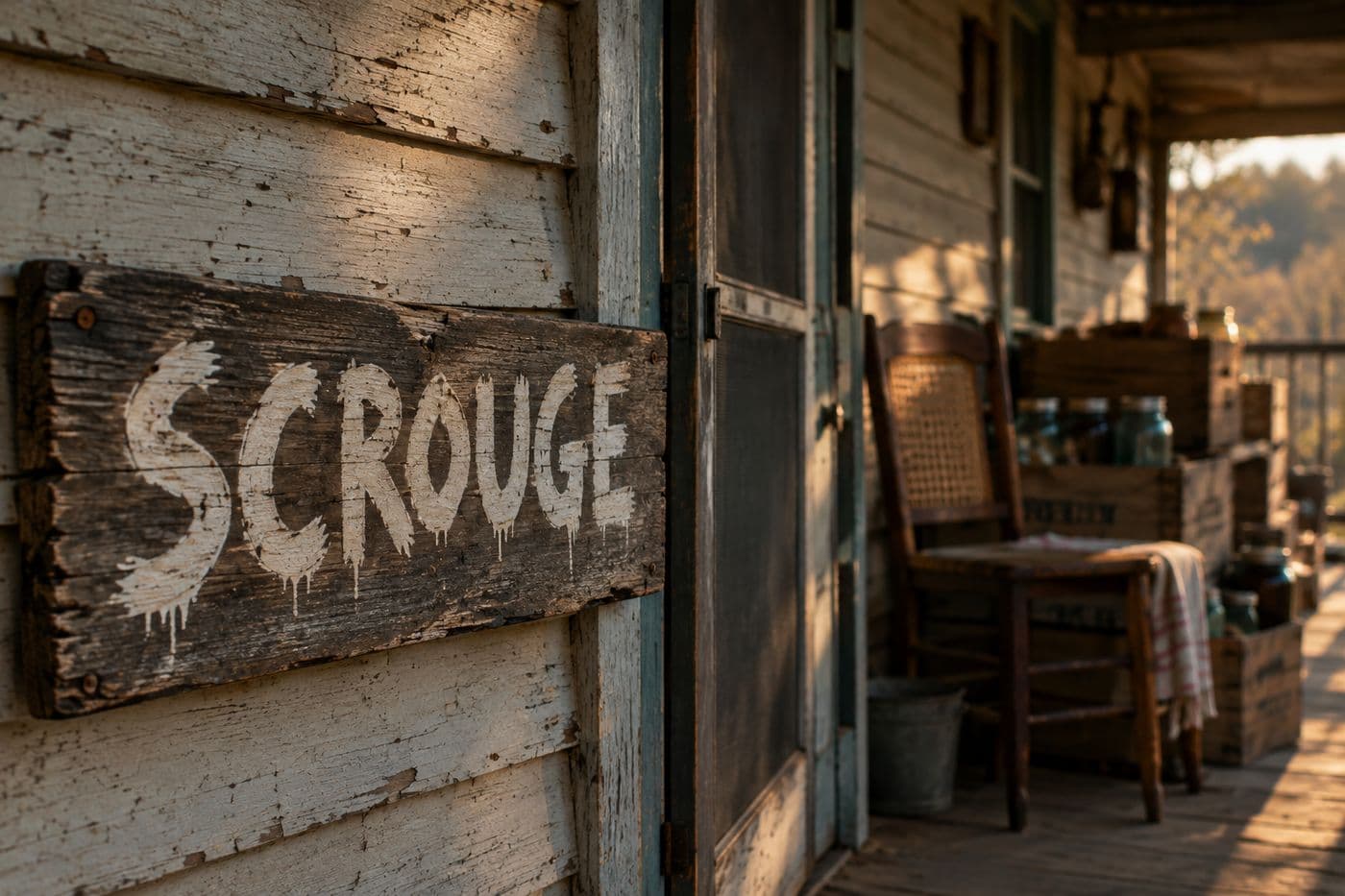
1 What It Means
To crowd, press, or squeeze people or things tightly together into a space too small for them.
2 Caught in the Wild
"Scrouge up a little, there's room for one more on the end of the bench."
Illustrative usage · Undated
3 Where It Comes From
Scrouge traces back to English dialect speech, likely a blend of "scrounge" and "gouge," both already carrying a sense of forceful pressure. It crossed the Atlantic with English and Scots-Irish settlers and settled hard into Appalachian and Ozark speech, where it stayed put while standard English drifted toward flatter words like "crowd" and "squeeze." It never vanished so much as it got fenced in. Dialect surveys and the English Dialect Dictionary kept recording it long after national publishing, radio, and later television smoothed out regional speech for a wider audience, leaving words like this one alive only where the old patterns of talk held on.
4 The World Behind the Word
Ozark and Southern Appalachian speech kept a vocabulary shaped by isolation. Communities tucked into hollows and ridgelines had limited contact with outside publishing and broadcast English well into the twentieth century, so older British and Scots-Irish dialect forms persisted there long after they faded from cities. Scrouge belongs to a whole family of these words describing physical closeness and effort, things like "scrunch" and "squinch," each doing slightly different work. A single word that captures bodies pressing into a pew, a wagon bed, or a crowded kitchen saved speakers from reaching for a whole descriptive sentence. Folklorists and dialect collectors who recorded Ozark speech in the early twentieth century treated words like this as evidence of how English fractured and preserved itself differently across regions that railroads and radio had not yet fully connected.
5 Use It Yourself
Drop it the next time a group chat photo shows everyone crammed onto one couch, or when a contractor's estimate packs three appliances into a kitchen that barely fits two. It carries warmth, not insult, so it plays well among family or old friends. Outside a Southern or Ozark context, be ready to explain it, since most listeners will hear it as nonsense before they hear it as English.
Try it out loud
Everybody scrouge in a little closer so we can all fit in the picture.
🗝️The Deep Cut File
The word shows up, lightly disguised, in children's literature most American readers already know. Roald Dahl used "scrouge" and its cousin "squelcher" in his invented-sounding vocabulary, drawing on real dialect terms he'd absorbed rather than inventing them from scratch, which is part of why his nonsense words often feel oddly plausible. Dialect collectors in the Ozarks, meanwhile, recorded scrouge well into the mid-twentieth century as everyday speech, not an archaism, proof that a word can sound invented to outsiders while being perfectly alive at home.