
1 What It Means
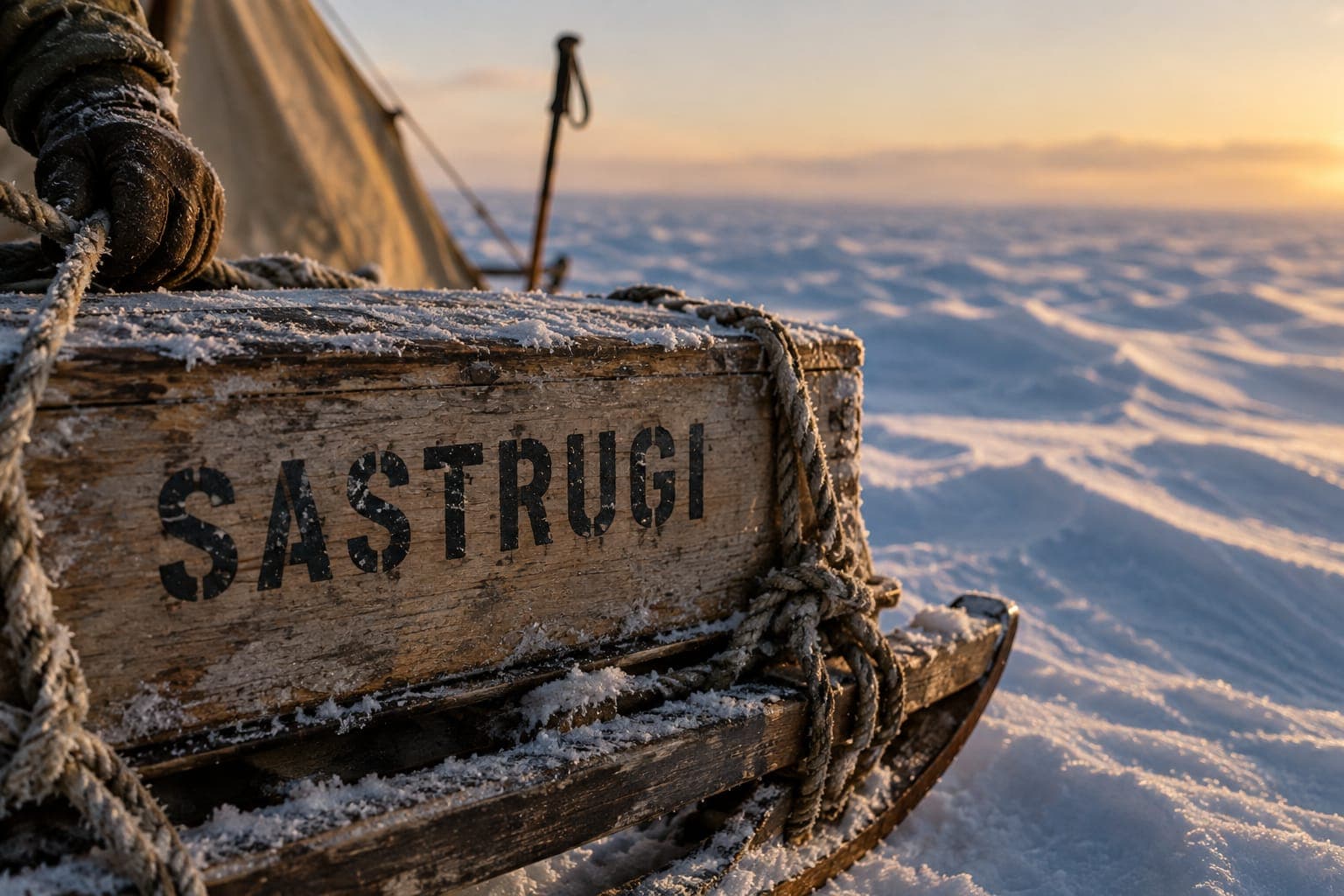
Sharp, wind-carved ridges on the surface of hardened snow, running parallel to the direction of the wind and often hard enough to jolt or wreck a sled.
2 Caught in the Wild
The sledges bucked and slammed across the sastrugi all afternoon, and by evening nobody wanted to talk about anything except their knees.
Illustrative usage. · Undated.
3 Where It Comes From
English borrowed the word from Russian, where zastruga names a ridge or furrow cut in snow by wind. The Russian root is tied to the word for a plane or scraper, which suits the job. The plural form came along too, so English speakers usually say sastrugi even for a single ridge. Spelling wobbled for a while and you will still meet zastrugi in older books. The word never reached general English because the thing it names lives where almost nobody does. Sastrugi form on open, windy, frozen ground, so the people who needed the word were polar explorers, glaciologists, and mountain skiers. They kept it, and the rest of us never had a reason to learn it.
4 The World Behind the Word
Fresh snow is soft. Wind changes that. It lifts loose grains and drives them along the surface, where they strike, break, and pack down against each other. Over hours or days the grains bond into a crust hard enough to resist a boot. Then the wind starts carving. It scours some patches away and piles drift against others, leaving ridges that run in the direction the wind blew. Sizes vary from a few centimeters to well over knee height. For anyone traveling by sled or ski, this matters enormously. Crossing the ridges at an angle means a constant lurching ride, and a loaded sled can tip or break. Travelers also learned to read them. Where winds hold a steady direction, as they do over large parts of Antarctica, the ridges line up like a grain in wood. In a whiteout, with no horizon, that alignment can help hold a heading when little else will.
5 Use It Yourself
Sastrugi earns its place on any winter hike where the snow has been scoured and frozen into ridges. It also works on the roof of a parked car after a windy week, or on a field of frozen mud. Say it to a skier and they will nod. Say it to everyone else and you will get a polite blank look, so expect to explain. The word is not slang, and it sounds a little like a Russian pastry, but it is strictly about wind and snow. Do not use it for the soft rippled dunes of sand.
Try it out loud
The trail looked flat on the map, but the wind had turned it into a field of sastrugi.
🗝️The Deep Cut File
Snow ridges can act as a weathervane frozen in place. Because they form in the direction of the prevailing wind, they preserve a record of where it blew, sometimes for weeks, until a new storm resets the surface. Polar travelers have long used that record as a rough compass when cloud and blowing snow hide the sun. The catch is that a second wind can lay a newer set of ridges across the old ones, and a navigator who trusts the wrong set walks in a slow curve without knowing it. Field accounts from Antarctica are full of this puzzle, and it explains why careful travelers checked the ridges against a real compass.