
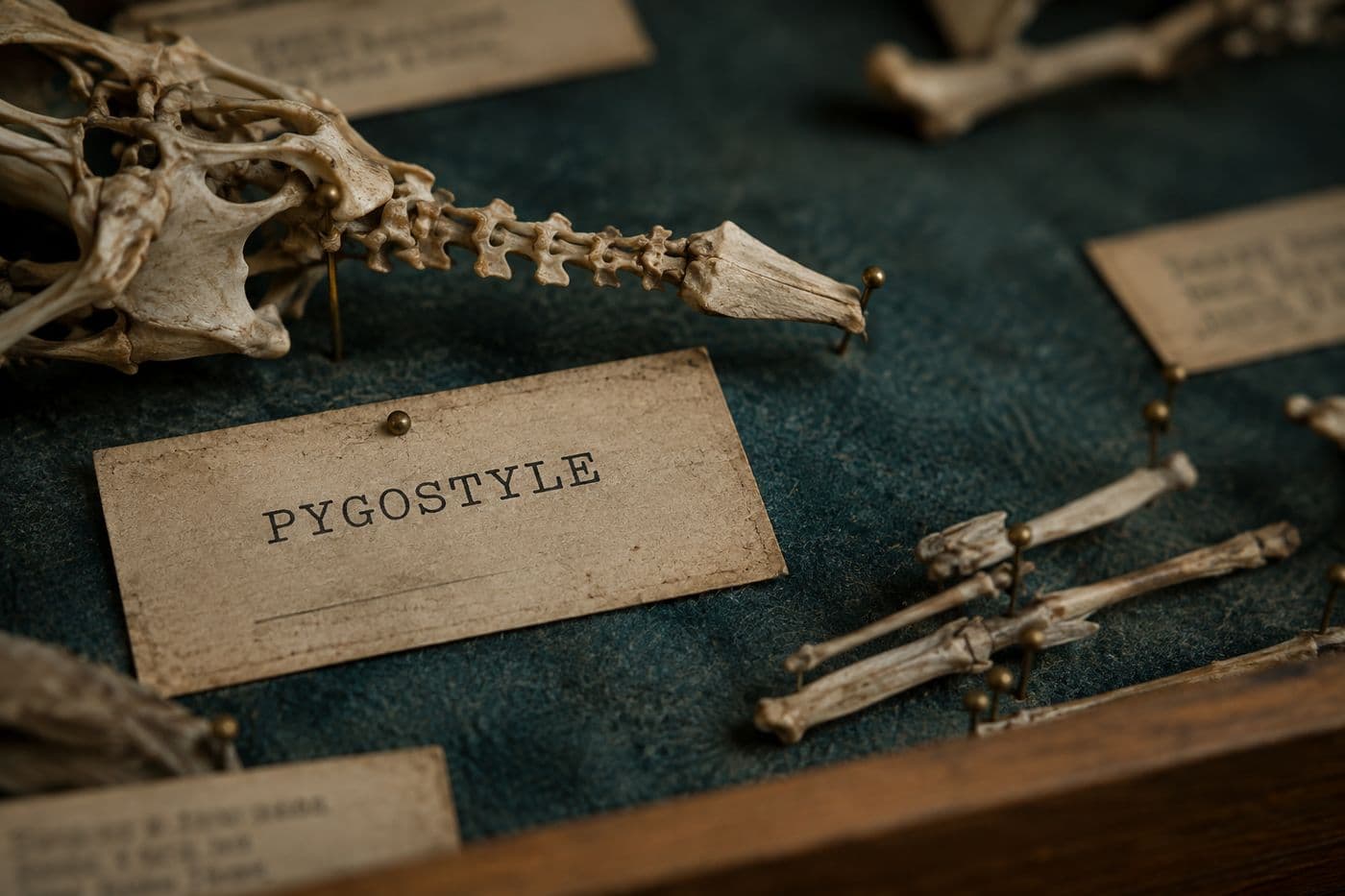
1 What It Means
The fused bone at the tip of a bird's tail that supports and anchors its tail feathers, allowing them to fan and steer in flight.
2 Caught in the Wild
Dissection revealed the pygostyle firmly fused, the last several caudal vertebrae compressed into a single blade-like structure anchoring the rectrices.
Illustrative usage. · Undated
3 Where It Comes From
The word comes from Greek pyge, meaning rump, and stylos, meaning pillar or column. Nineteenth-century comparative anatomists coined it when they needed a precise term for the compressed, fused tailbone found in most modern birds, distinct from the long bony tail their dinosaur ancestors carried. It never spread beyond biology because there was no reason for it to. Nobody outside a dissection lab or a museum prep room needs to name this bone specifically. The general public got by fine calling the whole assembly a tail, and the word stayed locked inside the discipline that actually had to look at the bone and describe what it does.
4 The World Behind the Word
Bird skeletons compress a long ancestral tail into something short and rigid, and the pygostyle is the last piece of that story. Early birds and their dinosaur relatives had dozens of free tail vertebrae, useful for balance but heavy for flight. Over evolutionary time, most of those vertebrae fused into one blade-shaped bone at the tip of the tail. That bone anchors a fan of stiff feathers called rectrices, and a set of muscles attaches directly to it, letting the bird spread, tilt, and twist its tail feathers mid-flight for steering and braking. Ornithologists rely on the pygostyle's shape and size to identify species from fossil fragments, since it varies enough between groups to be diagnostic even when the rest of the skeleton is missing.
5 Use It Yourself
This one earns its keep at a natural history museum or on a hike when someone points at a wild turkey fanning its tail and asks how that works mechanically. Drop pygostyle and you sound like you actually know anatomy instead of just birds. Skip it at dinner unless your audience likes dissection stories.
Try it out loud
The turkey fanned its tail, and you could see the whole fan pivot on its pygostyle like a tiny hinge.
🗝️The Deep Cut File
The pygostyle is the reason paleontologists can tell a modern-type bird tail from a dinosaur's long bony one in the fossil record, sometimes from a single preserved bone. Archaeopteryx, often called the first bird, still had the long ancestral tail with dozens of separate vertebrae, no fused pygostyle at all. The compressed, fused version shows up later in true avian lineages, so its presence or absence in a fossil functions almost like a checkbox for classifying how bird-like an extinct animal really was.