
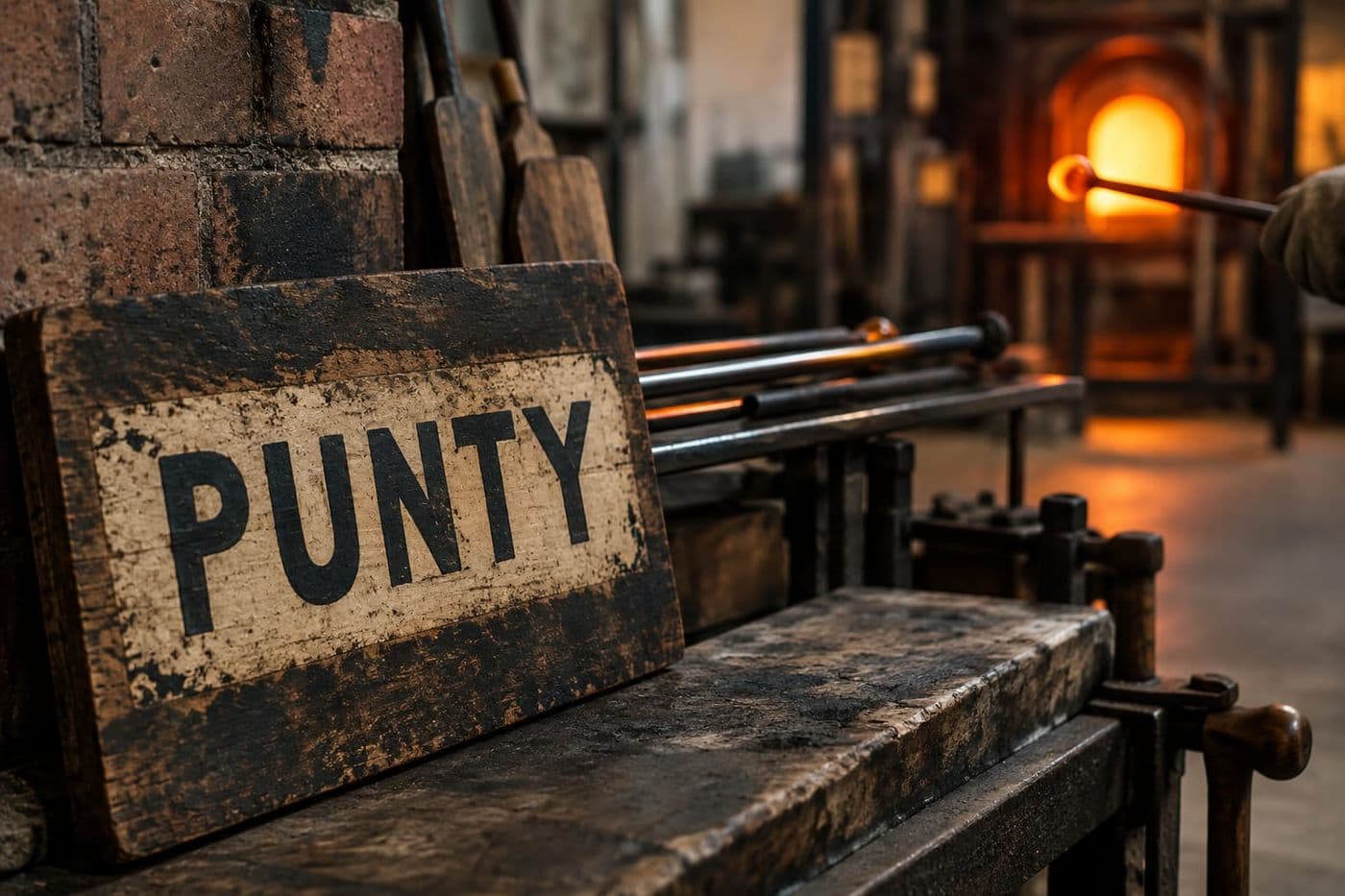
1 What It Means
A solid iron rod that a glassblower sticks to the base of a hot vessel so it can be held and reshaped while the open end is finished.
2 Caught in the Wild
Once the piece comes off the blowpipe, the gaffer takes it on a punty and carries it back to the furnace to open up the mouth.
Illustrative usage. · Undated.
3 Where It Comes From
Punty is a variant of pontil, the older form of the same word. Dictionaries trace pontil to French, which took it from an Italian word built on punto, meaning point. Spellings drifted in workshops, where the word was spoken far more than it was written, and English-speaking glassmen ended up with punty, pontee, and a few relatives. The word never reached general English because the thing it names never left the shop floor. Nobody owns a punty. It is not sold, worn, or handed around a dinner table. It lives in the hot end of a glass studio, passed from worker to worker by speech, and it stays there because that is the only place anyone needs it.
4 The World Behind the Word
A glass vessel starts life on a blowpipe, a long hollow iron tube. The glassblower gathers molten glass on one end, blows a bubble, and shapes it with tools and gravity. Problem: the pipe is attached at the mouth, and the mouth is the part still unfinished. The vessel needs to be held from the other end. So an assistant attaches a small gather of hot glass to a solid iron rod, the punty, and presses it to the base of the piece. Glass sticks to glass. A sharp tap at the neck breaks the blowpipe free. Now the open end can go back into the furnace opening called the glory hole, softened, and shaped with wooden paddles and metal tongs called jacks. When the lip is done, a tap knocks the vessel off the punty, leaving a rough scar underneath.
5 Use It Yourself
Punty earns its keep in a studio tour, a glassblowing class, or any antique shop where someone is squinting at the bottom of a bottle. Say it there and you will get a nod. Elsewhere it needs a footnote. It is not a slang word, so there is no register trap, only blank looks. Try it as a metaphor for anything that holds a project steady while you finish the part you could not reach: the friend who steadies the ladder, the clamp on the table.
Try it out loud
Hold the vase steady on the punty while I open the lip before it cools.
🗝️The Deep Cut File
Flip over an old glass bottle and you may find a rough, circular scar on the base. That is the pontil mark, left where the punty was knocked away. Antique bottle collectors read it as evidence of how a bottle was finished by hand. Some marks are bare and ragged, others show a ring of iron residue from the rod itself, and a smooth, ground base means someone polished the scar away. Bottle makers eventually developed other ways to hold a bottle while finishing the neck, and many later bottles carry no such scar. A small blemish became a dating clue, and a tool most buyers never saw turned into evidence for people who study old glass.