
October 24: The Sea Serpent Surfaces
Earlier this week, a 16-foot oarfish washed up on a beach in northern Chile. It’s a long, silvery deep-sea fish that most people will never see alive. Photos of the ribbon-like creature stretched across the sand spread quickly online, and with them came an old legend. In Japan, the oarfish has long been called a messenger from the depths whose appearance warns of earthquakes and tsunamis, which is why the internet knows it as the “doomsday fish.”
A Messenger From the Deep
The fish turned up on Tuesday, October 20, and it’s a rare sight. Oarfish live in the ocean’s twilight zone, usually more than 3,000 feet below the surface, where they drift in the darkness feeding on plankton and tiny crustaceans. They are the longest bony fish known to science and can grow well beyond 20 feet. They are also weak swimmers that move by rippling a long red dorsal fin, so strong currents can easily overpower them. Marine biologists say that is the likely explanation here: this one was probably sick, injured, or pushed toward the coast by powerful currents, not drawn to the surface by anything happening underground.
The legend goes back centuries. In Japanese folklore, the oarfish is ryugu no tsukai, the “messenger from the Sea God’s palace,” said to rise before the earth shakes. The belief got new attention after reports that a number of oarfish had washed ashore in Japan in the years before the devastating 2011 Tōhoku earthquake. Scientists have tested the idea. A 2019 study by Japanese researchers compared more than 300 records of deep-sea fish sightings with earthquake data going back decades and found no meaningful connection. The doomsday fish, it turns out, is just a fish, if an extraordinary one.
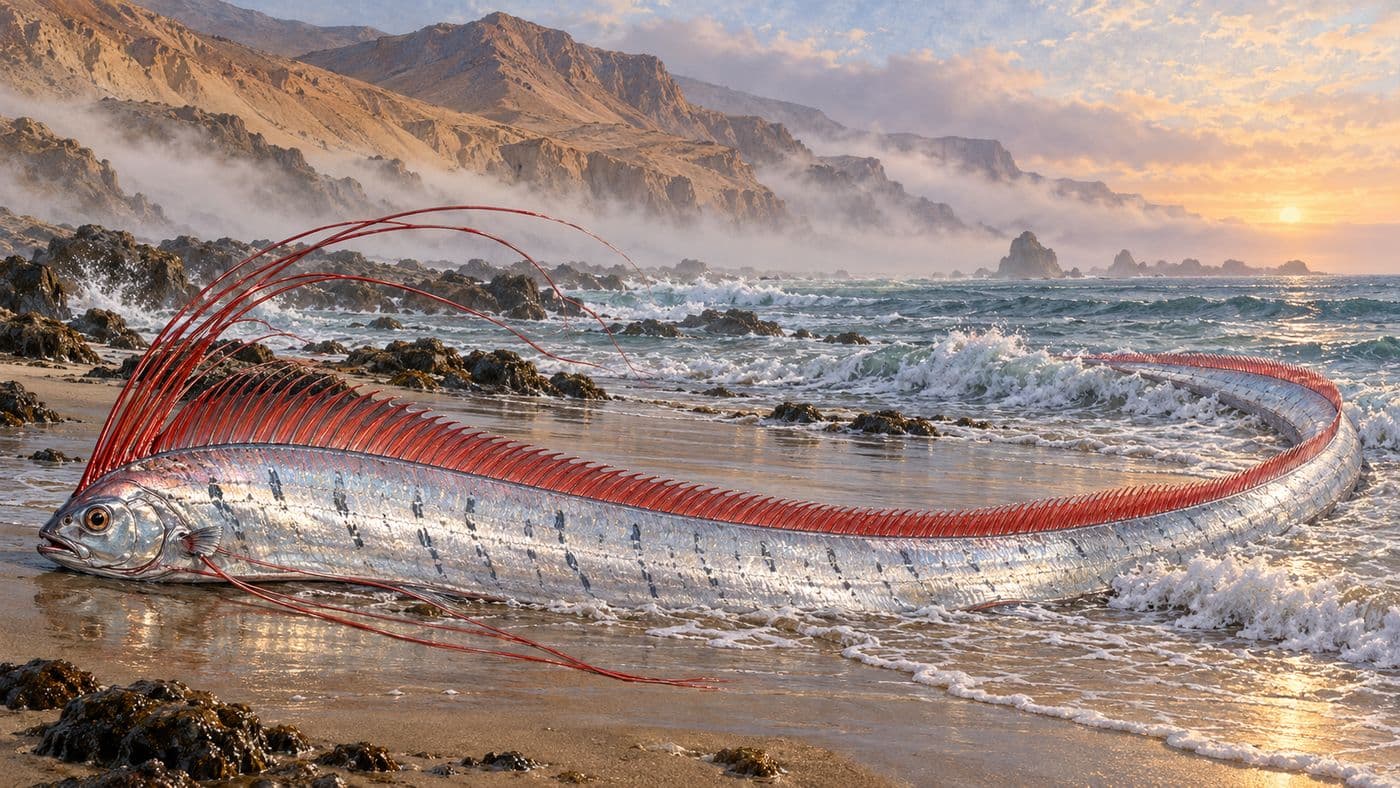
The oarfish may explain more than one legend. For centuries, sailors told stories of enormous serpents rising from the waves, with crested heads and endless shimmering bodies. Many scientists believe glimpses of oarfish near the surface were behind many of those tales. Each time one washes ashore, people react the way sailors once did, with fascination and a little fear. The deep ocean remains one of the least explored places on Earth, and a find like this one is a reminder of how much is still down there.