
The Paper That Won't Stop Moving
Today, Day 76 of the U.S.-Iran war, the two countries are doing something they have never done before in their 47 years of enmity: trading written peace proposals through a third-party intermediary while an active ceasefire holds and negotiators on both sides remain at the table. Iran submitted a 14-point framework to Pakistan on Thursday. Trump called it "TOTALLY UNACCEPTABLE" on Saturday. The U.S. sent a counter-response through Pakistan. Iran said it was reviewing it. This morning Trump said his representatives were having "very positive discussions" with Iran and that the war would "be over quickly." The guns are still quiet. The proposals are still moving. And the gap between what each side says publicly and what each side does privately has rarely been wider — which is, as it happens, precisely how most wars have ended.
What the History of Peace Proposals Looks Like
The Oslo Accords of 1993 — the agreement that produced the first handshake between an Israeli prime minister and a Palestinian leader on the White House lawn — were negotiated in complete secrecy over 14 months in a Norwegian country house, while both governments publicly denied that any talks were happening at all. The Israeli government told its own people that it was not negotiating with the PLO. The PLO told its own people the same thing in reverse. The back-channel worked precisely because it was invisible to the constituencies that would have killed it. When the agreement was finally announced on August 19, 1993, it was a genuine shock to almost everyone — including most of the diplomats who had spent years working on the problem. The paper had been moving for over a year before the world knew it existed. The Korean armistice negotiations offer a different but equally instructive template. From July 1951 to July 1953, negotiators at Panmunjom met 158 times, frequently broke off talks in public protest, and returned to the table every time — because neither side could afford the alternative. The negotiations were characterized throughout by public intransigence and private pragmatism: each side staked out maximalist positions for domestic consumption while quietly working toward the line both could live with.
The current exchange between Washington and Tehran fits this pattern with almost uncomfortable precision. Iran's 14-point proposal demands a war's end within 30 days, U.S. military withdrawal from the region, sanctions lifted, frozen assets released, reparations paid, and a new Strait of Hormuz governance mechanism — a maximalist opening position that no serious negotiator expected Washington to accept. The U.S. framework, meanwhile, demands Iran halt uranium enrichment for 12 years, surrender its enriched uranium stockpile, accept stringent nuclear inspections, and reopen the Strait — terms that no Iranian government could accept without domestic political collapse. Both documents are written for public rejection. The significance is not what they contain but that they exist at all: that both governments have now put something on paper, transmitted it through a trusted intermediary, and returned a written response. The proposals are the negotiation. The public posturing is the theater around it. Iran's decision to set aside nuclear talks until a later phase — quietly presented as a "significant shift" by a senior Iranian official — is the kind of substantive concession that gets made in the middle distance between opening positions and final agreements, in the space where actual diplomacy happens. Pakistan is still mediating. Beijing almost certainly accelerated the exchange after this week's summit. The paper keeps moving.
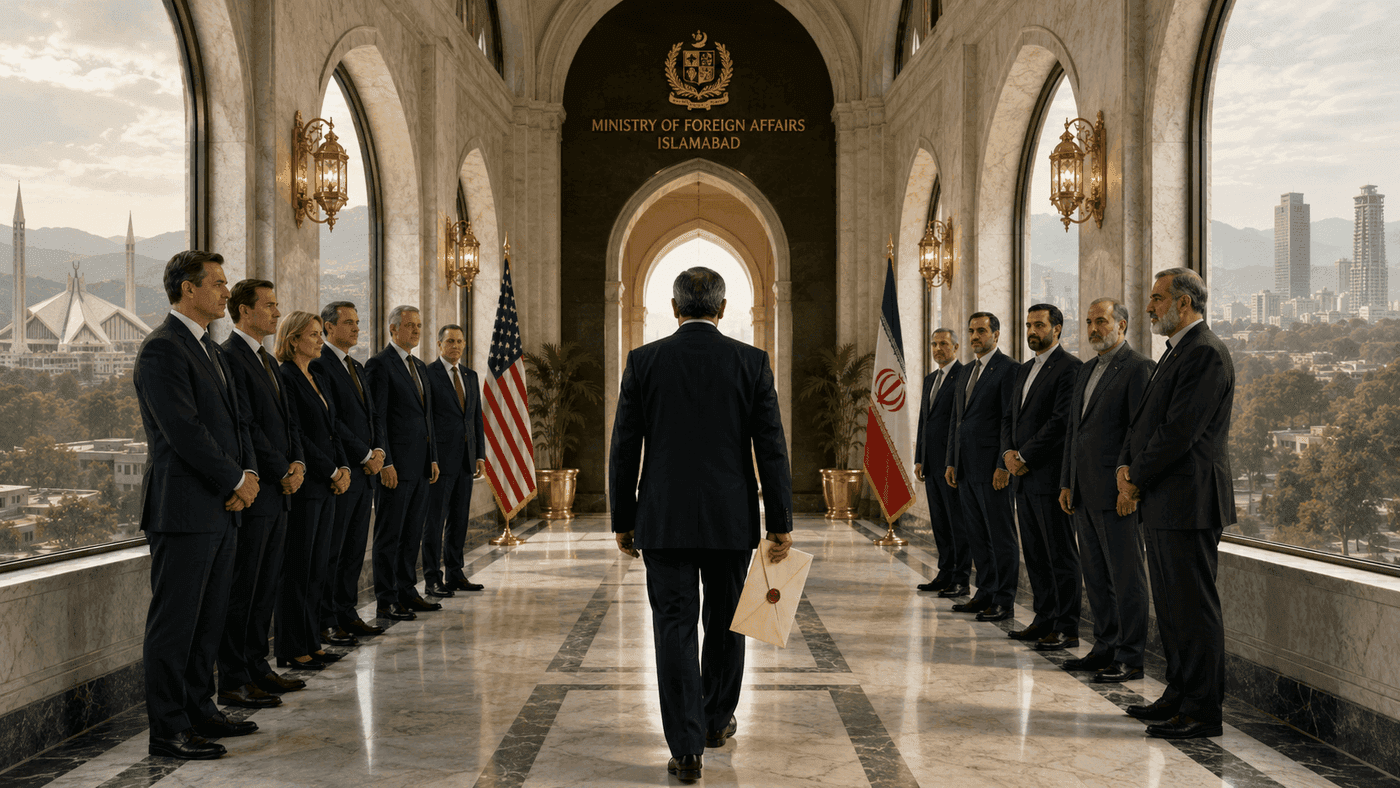
There is no guarantee that the paper moving through Islamabad today becomes the agreement that ends this war. The gap between the two sides' opening positions remains enormous — on nuclear enrichment, on sanctions, on U.S. military posture, on the Strait. The naval standoff continues. Attacks on commercial shipping have not stopped. Trump has made Iran's nuclear program a "red line" that Iran has not agreed to address in this phase. These are not small obstacles. But the history of successful peace negotiations — from Oslo to Panmunjom to the Camp David Accords of 1978, in which Jimmy Carter kept Anwar Sadat and Menachem Begin at the table for 13 days until they produced the framework that became the Egypt-Israel peace treaty — is a history of gaps that looked unbridgeable until, suddenly, they were bridged. What those negotiations share with what is happening today is this: both sides are still talking. In the history of wars that end, that is always where it begins.