
The Town Where the Sun Forgot to Set
At 2:57 a.m. on Saturday, May 10, 2026, the sun rose over Utqiaġvik, Alaska — and for the next 84 days, it will not go down. Not at midnight. Not at 3 a.m. Not at any hour between now and August 2nd, when darkness will finally return to the northernmost city in the United States. The sun will simply circle the sky in a low, patient loop, peaking at the summer solstice on June 21st and casting long shadows at all hours across a landscape of Arctic tundra, thermokarst lakes, and the frozen edge of the Beaufort Sea. Children will play outside at midnight under full daylight. Residents will hang blackout curtains and rearrange their sleep around a sky that offers no natural cue for rest. The local football team — whose field is the northernmost in the world — will practice in perpetual sunshine. And the Iñupiat people, who have called this place home for more than 1,500 years, will prepare for the season they have always organized their lives around: the season of the whale.
A Place for Gathering Wild Roots
The city's name — Utqiaġvik, pronounced oot-kee-AHG-vik — means "a place for gathering wild roots" in Iñupiaq, the language of the Indigenous Iñupiat people who have lived on this stretch of Alaska's North Slope for over a millennium and a half. For most of its existence as a place Americans knew about, it was called Barrow — a name given by a British Royal Navy expedition in 1825 in honor of Sir John Barrow, Second Secretary of the Admiralty, who had never visited and had nothing to do with it. In 2016, residents voted to restore the original Iñupiaq name, and Utqiaġvik it became again: a place for gathering wild roots, at the top of the world, where the sun circles for 84 days every summer and disappears for 64 days every winter, and where a community of roughly 4,500 people — approximately 60 percent Iñupiat — has organized its entire existence around the rhythms of a sky unlike any other in the United States.
The science behind the midnight sun is elegant and ancient simultaneously. Earth's axis is tilted 23.5 degrees relative to its orbital plane around the sun. In summer, the Northern Hemisphere leans toward the sun; above the Arctic Circle — which begins at roughly 66.5 degrees north latitude — that tilt is severe enough that the sun never fully dips below the horizon during the weeks surrounding the solstice. Utqiaġvik sits at 71.3 degrees north, more than 300 miles above the Arctic Circle, deep enough into the polar zone that its midnight sun season lasts nearly three months. The inverse arrives in November: 64 consecutive days of polar night, when the sun never rises at all and the town is lit only by moonlight, stars, and the green and violet curtains of the aurora borealis. The Iñupiat have lived through this cycle for 1,500 years, and they did not merely survive it — they built a civilization around it. The spring whaling season, which the long summer daylight makes possible, is not only a source of food but the cultural center of Iñupiat life, culminating in the Nalukataq festival: communal feasts, traditional songs and dances, and the blanket toss, in which a dancer is launched high into the Arctic sky from a blanket of seal skin as an act of communal celebration and thanks.
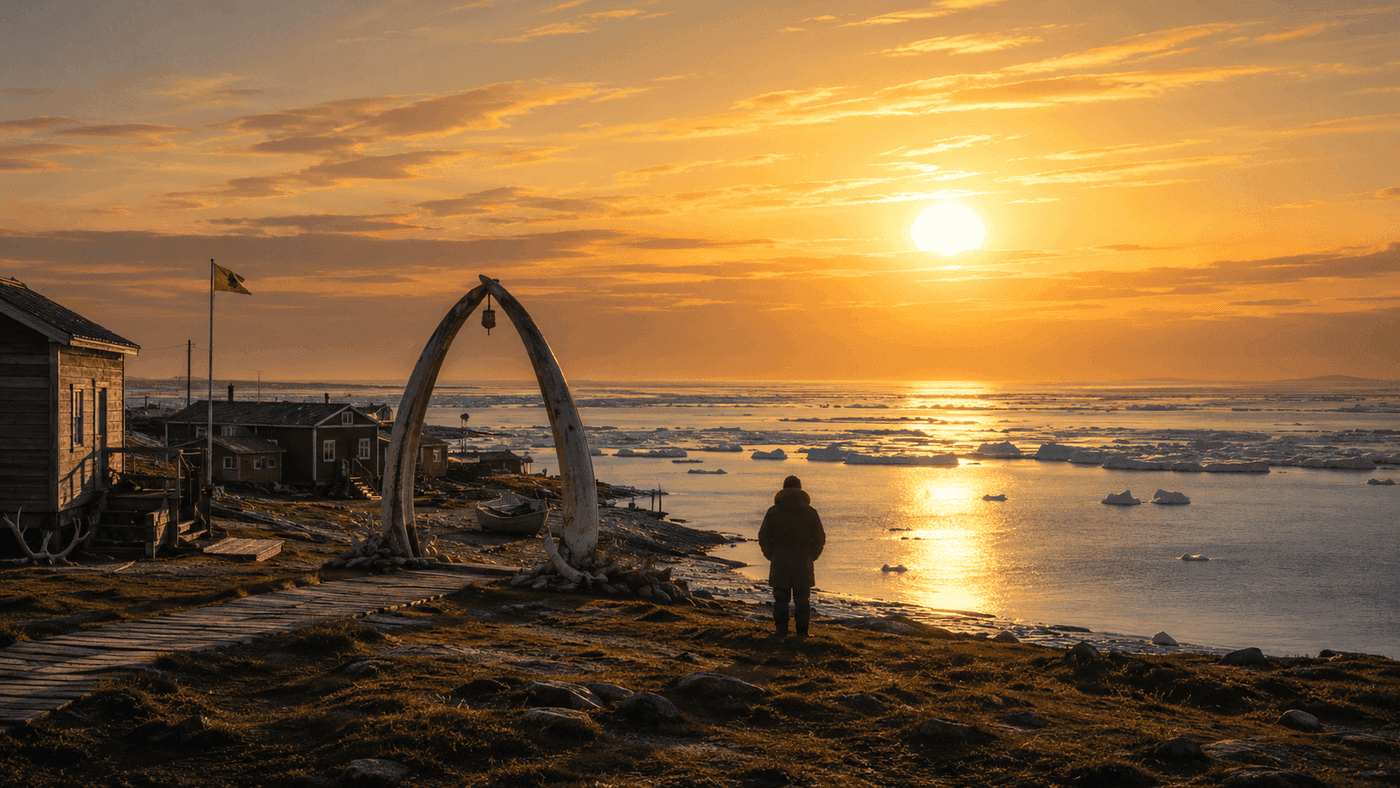
There is something in the Utqiaġvik story that feels like a useful thing to hold onto — particularly in a week that has offered no shortage of darkness from other directions. A community at the top of the world, shaped by extremes that most Americans will never experience, that learned long ago that the light always comes back, and that the darkness, however deep, is not the end of the story. The Iñupiat call the period of polar night a time for storytelling, for crafts, for community gathering — for doing the interior work that the long summer light makes it easy to forget. And then May arrives, and the sun circles back, and the whalers go out, and children play under the midnight sky, and the blanket toss sends someone high above the Arctic tundra. The sun rose over Utqiaġvik two days ago. It will not set for 84 more. That is, by any measure, a remarkable amount of light.