June 9: Secretariat's Thirty-One Lengths, Cartier Finds a River, The Building That Shouldn't Have Fallen
June 9 holds three stories that each turn, in their different ways, on the question of what a place or a performance can mean beyond its immediate facts. A racehorse ran the Belmont Stakes on this date in 1973 at a speed and margin so extraordinary that the numbers still don't fully explain what the people who witnessed it felt they had seen. A French navigator sailed into the mouth of a river on this date in 1534 and followed it into a continent whose dimensions he could not yet guess. And a building in Washington, D.C. — already saturated with the grief of Lincoln's assassination — collapsed in 1893 and killed twenty-three people, adding a new catastrophe to a structure that seemed, in the American memory, to exist beyond the ordinary rules of time and maintenance. Three very different June 9 stories, each one asking what we owe to the extraordinary things in our care.
Big Red
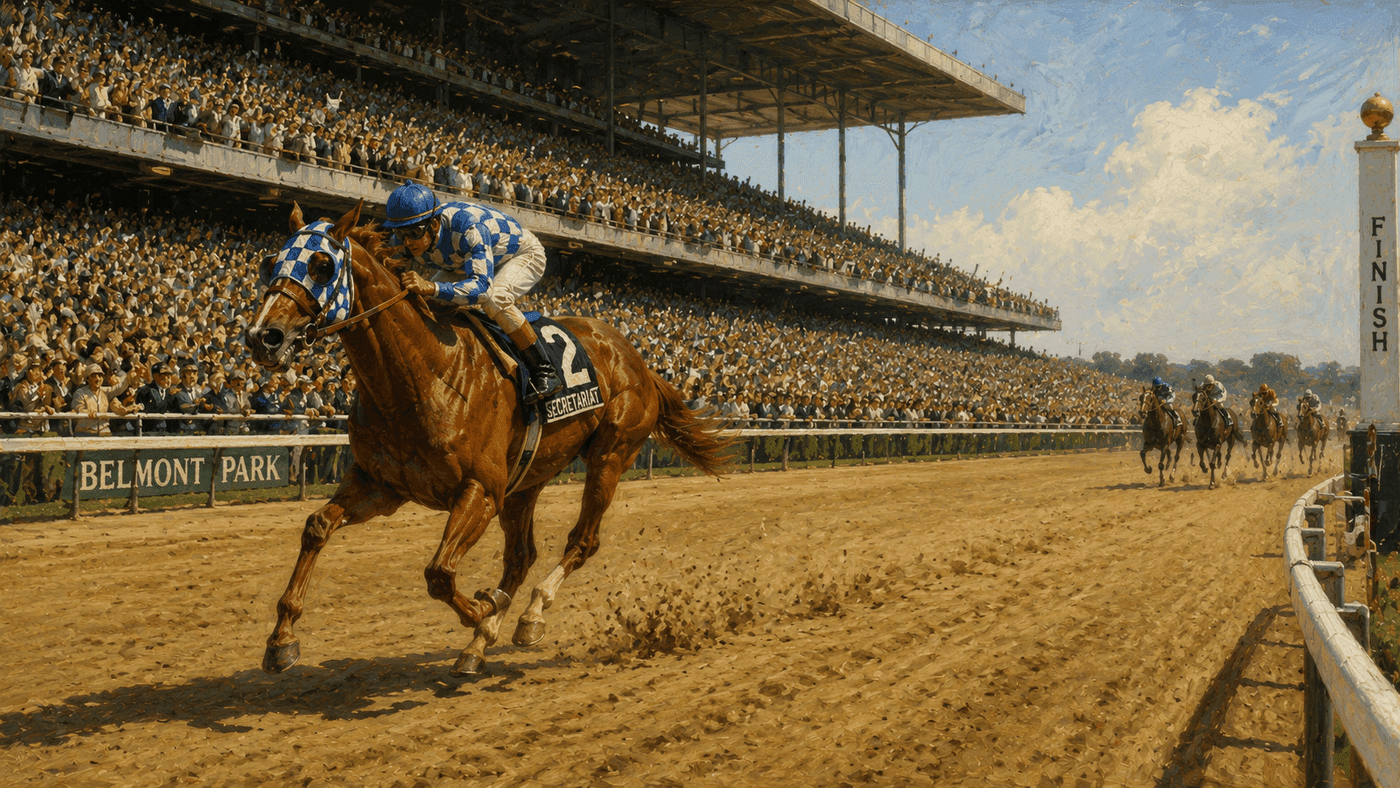
On June 9, 1973, Secretariat ran the Belmont Stakes in 2 minutes and 24 seconds flat — a time that shattered the track record by more than two seconds, a margin that in horse racing is an eternity, and that has never been equaled or broken in the race's subsequent runnings. He won by thirty-one lengths. The second-place horse, Twice a Prince, finished so far back that the television broadcast had to cut away from Secretariat to find him. The announcer, Chic Anderson, described what he was watching as not a horse race but something else — something he was struggling to name in real time. Secretariat had already won the Kentucky Derby in a track-record time that also has never been broken, and the Preakness, and now the Belmont, completing the first Triple Crown in twenty-five years. He did it while running each successive leg of the Triple Crown faster than the one before — an unprecedented physical achievement that running the fastest horses in the world progressively harder should have made impossible.
What explains Secretariat has preoccupied horse racing enthusiasts, veterinarians, and sports scientists since 1973. A post-mortem examination after his death in 1989 found that his heart was approximately two and a half times the normal size for a thoroughbred — an anatomical anomaly that may help account for his extraordinary cardiovascular capacity, though experts have noted that large hearts are common among thoroughbreds and do not by themselves explain the specific combination of speed, stamina, and late-race acceleration that defined his Belmont performance. The thirty-one-length margin also obscures something important: Secretariat was not merely running faster than his competition. He was, by the split times recorded at each quarter-mile, accelerating as the race went on — running the final quarter of the Belmont faster than any of the preceding ones. Horses are not supposed to run a mile and a half like that. Secretariat did not appear to be aware of that constraint. The performance on June 9, 1973, is the single most statistically dominant result in the history of American horse racing, and it was produced by an animal that seemed, to the people watching it happen, to belong to a different category than the horses it was racing against.
The River Into the Continent
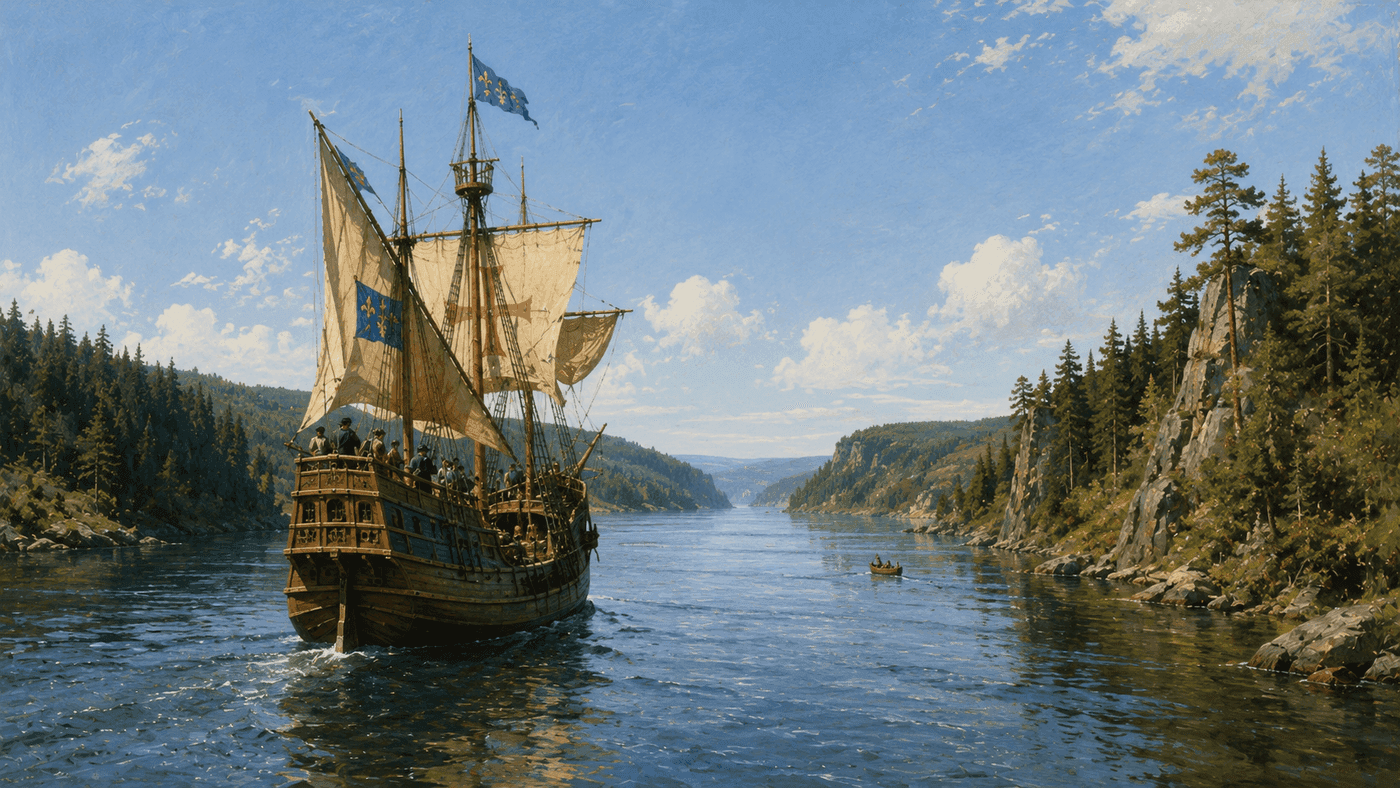
On June 9, 1534, French navigator Jacques Cartier sailed into the mouth of the St. Lawrence River — a body of water whose full dimensions he would spend the next several years exploring — beginning an expedition that would lay the foundations for French colonial presence in North America. Cartier had departed Saint-Malo, in Brittany, in April 1534 on commission from King Francis I, with instructions to find a passage to Asia and to secure whatever wealth the New World might offer. He had already explored portions of the Newfoundland coast and the Gulf of St. Lawrence before entering the river itself on June 9. What he found, as he sailed west into the continent, was a waterway of extraordinary length and navigable depth that gave access to the interior of North America in a way that no other river system on the eastern coast could match — a geographic fact that would eventually make the St. Lawrence the corridor through which France built its North American empire.
Cartier made three voyages to the St. Lawrence between 1534 and 1542, exploring as far inland as the Huron-Iroquois communities at Stadacona — present-day Quebec City — and Hochelaga — present-day Montreal. He claimed the land for France with a cross at Gaspé Bay in July 1534, an act that the Iroquoian chief Donnacona protested directly to Cartier's face with a formal speech — a moment that the French records document in sufficient detail to make clear that Indigenous leadership understood exactly what the planting of a foreign sovereign's symbol on their land implied. Cartier kidnapped Donnacona and several other Iroquoians, bringing them to France to serve as interpreters and living proof of his discoveries. The colonial relationship between France and the Indigenous peoples of the St. Lawrence Valley was, from these earliest encounters, characterized by the combination of genuine cultural exchange and fundamental asymmetry of power that would define it for the next two centuries. The river Cartier entered on June 9, 1534, became the spine of New France — and then of Canada.
Ford's Theatre Falls
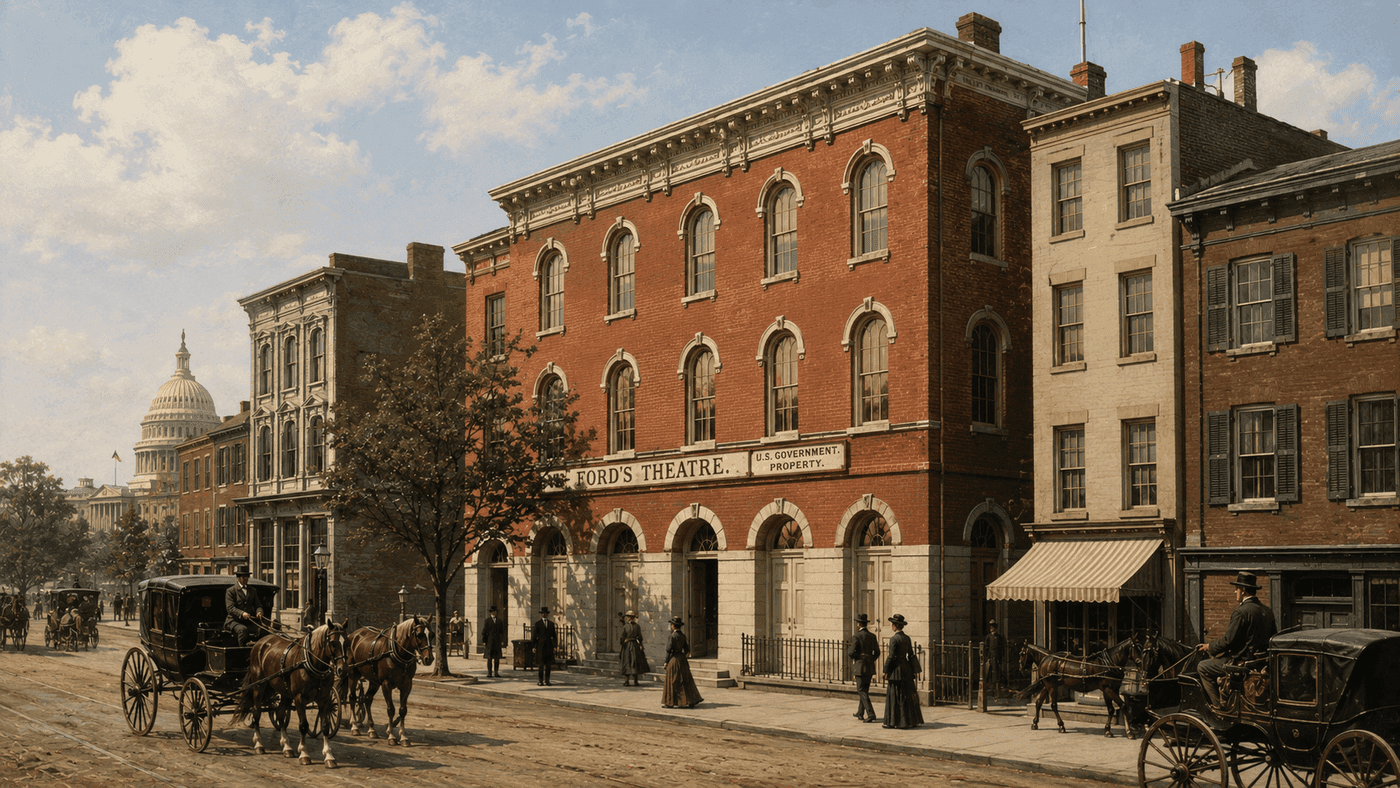
On June 9, 1893 — twenty-eight years after Abraham Lincoln's assassination at Ford's Theatre on April 14, 1865 — the building where the president had been shot collapsed without warning, killing twenty-three government clerks and injuring sixty-eight more. The theatre had ceased operating as a performance venue after Lincoln's death, purchased by the federal government and converted into government office space. Three floors of the interior had been subdivided into offices housing the record-keeping operations of the War Department. On the morning of June 9, structural failure in the basement supports triggered a progressive collapse of all three floors simultaneously — a catastrophic pancaking of the building's interior that trapped hundreds of workers in the rubble. The collapse was attributed to years of deferred maintenance on a building that had been structurally altered from its original design without adequate engineering review.
The 1893 collapse added a particular dimension of irony and sorrow to a building already saturated with national grief. Ford's Theatre had been the site of the most traumatic political assassination in American history; now it had claimed twenty-three more lives through simple institutional neglect. The federal government, which had owned and occupied the building for nearly three decades, had failed to maintain it adequately — a failure of attention and investment that the building's symbolic weight made all the more striking. The structure was subsequently reinforced and used for storage and other purposes until 1968, when a major restoration returned it to use as an active theater and museum. Today Ford's Theatre is one of the most visited historic sites in Washington, presenting theatrical productions alongside exhibits about Lincoln and his assassination. The twenty-three people who died in the June 9, 1893 collapse are significantly less commemorated than the single person who died there twenty-eight years earlier — a disparity that reflects, without resolving, something complicated about which tragedies a nation chooses to remember and which it allows to become footnotes.