June 6: The Longest Day, Movies Under the Stars, A Bullet That Launched a Movement
June 6 is a date that understands what courage looks like in different registers. In 1944, it looked like soldiers stepping off landing craft into the surf under fire on a heavily defended beach, knowing that the men ahead of them were dying and going anyway. In 1933, it looked like an entrepreneur stringing up a bed sheet in a Camden, New Jersey, parking lot and betting that Americans would pay to watch movies from their cars. In 1966, it looked like a Black man walking alone down a Mississippi highway with nothing but the conviction that the right to walk freely in his own country was worth risking his life to demonstrate. Three different kinds of courage — military, entrepreneurial, and moral — on the same calendar date across three decades.
June 6, 1944
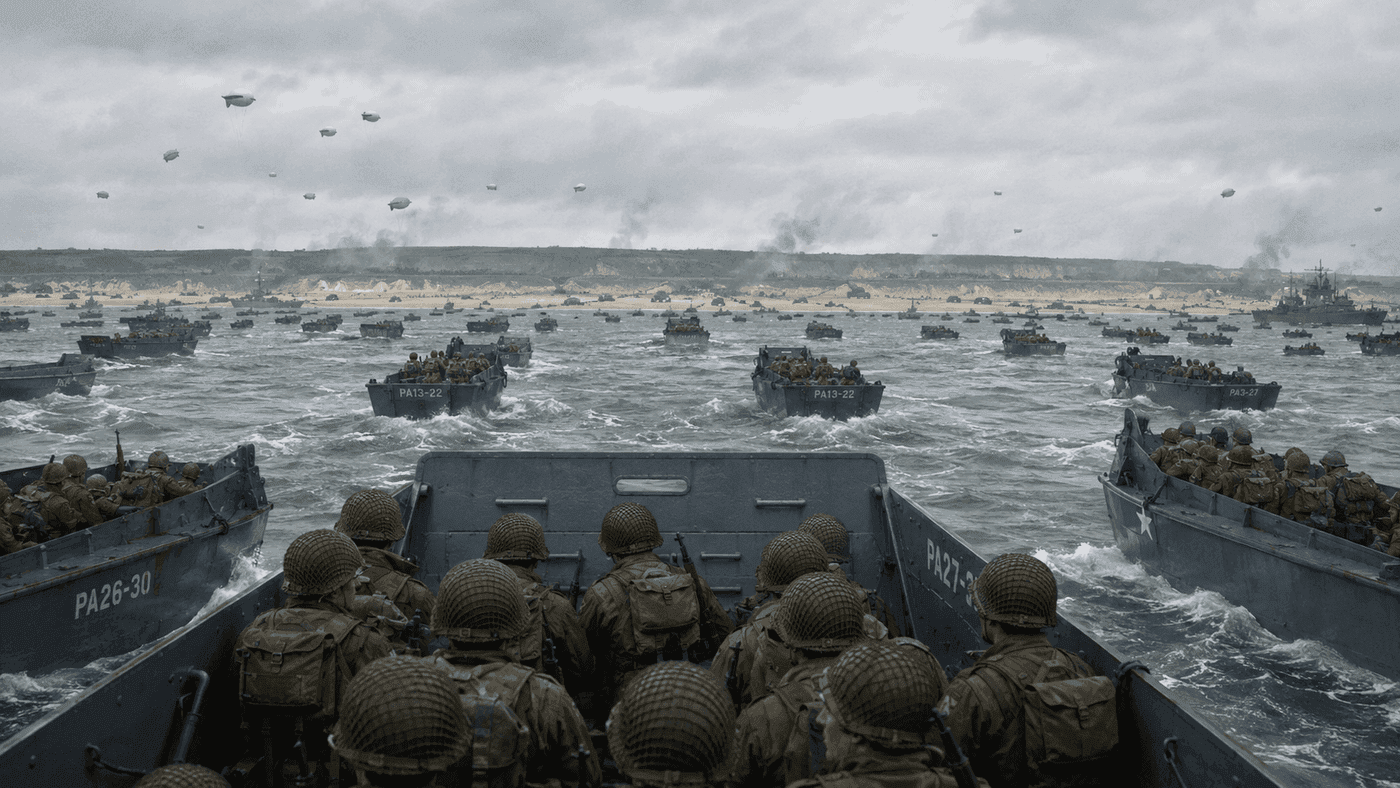
In the pre-dawn hours of June 6, 1944, the largest amphibious military operation in history began when 156,000 Allied troops crossed the English Channel in nearly 7,000 vessels, supported by 11,000 aircraft, and began landing along a fifty-mile stretch of the Normandy coast of occupied France. The beaches had been given code names — Utah, Omaha, Gold, Juno, Sword — and the landings at four of them proceeded with heavy but manageable casualties. At Omaha, the landing went catastrophically wrong almost immediately: rough seas scattered the landing craft, the preliminary naval and air bombardment had largely missed its targets, and the German defenses were stronger than intelligence had indicated. In the first waves at Omaha Beach, American soldiers died before they could leave their landing craft, in the water, and in the sand within yards of the waterline. By the end of June 6, approximately 2,500 Americans had been killed at Omaha alone. Total Allied casualties across all five beaches on D-Day are estimated between 10,000 and 12,000, with roughly 4,000 to 5,000 dead.
The men who landed on those beaches knew, in varying degrees, what they were walking into. Some had been told; many had seen the flares and heard the fire from the vessels ahead of theirs. They went anyway — because orders required it, because the men beside them were going, because turning back was not a category of option available to them, and in many cases because they understood, with the clarity that danger sometimes provides, that what they were doing mattered. By nightfall on June 6, a foothold had been established in France that could not be dislodged. Paris was liberated in August 1944; Germany surrendered in May 1945. The road from the beaches of Normandy to the end of the war in Europe was long and cost many more lives than the landing itself. But June 6, 1944, was where that road began — where the decision made in conference rooms in London and Washington and at Eisenhower's headquarters in England was converted, by the bodies of young men in the surf, into a historical fact.
The Lot on Admiral Wilson Boulevard
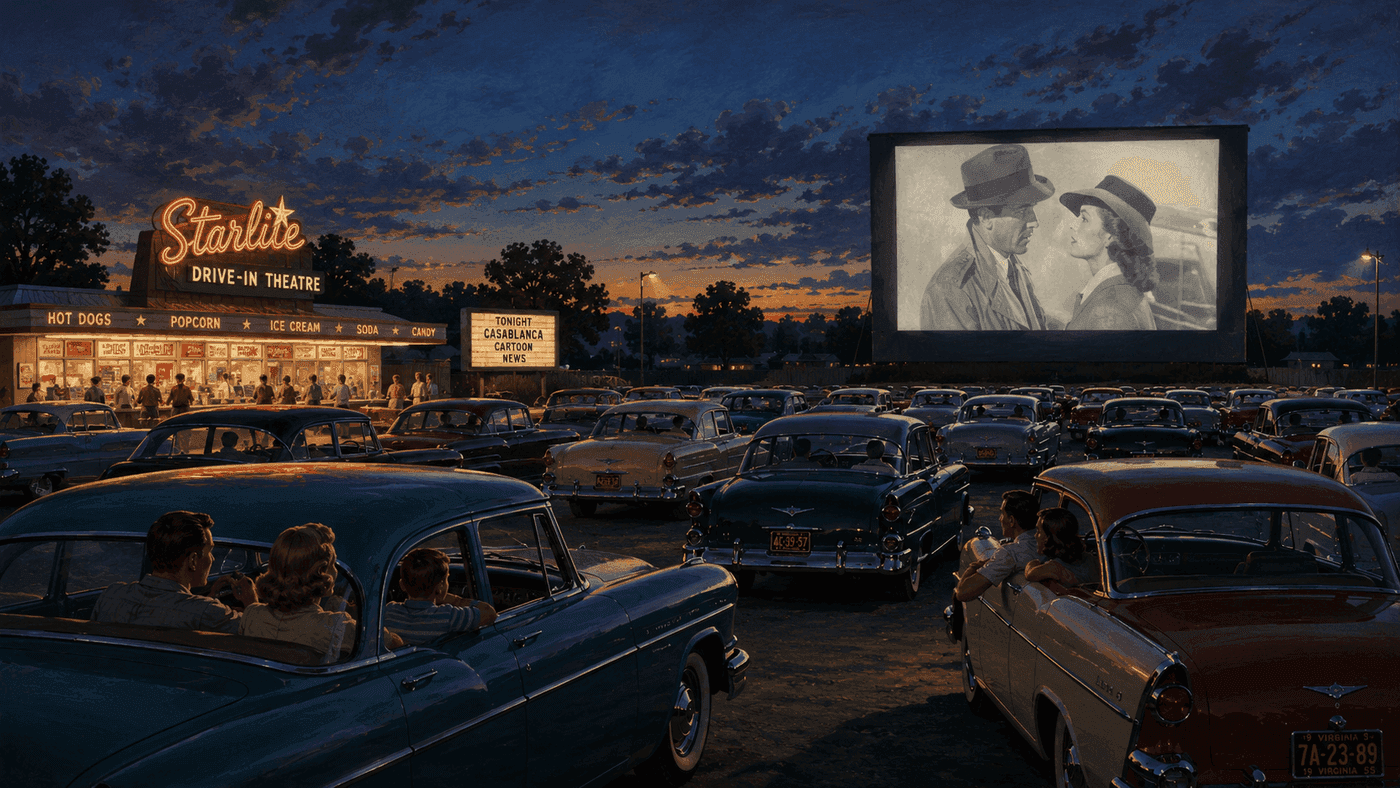
On June 6, 1933, Richard Hollingshead opened the world's first drive-in movie theater on a lot he had leased at 2601 Admiral Wilson Boulevard in Camden, New Jersey, charging 25 cents per car and 25 cents per person with a maximum of one dollar per carload. Hollingshead had patented the concept three months earlier, having spent the previous year experimenting in his driveway — propping a screen against trees, setting a projector on the hood of his car, and working through the engineering problems of projection angle, speaker placement, and drainage. His patent described a method of mounting speakers on car windows to deliver individualized sound, and of ramping the parking rows so that each car had a clear sightline to the screen. The opening film at the Camden drive-in was Wives Beware, a British comedy. Approximately 400 cars attended in the first week.
Hollingshead's drive-in concept spread slowly at first, then explosively after World War II, when the combination of suburban expansion, rising car ownership, and baby boom families with young children created a perfect audience for an entertainment format that accommodated noise, movement, and informality in ways that traditional movie houses could not. By the late 1950s, there were more than 4,000 drive-in theaters in the United States. They became a fixture of American adolescent social life — the privacy of a car in a dark parking lot offering freedoms that the home and the classroom did not — and of the postwar suburban cultural geography that the automobile had made possible. The format declined sharply from the 1970s onward, as real estate values made the large lots more profitable for other uses and as home video eroded the drive-in's convenience advantage. There are fewer than 300 operating drive-ins left in the United States today, most of them treasured by their communities as survivors of an era. Richard Hollingshead's patent expired in 1950, and he never became wealthy from his invention. The concept outlasted the patent by decades and the inventor by generations.
The March Against Fear
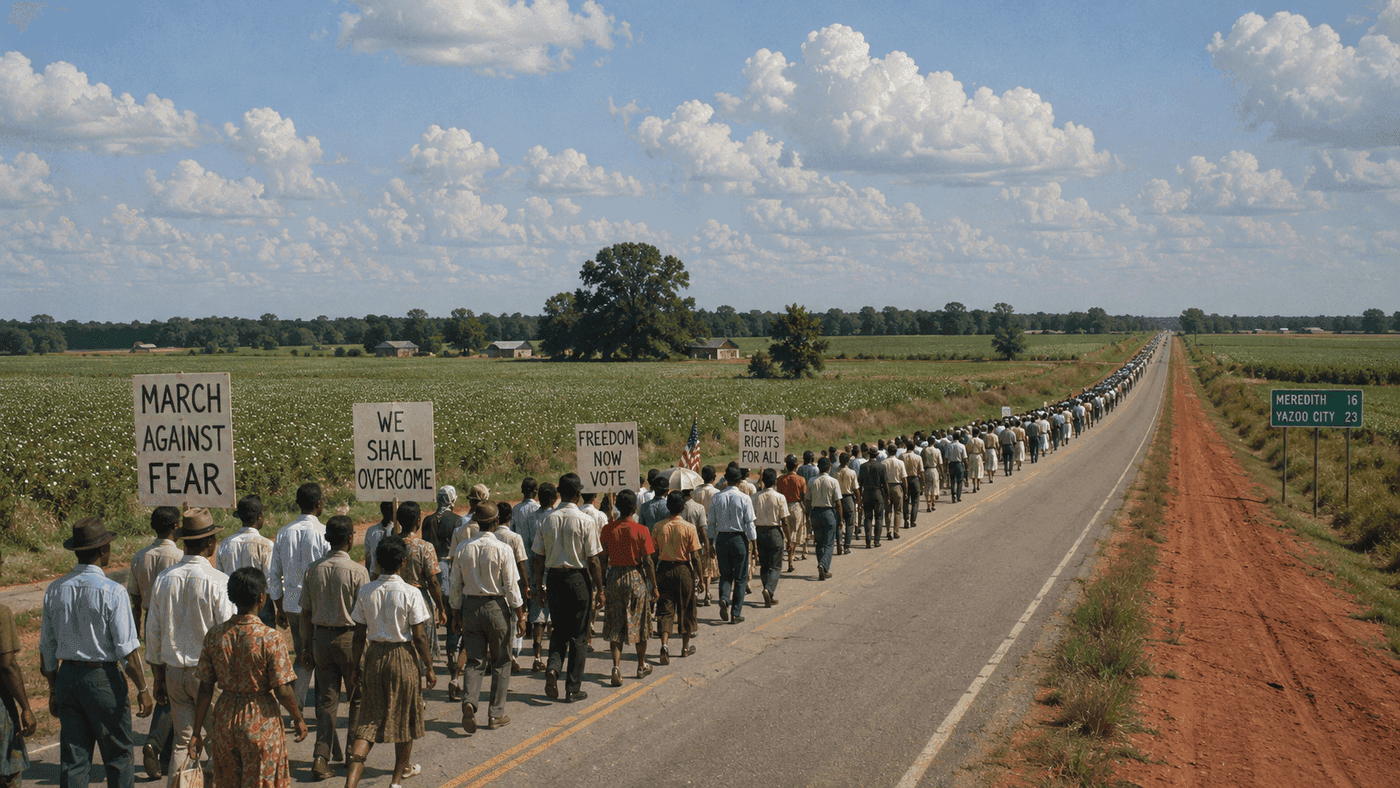
On June 6, 1966, James Meredith — who in 1962 had become the first Black student to enroll at the University of Mississippi, requiring federal marshals and eventually National Guard soldiers to enforce his right to attend — set out alone from Memphis, Tennessee, on what he called the March Against Fear: a 220-mile walk to Jackson, Mississippi, intended to demonstrate that a Black man could travel through Mississippi without intimidation and to encourage Black Mississippians to register to vote. He carried a cane and wore a pith helmet. He was shot by a white sniper named Aubrey James Norvell on the second day of the march, on a highway in Hernando, Mississippi. He survived. He was taken to a Memphis hospital, and the nation received the news of his shooting with the particular combination of horror and exhaustion that had come to accompany the civil rights movement's every encounter with southern racial violence in that decade.
What the shooting of James Meredith produced was one of the civil rights movement's most significant and most complicated events. Martin Luther King Jr., Stokely Carmichael, Floyd McKissick, and other civil rights leaders descended on Mississippi and continued the march in Meredith's name, eventually drawing thousands of participants. It was during this march — known as the Meredith March Against Fear — that Stokely Carmichael, recently elected chairman of the Student Nonviolent Coordinating Committee, first used the phrase "Black Power" publicly, in a Greenwood, Mississippi, speech that signaled a generational shift in the movement's language and tactics. The phrase's emergence during a march that had begun with one man's act of individual courage crystallized the tensions within the civil rights coalition between integration and self-determination, between nonviolent advocacy and militant resistance. Meredith himself rejoined the march for its final miles into Jackson. He later pursued a career in business and politics and has remained a controversial figure within the civil rights movement for his subsequent political views. The march he began alone on June 6, 1966, became something much larger than he had planned — in the way that genuine acts of courage sometimes do.