
One Week to the Most American Day in History
Seven days from today, the United States of America will celebrate its 250th birthday — the semiquincentennial, the quarter-millennium, the once-in-a-lifetime milestone that no living American has seen before and none will see again. On the morning of July 4, 1776, fifty-six delegates to the Second Continental Congress adopted a document that was, by any reasonable measure, an act of audacity bordering on recklessness: a formal declaration of independence from the most powerful empire on Earth, signed by men who knew that if the revolution failed, they would likely hang for it. Two hundred and fifty years later, the nation those men set in motion is preparing to mark that moment with celebrations from Philadelphia's Independence Hall to New York Harbor to the National Mall in Washington — and with a sense of occasion that the country has not felt since the bicentennial in 1976, half a lifetime ago.
From 13 Colonies to 250 Years
The numbers alone are staggering. In 1776, the United States had a population of roughly 2.5 million people — about the size of Houston today — spread along the Atlantic seaboard of a continent whose interior was almost entirely unknown to European settlers. It had no standing army worthy of the name, no navy, no established currency, no functioning national government. What it had was an idea, articulated in 1,320 words: that all men are created equal, that they are endowed with certain unalienable rights, that among these are life, liberty, and the pursuit of happiness. The gap between that idea and the nation's practice of it has been the central argument of American history — an argument still very much in progress. But the idea survived. The 13 colonies became 50 states. The 2.5 million became 340 million. The fragile experiment in self-governance became, by almost any measure, the most consequential political project in the history of the modern world.
The celebrations planned for July 4th are proportionate to the milestone. In Philadelphia — the city where independence was declared, where the Constitution was written, where the Liberty Bell cracked — the America250 commission will oversee a national Independence Day ceremony culminating in the burial of a time capsule at Independence Mall, sealed for future generations. In New York Harbor, the U.S. Navy will host the International Fleet Review, with 60 ships from 30 nations sailing past the Statue of Liberty in a display last seen in 1986 for the statue's centennial. On the National Mall in Washington, the Great American State Fair has already opened, with six state-of-the-art Freedom Trucks traveling all 48 contiguous states throughout the year to bring the story of American independence to communities across the country. The bipartisan America250 commission — supported by a Congressional caucus of more than 350 members, the largest caucus in U.S. history, with former Presidents Bush and Obama serving as honorary co-chairs — has been planning this moment since 2016. July 4, 2026 falls on a Saturday, giving the country a full three-day weekend to mark what may be the most singular birthday in American life.
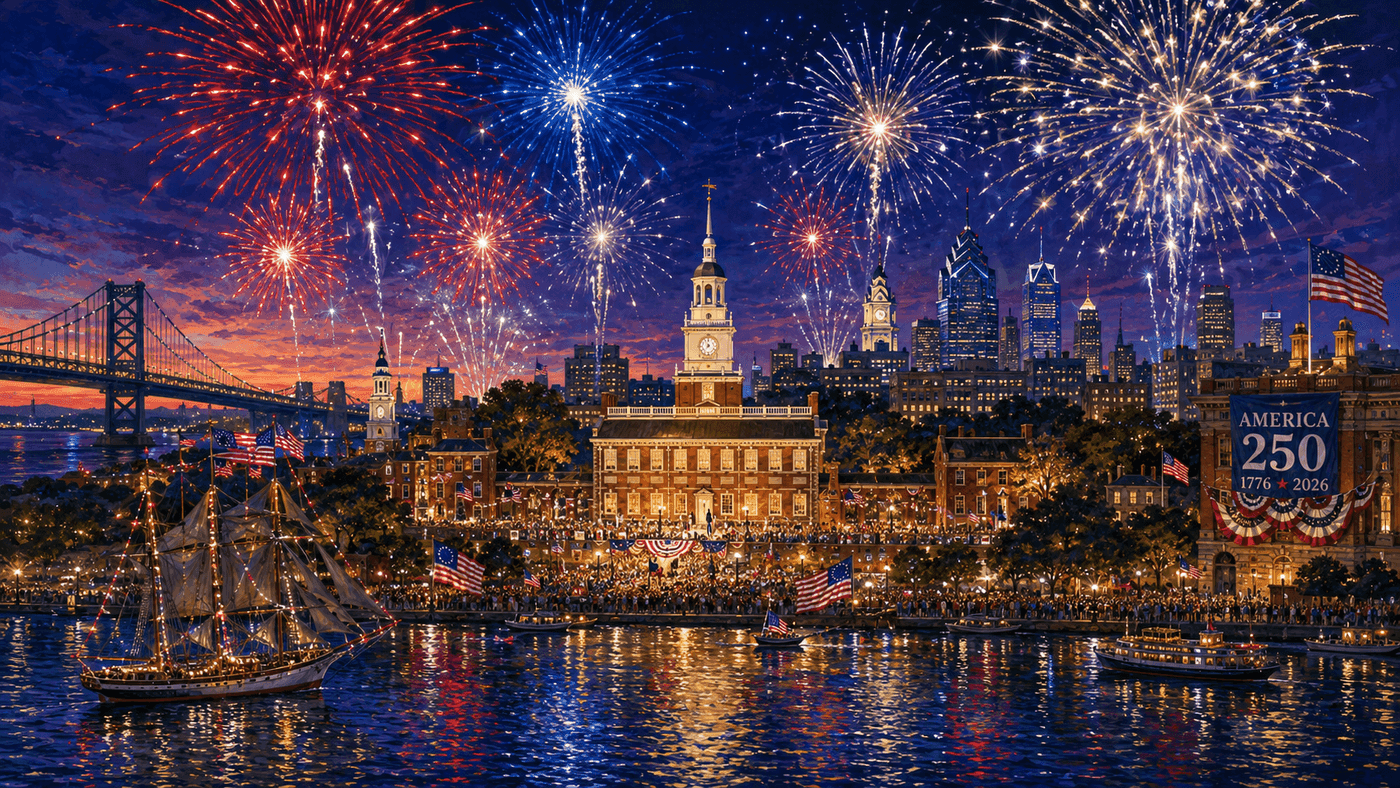
The last major milestone — the bicentennial of 1976 — arrived during a moment of national doubt: the country still raw from Vietnam and Watergate, the economy struggling, the national mood fractured. It celebrated anyway. The tall ships sailed into New York Harbor on July 4, 1976, and the country found, however briefly, something to agree on. The semiquincentennial arrives in a similarly complicated moment — a country that has just ended a war, is hosting the World Cup, and is simultaneously arguing, as it always has, about what the founding documents mean and who they were written for. That argument is not a sign of failure. It is, perhaps, the most authentically American thing there is: a country that has spent 250 years arguing about whether it is living up to its own declaration, and hasn't stopped yet. Seven days from today, whatever else divides us, the fireworks will go up in every city and town in America. The experiment that started with 56 signatures and a great deal of hope turns 250 years old. It is still going.