
Two Hundred and Fifty
Two hundred and fifty years ago today, fifty-six men in Philadelphia affixed their names to a document that was, by any rational measure, an act of magnificent audacity. The British Empire was the most powerful force on Earth. The Continental Army was undertrained, undersupplied, and losing. The outcome of the revolution was far from certain. And yet the delegates to the Second Continental Congress signed their names beneath a declaration that all men are created equal, that they possess unalienable rights, and that when a government fails to protect those rights, the people may alter or abolish it — knowing that if the revolution failed, they had just signed their own death warrants. Today, in sweltering heat across an America that has grown from 2.5 million colonists to 340 million citizens, across 50 states and a World Cup and a harbor full of tall ships and fireworks over every city, that document turns 250 years old. The experiment it launched is still running.
How a Nation Marks a Quarter Millennium
America has marked its major birthdays before — and each time, the celebration has revealed something about the country's mood. The Centennial of 1876 came barely a decade after the Civil War, a nation trying to convince itself it had healed: Philadelphia's Centennial Exhibition drew ten million visitors to the first World's Fair on American soil, unveiled Alexander Graham Bell's telephone and the right arm of the yet-unfinished Statue of Liberty, and radiated a confidence in American industry and progress that papered over the unresolved wounds of Reconstruction. The Bicentennial of 1976 arrived in the aftermath of Vietnam and Watergate, a country in a period of genuine self-doubt — and celebrated anyway. The tall ships sailed into New York Harbor on July 4, 1976, and the country found, however briefly, the thing it needed: a moment of uncomplicated pride. Today's Semiquincentennial arrives in its own complicated moment — a nation that has just ended a war, is hosting the World Cup, and is arguing, as it always has, about what the founders' words mean and who they were written for. It celebrates anyway. That is, perhaps, the most American thing it does.
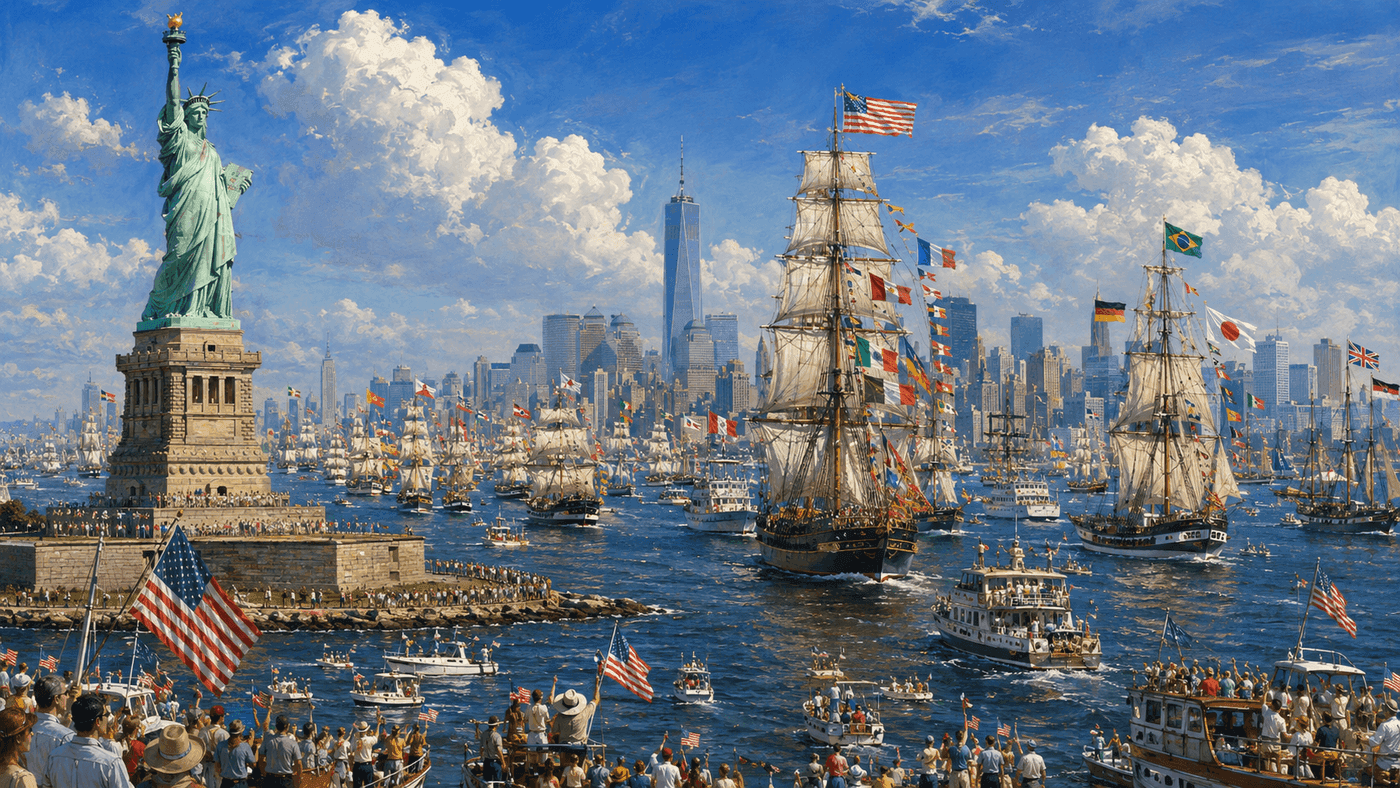
Today's celebrations are proportionate to the milestone. In New York Harbor, the U.S. Navy's Sail250 gathering — 60 ships from 30 nations, the largest maritime gathering in American history — sails past the Statue of Liberty, herself a gift from France that arrived in 1886, 110 years after the revolution that inspired it. In Philadelphia, where the Declaration was adopted, a national ceremony will culminate in the burial of a time capsule at Independence Mall — sealed today, to be opened by Americans not yet born. In Washington, D.C., the National Mall hosts concerts, a parade, and fireworks over monuments that have stood through every chapter of the American story since the republic's founding. And across the country, a piece of American mechanical history is on the move: Union Pacific's Big Boy No. 4014 — the world's largest operating steam locomotive, built in 1941 to haul war machinery — is midway through a month-long birthday journey from Scranton to Cheyenne, stopping in eight cities, its whistle echoing through towns that have been American for the full span of this anniversary and longer.
The 250th birthday lands on a Saturday in a summer unlike any in recent American memory — the World Cup on home soil, an Iran peace deal signed, a heat wave over the eastern seaboard, and a country moving through one of the more consequential chapters of its modern history. The Declaration of Independence was written in the summer too, in a Philadelphia that was also hot, also uncertain, also in the middle of something that hadn't resolved yet. John Adams wrote to his wife Abigail on July 3, 1776, that the anniversary of independence "ought to be solemnized with pomp and parade, with shows, games, sports, guns, bells, bonfires, and illuminations, from one end of this continent to the other, from this time forward forevermore." He got the date wrong by a day — he thought the second of July was the day, when the vote for independence actually passed — but he got everything else exactly right. Two hundred and fifty years later, the bells are ringing, the illuminations are coming, and the experiment he helped launch is still, stubbornly, magnificently, going.