July 18: Ghosts in the Deep, a Third Term, and a Dangerous Book
July 18 holds three stories about what happens when something long buried finally comes into view. In 1986, a remotely operated camera descended two and a half miles into the North Atlantic and brought the wreck of the Titanic into focus for the first time in seventy-four years, ending decades of speculation about exactly what had happened to the ship that was supposed to be unsinkable. In 1940, Franklin Roosevelt accepted his party's nomination for an unprecedented third presidential term, breaking a tradition that had stood since George Washington and reshaping the boundaries of American executive power. And in 1925, a failed revolutionary's prison manifesto reached bookstores in Germany — a text that read, at the time, like the rantings of a fringe extremist, and that would within two decades provide the ideological architecture for one of history's greatest catastrophes. Three July eighteenths. Three moments when something previously hidden or unprecedented broke into the open.
Twelve Thousand Five Hundred Feet Down
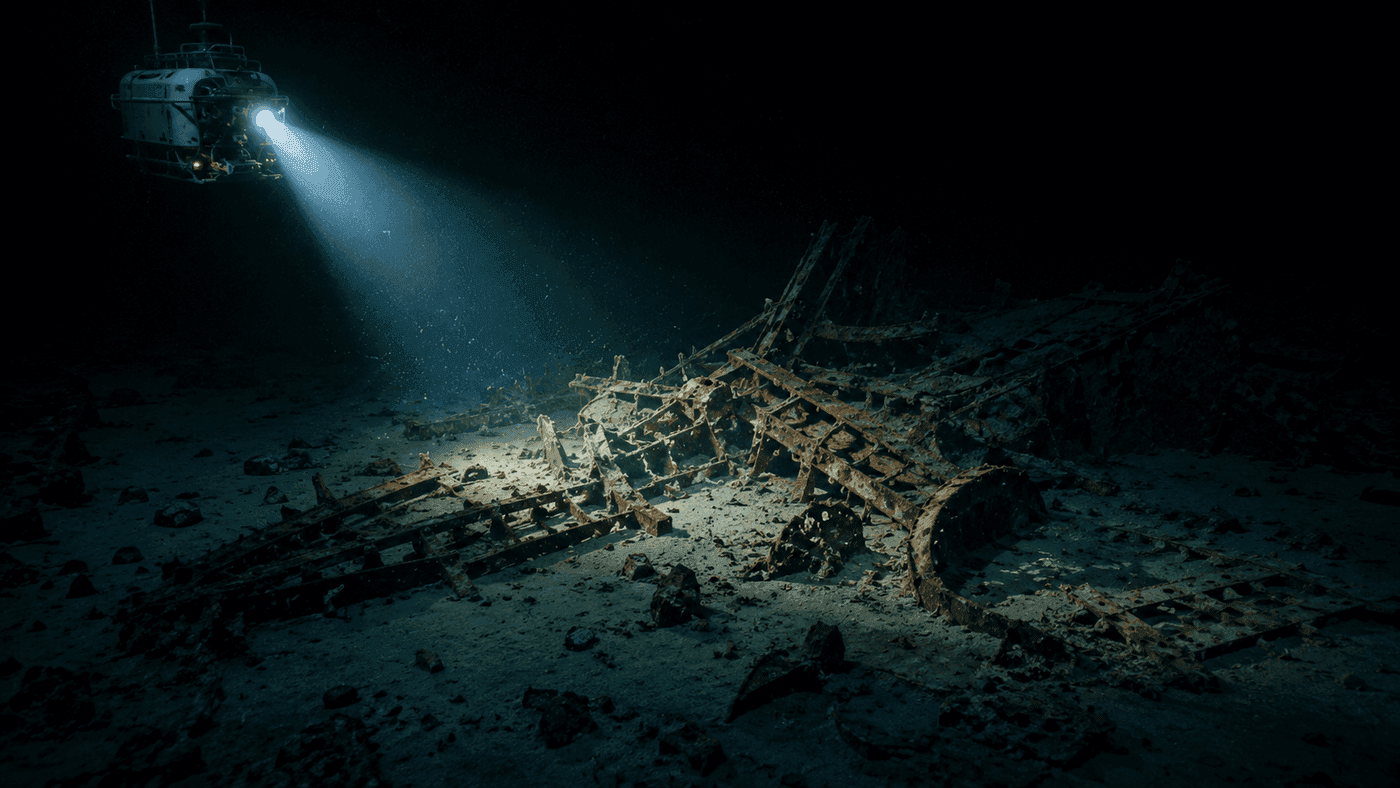
On July 18, 1986, the remotely operated vehicle Jason Jr., deployed from the research vessel Knorr, captured the first detailed video footage of the RMS Titanic's wreckage, resting in absolute darkness 12,500 feet beneath the surface of the North Atlantic. The wreck itself had been located the previous September by a team led by Robert Ballard, using sonar and a deep-sea camera sled called Argo, but it was the July 1986 expedition — in which Ballard's team piloted the small robotic submersible Jason Jr. directly into and around the wreck — that produced the haunting, detailed images that finally let the world see what had happened to the ship that had sunk on its maiden voyage in April 1912. The footage revealed that the Titanic had broken into two enormous sections during its descent, separated by nearly 2,000 feet of ocean floor and surrounded by a debris field scattered with shoes, suitcases, dishware, and the countless small artifacts of more than 1,500 lives lost.
The 1986 footage ended seventy-four years of speculation and answered questions that had divided historians and survivors' accounts for decades — most significantly confirming that the ship had broken apart at the surface before sinking, rather than going down intact as the official 1912 inquiry had concluded. The discovery reignited global fascination with the Titanic disaster, inspiring documentaries, museum exhibitions, and ultimately James Cameron's 1997 film, which became one of the highest-grossing movies ever made. It also opened a contentious debate about the ethics of disturbing the wreck site, which many consider a mass grave: subsequent expeditions have recovered thousands of artifacts for display and sale, drawing criticism from those who believe the site should be left undisturbed. The wreck itself continues to deteriorate, consumed gradually by iron-eating bacteria; some marine scientists estimate it may collapse entirely within decades. The images captured on July 18, 1986, may eventually be the most detailed record that ever exists of the ship as it actually rests on the ocean floor.
Breaking Precedent
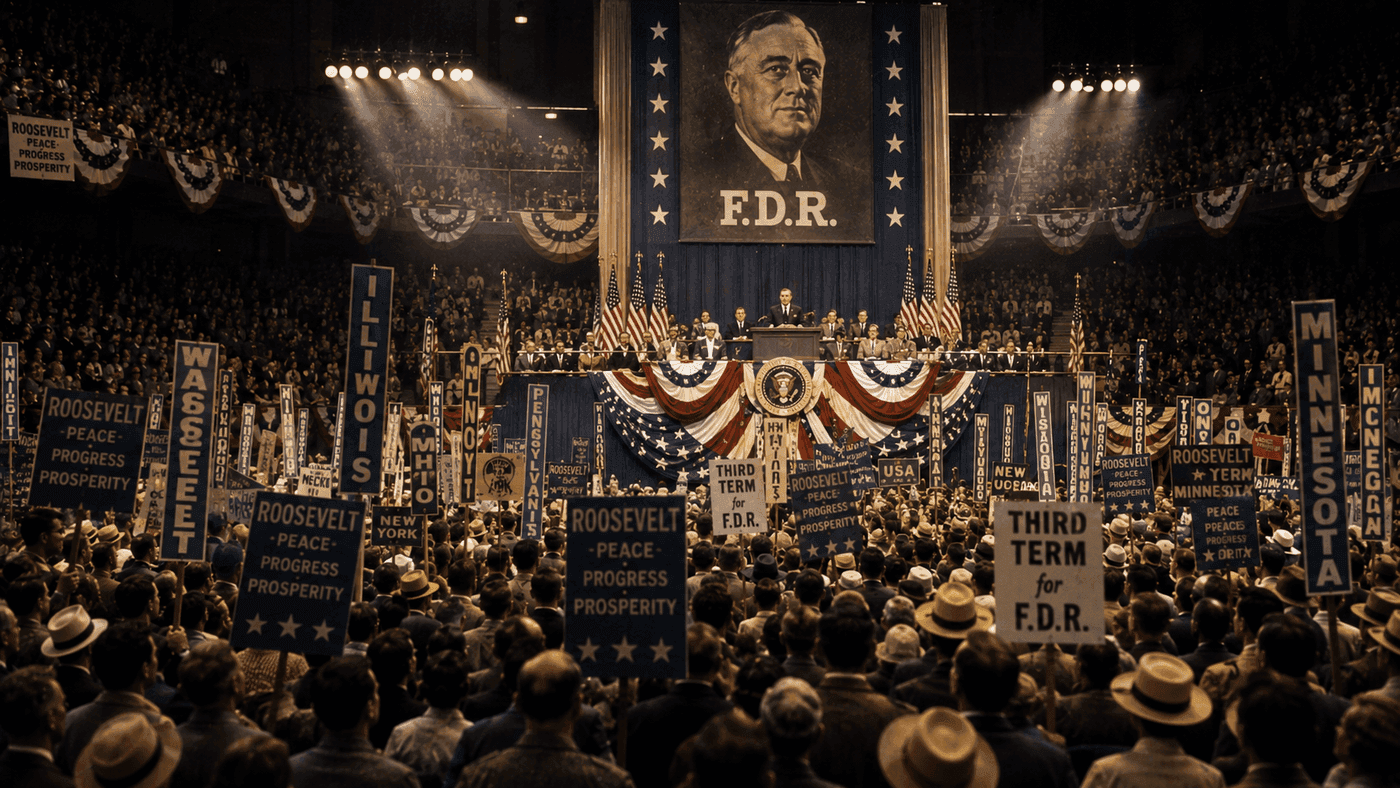
On July 18, 1940, Franklin D. Roosevelt accepted the Democratic Party's nomination for an unprecedented third presidential term at the party's convention in Chicago, shattering a two-term tradition that every American president since George Washington had voluntarily observed for 144 years. Roosevelt had not formally campaigned for the nomination and had allowed considerable ambiguity about his intentions throughout the spring of 1940, but the convention drafted him with an enthusiasm that left little doubt the outcome had been carefully managed behind the scenes. His justification rested heavily on the deteriorating situation in Europe: France had fallen to Nazi Germany just weeks earlier, Britain stood alone against the Luftwaffe, and Roosevelt argued that the gathering global crisis made continuity of experienced leadership more important than the precedent of voluntary term limits.
Roosevelt went on to win the 1940 election decisively against Republican challenger Wendell Willkie, and was reelected to a fourth term in 1944 before dying in office in April 1945, just months into that term. His unprecedented tenure — more than twelve years in office, spanning the Great Depression and nearly the entirety of American involvement in World War II — prompted a constitutional response once the war had ended: the Twenty-Second Amendment, ratified in 1951, formally limited future presidents to two elected terms, codifying as law the tradition Roosevelt had broken. The amendment stands today as a direct legacy of the decision made in Chicago on July 18, 1940 — a structural check written into the Constitution specifically because one president's judgment about necessity had proven, to subsequent generations, too significant a precedent to leave merely to custom.
The Blueprint
On July 18, 1925, the first volume of Mein Kampf was published in Germany, a sprawling autobiographical and ideological manifesto that Adolf Hitler had dictated while imprisoned following the failed Beer Hall Putsch of 1923 — an attempted coup that had landed him in Landsberg Prison on a charge of treason, where he served less than a year of a five-year sentence. The book combined a self-serving account of Hitler's early life with a comprehensive statement of the racial and political ideology that would define Nazism: virulent antisemitism, theories of Aryan racial superiority, calls for German territorial expansion, and explicit contempt for democratic governance. Sales were modest at first — the book was widely regarded, even within Germany, as the rambling output of a failed and somewhat ridiculous political agitator, and few outside Hitler's immediate circle took its contents seriously as a genuine program for action.
That assessment proved catastrophically wrong. As the Nazi Party rose to power through the late 1920s and into the 1930s, Mein Kampf became required reading in German schools and a fixture in German households, with the state purchasing copies for newlywed couples and military personnel. By the time of Hitler's death in 1945, the book had sold an estimated twelve million copies in Germany alone. The ideology it articulated in 1925 was, with horrifying fidelity, the ideology the Nazi regime implemented: the persecution and ultimately the genocide of European Jews, the invasion of neighboring nations in pursuit of so-called living space, and the elevation of a racial hierarchy to the organizing principle of state policy. The book remains, in the words of historians who have studied it, one of the clearest cases in modern history of an extremist text serving as a literal blueprint for atrocity — read in advance by millions of people who, in many cases, chose not to believe its author meant what he wrote.