July 17: A Handshake in Orbit, a Meeting in Potsdam, and a Kingdom in Anaheim
July 17 has a habit of bringing adversaries into the same room — or the same orbit. In 1975, American astronauts and Soviet cosmonauts docked their spacecraft together 140 miles above the earth and shook hands through an open hatch, offering a moment of genuine cooperation in the middle of a decades-long standoff. Thirty years earlier, in a battered German town outside Berlin, Harry Truman met Joseph Stalin for the first time — two leaders tasked with deciding the shape of a shattered postwar world, their wartime alliance already curdling into the rivalry that would define the rest of the century. And in 1955, in Anaheim, California, an entrepreneur opened the gates to a theme park built entirely from his own imagination, betting that families would want to step, however briefly, into a world built purely for delight. Three July seventeenths. Three very different kinds of meeting ground.
The Handshake in Orbit
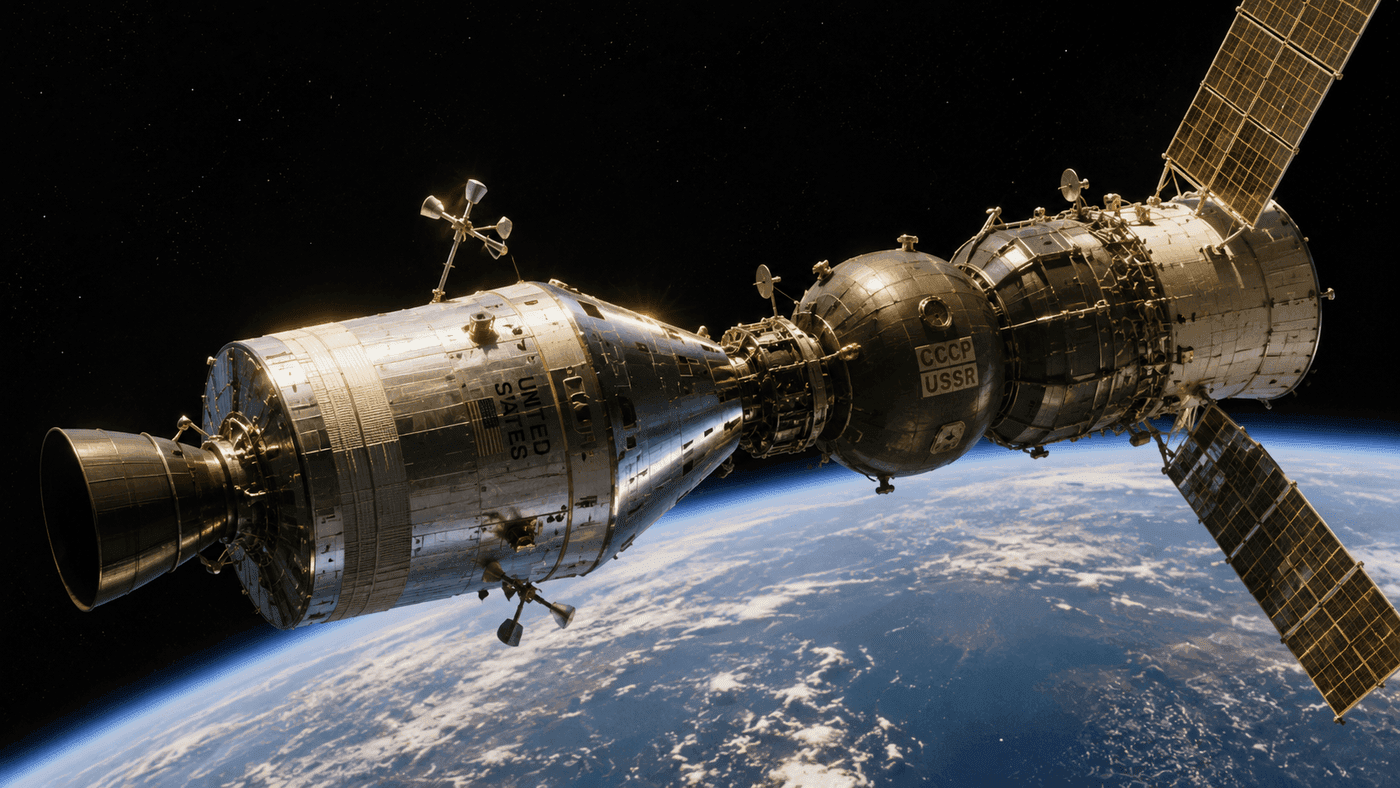
On July 17, 1975, an American Apollo spacecraft and a Soviet Soyuz spacecraft docked together approximately 140 miles above the earth, and astronaut Thomas Stafford reached through the open hatch to shake hands with cosmonaut Alexei Leonov — a gesture broadcast live to television audiences in both countries and around the world. The Apollo-Soyuz Test Project was the product of years of technical negotiation between two space programs that had spent the previous decade and a half locked in fierce competition, racing each other to orbit and then to the moon. Engineers on both sides had to solve genuinely difficult problems to make the docking possible: the two nations' spacecraft used incompatible atmospheric pressures and docking mechanisms, requiring the design of an entirely new docking module that could serve as both an airlock and a universal adapter. The mission represented détente made literal — Cold War rivals demonstrating, in the most visible way available, that cooperation was possible even at the height of mutual suspicion.
The crews spent nearly two days docked together, conducting joint experiments, sharing meals, and exchanging gifts and flags in a series of staged but genuinely warm encounters that NASA and Soviet officials hoped would resonate with publics on both sides of the Iron Curtain. The mission was the last Apollo-era American spaceflight and would not be followed by another joint U.S.-Soviet crewed mission for two decades, until the Shuttle-Mir program of the 1990s picked up the diplomatic and technical threads that Apollo-Soyuz had first woven together. The handshake itself became one of the most reproduced images of the Cold War's later, more cautiously hopeful years — visual proof that two nations capable of annihilating each other several times over could also, when the will existed, work side by side in the genuine silence of space.
Potsdam
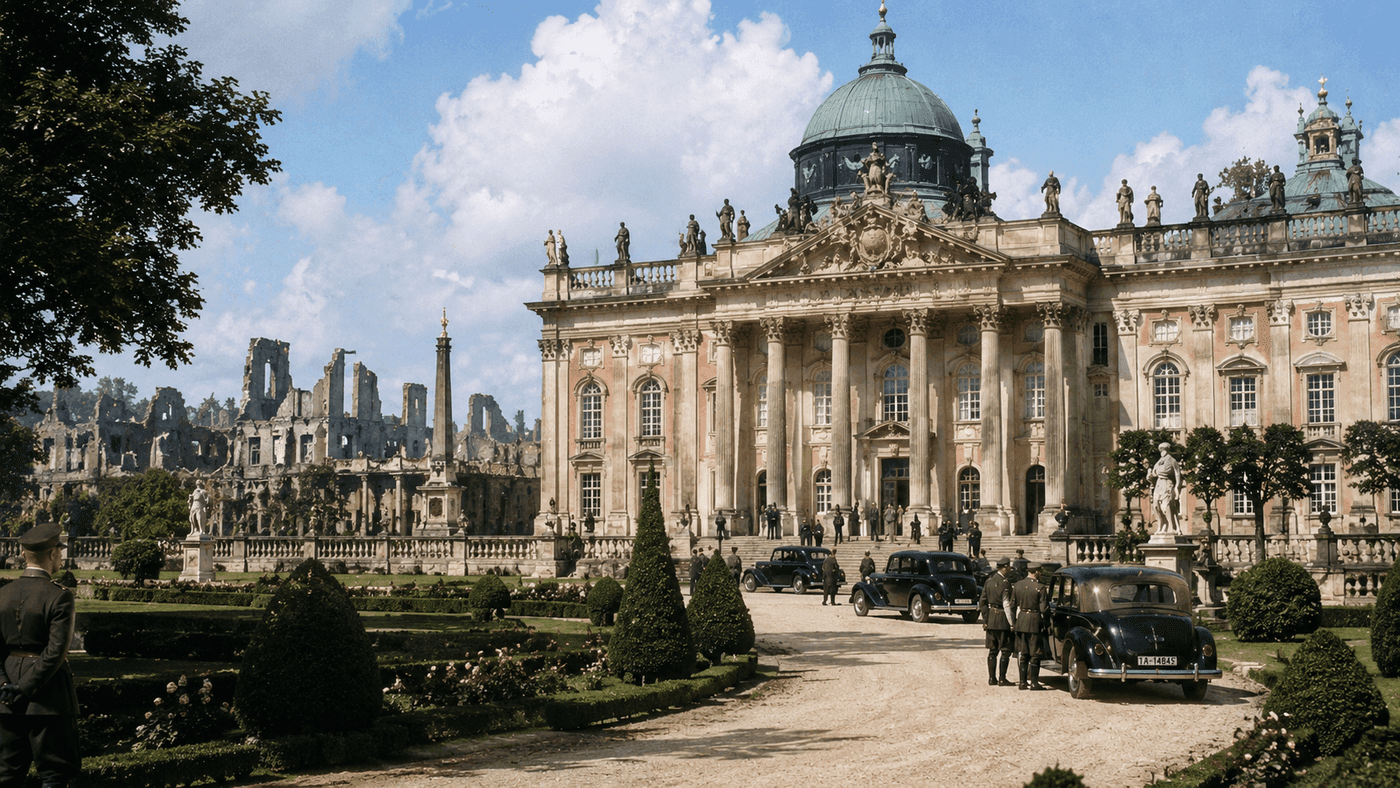
On July 17, 1945, President Harry S. Truman met Soviet Premier Joseph Stalin in person for the first time, at the Potsdam Conference held in a battered suburb just outside the ruins of Berlin. Truman had assumed the presidency only three months earlier, following Franklin Roosevelt's sudden death, and arrived at Potsdam with far less personal rapport with Stalin than Roosevelt had cultivated at Yalta the previous February. The conference brought together the leaders of the three major Allied powers — Truman, Stalin, and British Prime Minister Winston Churchill, who was replaced partway through by his successor Clement Attlee following Britain's general election — to negotiate the postwar order in Europe: the administration of occupied Germany, the redrawing of Polish borders, reparations, and the unresolved question of how a world ravaged by six years of war would be governed in peace.
Truman's private diary entries from those weeks, made public decades later, reveal a leader taking the measure of his counterpart with a mixture of guarded respect and rising unease. He found Stalin shrewd and capable but increasingly recognized that Soviet ambitions in Eastern Europe were not negotiable in any meaningful sense — that the wartime alliance forged against a common enemy had little to sustain it once that enemy was defeated. It was at Potsdam that Truman first informed Stalin, in deliberately vague terms, that the United States possessed "a new weapon of unusual destructive force" — a reference to the atomic bomb that had been successfully tested at Trinity just one day before the conference began. Stalin, who already knew of the American program through Soviet espionage, reacted with studied indifference. The conference that began with cautious diplomacy concluded with the lines of the Cold War already becoming visible — an alliance dissolving in real time, even as its architects continued to negotiate as though it might hold.
Black Sunday
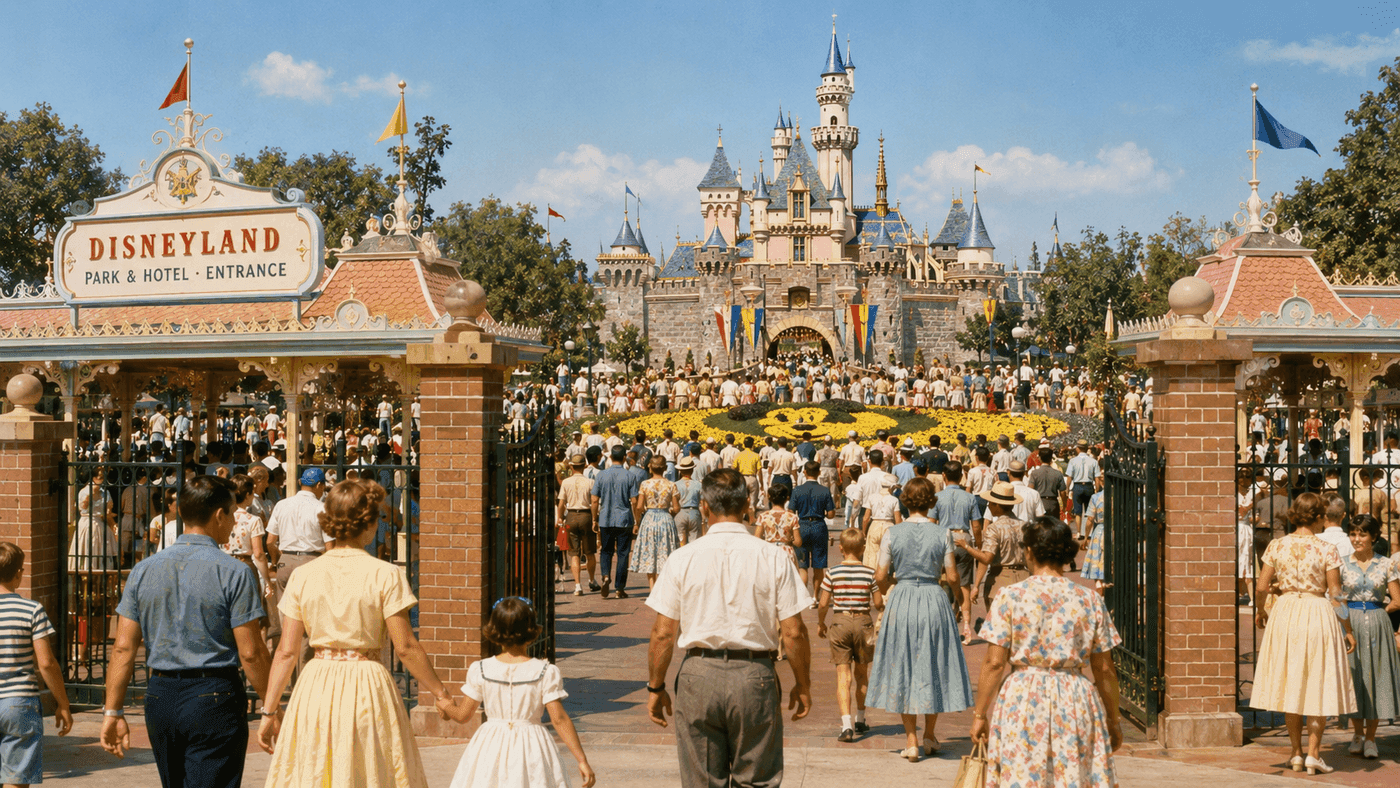
On July 17, 1955, Disneyland opened to the public in Anaheim, California, realizing a vision Walt Disney had nurtured for years: an amusement park unlike anything that had existed before, designed around immersive themed lands rather than the haphazard collection of rides typical of the carnivals and boardwalks of the era. The opening day, however, was a near-catastrophe that insiders came to call Black Sunday. Counterfeit tickets had flooded the event, swelling attendance to roughly twice the expected 15,000 guests. Asphalt freshly poured that morning had not fully set in the California heat, trapping women's high heels. A gas leak forced the temporary closure of Fantasyland and Adventureland. Temperatures soared past 100 degrees, and concession stands ran out of food and drink within hours. The live television broadcast of the opening, watched by an estimated 70 million Americans, captured a day that was, by any operational measure, a disaster.
None of it mattered in the end. Disneyland's underlying concept — a meticulously designed, immersive environment where every detail, from costumes to landscaping to background music, served a coherent storytelling vision — proved to be exactly what American families wanted, chaos of the first day notwithstanding. Within seven weeks, the park had welcomed its one millionth guest. Disney's gamble had been enormous: he had mortgaged his own life insurance policy and borrowed heavily against his studio's other assets to finance construction, at a moment when most entertainment executives considered the theme park concept commercially unproven. Disneyland became the template for an entirely new industry, inspiring Walt Disney World in Florida and Disney parks in Tokyo, Paris, Hong Kong, and Shanghai, along with the broader modern theme park industry that exists in its image. The disastrous opening day of July 17, 1955, is now remembered mostly as folklore — the rocky birth of an institution that would go on to welcome more than three-quarters of a billion visitors over the decades that followed.