July 14: The Fortress Falls, the Hammer Swings, and a Holy City Breaks
July 14 is a date that understands the weight of collective action. In 1789, a crowd of Parisians stormed a fortress that held almost nothing of practical value and everything of symbolic importance — and set in motion a revolution that would reshape the political order of the modern world. One hundred and seventy-nine years later, in an Atlanta baseball stadium, a man who had spent his career enduring death threats and racial hatred swung a bat for the five hundredth time and sent a ball into the stands, claiming his place in the most exclusive company the sport offered. And in 1099, an army that had marched three years from the edges of Europe breached the walls of Jerusalem and ended a siege — completing a mission whose moral reckoning has never fully arrived. Three July fourteenths. Three moments of arrival, each one trailing consequences that the people inside them could not have predicted.
The Bastille
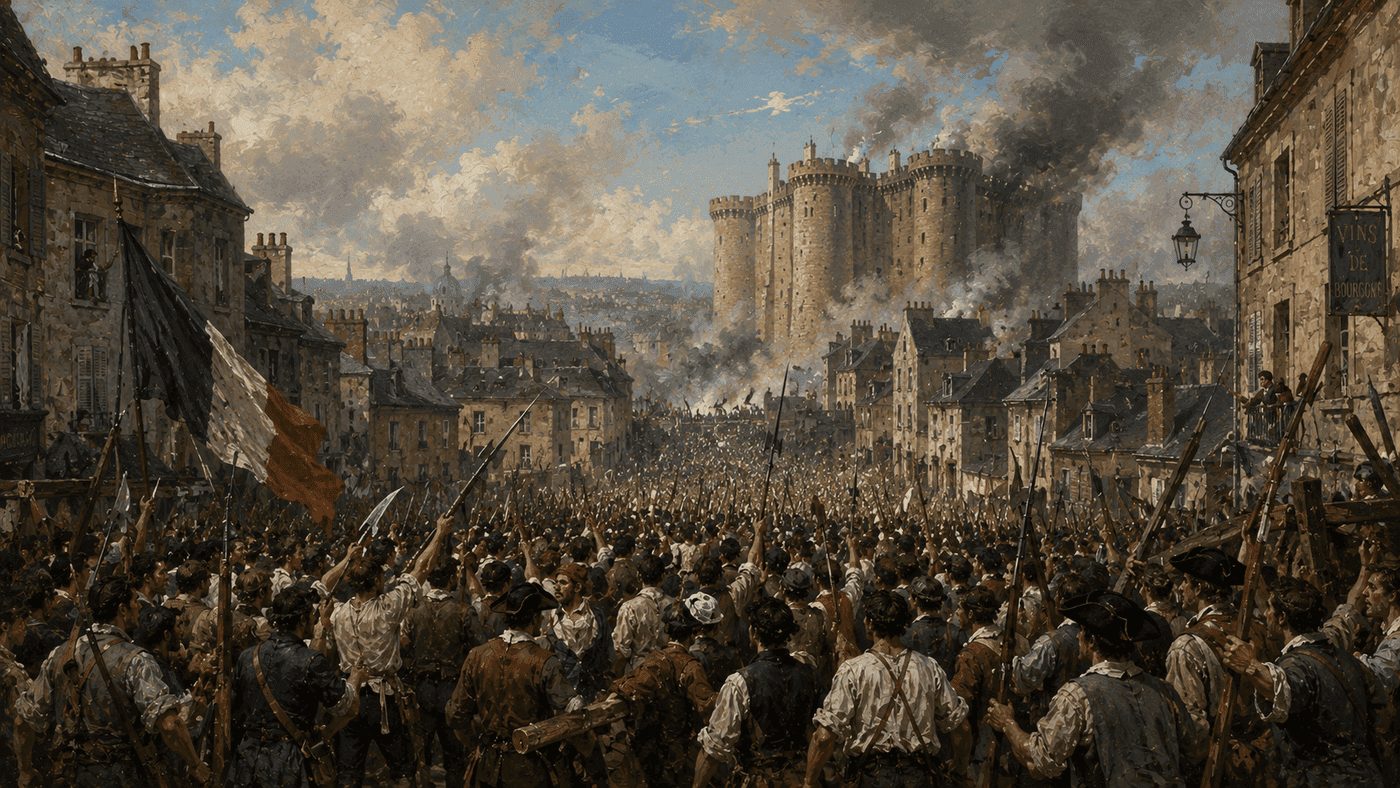
On July 14, 1789, a crowd of several thousand Parisians — hungry, frightened, and convinced that royal troops were massing to crush the nascent revolutionary movement in the National Assembly — marched on the Bastille, a medieval fortress on the eastern edge of the city that served as both a prison and an armory. They came for the gunpowder stored within its walls, but what they found when they breached its gates was almost anticlimactic: only seven prisoners, none of them political, and a garrison that had already been negotiating its surrender. The governor of the Bastille, the Marquis de Launay, was killed by the crowd; his head was displayed on a pike through the streets of Paris. The fortress itself was demolished in the months that followed, its stones sold as souvenirs. What mattered was not what the Bastille contained but what it represented — and the fact that a crowd of ordinary citizens had torn it down.
The storming of the Bastille on July 14, 1789, is the founding myth of the French Republic — a day celebrated ever since as Bastille Day, France's national holiday, with military parades down the Champs-Élysées and fireworks over the Seine. Its deeper significance lies in what it set in motion: the French Revolution, which abolished the monarchy, executed the king and queen, passed through the Terror, produced Napoleon, and ultimately exported the ideas of liberty, equality, and popular sovereignty across Europe and beyond. The American Revolution had preceded it by a decade, but the French Revolution was the one that made those ideas a global force — that demonstrated, at enormous cost, that the old order of monarchs and aristocrats was not simply imperfect but replaceable. The crowd that stormed the Bastille on July 14 was not thinking in centuries. But the world they helped make has been living in their wake ever since.
500
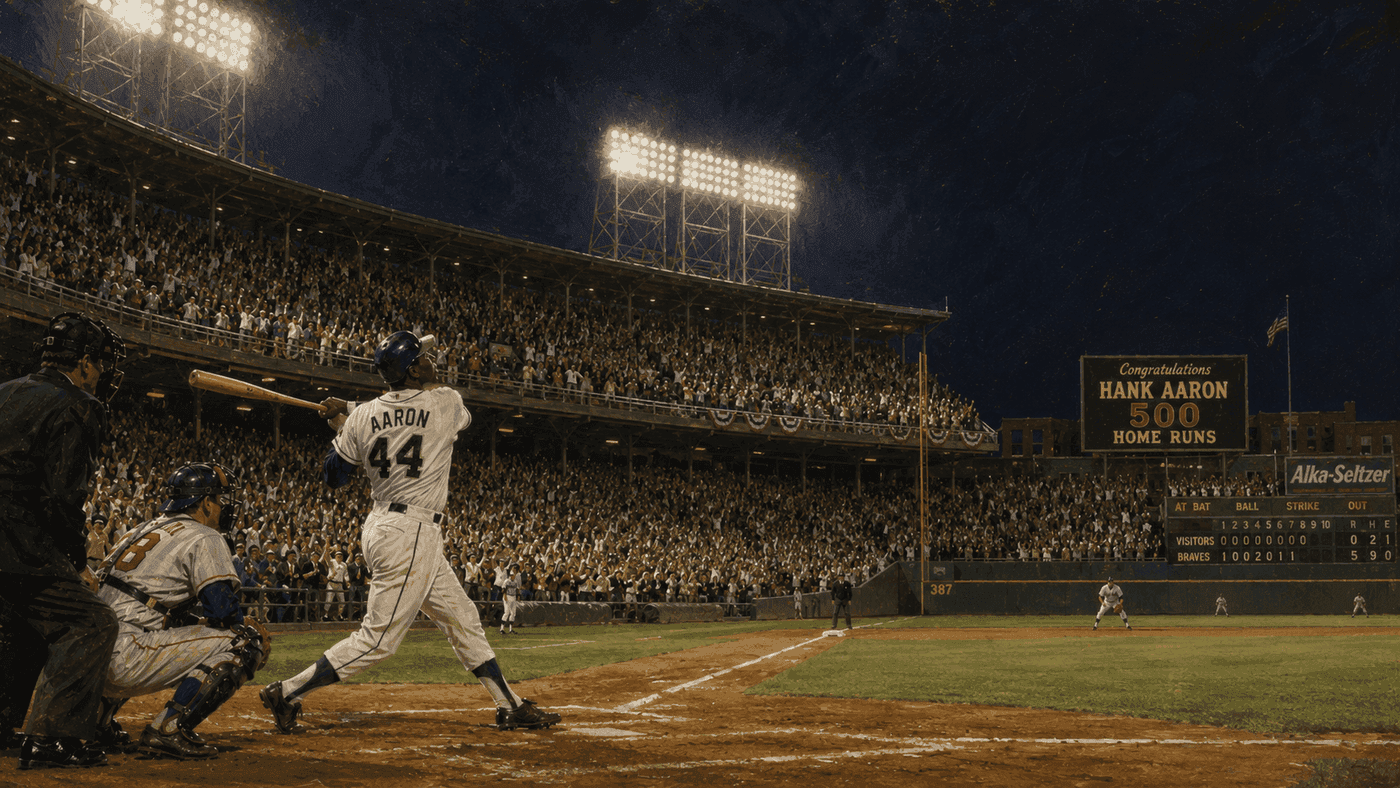
On July 14, 1968, Hank Aaron stepped into the batter's box at Atlanta Stadium against San Francisco Giants pitcher Mike McCormick and connected with a fastball that carried into the stands for his 500th career home run — joining Babe Ruth, Willie Mays, and Jimmie Foxx as the only players in major league history to have reached the milestone at that point. Aaron had come up with the Milwaukee Braves in 1954, a twenty-year-old from Mobile, Alabama, who had learned to hit by swinging a broom handle at bottle caps, and he had been hitting with extraordinary consistency ever since — not with the dramatic, explosive power of Ruth or Mickey Mantle, but with a quiet, accumulating excellence that the baseball establishment was sometimes slow to recognize precisely because it lacked the theatrical quality that drew the most attention.
The 500th home run on July 14, 1968, was a milestone, but it was the pursuit of Ruth's all-time record of 714 that defined the later years of Aaron's career — and exposed something dark in American life. As Aaron approached and then surpassed Ruth's record in the early 1970s, he received tens of thousands of pieces of hate mail and death threats so serious that he required a security detail. The abuse was so relentless that Aaron later said the years of the pursuit were the most difficult of his life — harder, in some ways, than the segregated bus rides and separate hotels of his early career. He hit his 715th home run on April 8, 1974, surpassing Ruth's record before a crowd in Atlanta that gave him a standing ovation. He finished his career with 755 home runs, a record that stood until 2007. He was, by any measure, one of the greatest players the game has ever produced — and the grace with which he carried what the country threw at him during those years was a different kind of record altogether.
Jerusalem, 1099
On July 14, 1099, crusader forces breached the walls of Jerusalem after a five-week siege, completing a military expedition that had begun three years earlier with Pope Urban II's call at Clermont for Christian knights to reclaim the Holy Land from Muslim rule. The army that arrived at Jerusalem's walls had traveled thousands of miles through Anatolia, Syria, and Palestine, fighting battles at Dorylaeum and Antioch, enduring famine, disease, and desertion, and losing a substantial portion of the force that had set out. What remained — perhaps twelve to fifteen thousand fighting men — had constructed siege towers and catapults from timber hauled across barren terrain and had spent weeks battering at walls whose garrison was determined and well-supplied. On July 14, the first crusaders reached the top of the walls. On July 15, the city fell.
The conquest of Jerusalem was accompanied by a massacre of the city's Muslim and Jewish inhabitants that contemporary accounts — including those written by the crusaders themselves — described in terms that leave little ambiguity about its scale and character. The violence was not incidental to the conquest but integral to the religious fever that had driven the army across the known world. The crusader kingdom established in Jerusalem's wake lasted less than a century before Saladin retook the city in 1187 — this time with notably more mercy shown to its inhabitants than the crusaders had demonstrated in 1099. The First Crusade's capture of Jerusalem on July 14, 1099, is one of the most consequential events in the history of the relationship between the Christian and Muslim worlds: a moment of religious triumphalism whose methods were so extreme that their memory has never fully faded from the civilizations that inherited them, on either side.