July 12: A First, a Sacrifice, and a Car from the Future
July 12 is a day for firsts and for courage — sometimes they are the same thing. In 1984, a Democratic presidential nominee walked to a podium and named a running mate who had never existed before in American politics, rewriting what was possible for every woman who came after. In the jungles of Vietnam in 1965, a Marine officer gave his life so that his men might survive, earning the first Medal of Honor the Corps would award in that war. And in a Chicago workshop in 1933, an inventor unveiled an automobile so far ahead of its time that the world wasn't sure whether to admire it or fear it. Three July 12s, three acts of imagination and sacrifice, three moments that asked more of the people inside them than comfort or convention would have required.
The Ticket
On July 12, 1984, Walter Mondale stood before the Democratic National Convention in San Francisco and announced that his vice-presidential running mate would be Geraldine Ferraro — a three-term congresswoman from Queens, New York, and the first woman ever selected as a vice-presidential candidate by a major American political party. The announcement was greeted with an eruption on the convention floor that those present described as unlike anything they had witnessed before: women in the gallery weeping, delegates embracing, an auditorium full of people processing the fact that something they had been told was impossible had just been declared possible. Ferraro herself, in her acceptance speech, acknowledged the weight of the moment directly: "My name is Geraldine Ferraro," she said. "I stand before you to proclaim tonight: America is the land where dreams can come true for all of us."
The Mondale-Ferraro ticket lost the 1984 election to Ronald Reagan in one of the most lopsided defeats in presidential history, carrying only Minnesota and the District of Columbia. The loss did not diminish the significance of what Ferraro's nomination had accomplished — it had made visible, for the first time at the highest level of American politics, the idea that the presidency and vice presidency were not inherently male offices. The campaign was not without turbulence: Ferraro faced relentless scrutiny of her family's finances that many observers believed was applied with a double standard, and she navigated questions about her Catholic faith and her position on abortion with a precision that drew both admiration and criticism. She ran for Senate twice after 1984, unsuccessfully, and spent the rest of her life as a public figure and advocate. When she died in 2011, the obituaries noted, almost universally, that no woman had yet appeared on a major party presidential ticket since her. That changed in 2016. The door she opened on July 12, 1984, had never fully closed.

First Medal
On July 12, 1965, Major Malcolm A. Carpenter of the United States Marine Corps was killed in action in Vietnam while leading his company through a firefight in which they were vastly outnumbered and under withering attack. Rather than withdraw or take cover, Carpenter repeatedly exposed himself to enemy fire to direct his men, coordinate fire support, and ensure the evacuation of his wounded. His actions saved the lives of the Marines under his command at the cost of his own. He was thirty-six years old. The Medal of Honor awarded posthumously to Major Carpenter was the first the Marine Corps would give for actions in the Vietnam War — a distinction that carried the full weight of what that war would demand of the men and women who served in it over the decade that followed.
The Vietnam War produced 246 Medals of Honor across all branches of the armed forces — more than any conflict since World War II, a reflection of the war's particular ferocity and the frequency with which small units found themselves in desperate, close-quarters engagements against determined adversaries in terrain that offered no easy advantage. Major Carpenter's was the first, and it established from the beginning of the conflict a pattern that would repeat itself: the Medal awarded not for dramatic battlefield triumph but for the decision, made in a fraction of a second under fire, to put the lives of others before one's own. The Marines he saved on July 12, 1965, came home. His name is on the Vietnam Veterans Memorial in Washington, D.C., among the more than 58,000 others — one of the first in a war that was, on that July day, only beginning.

The Dymaxion
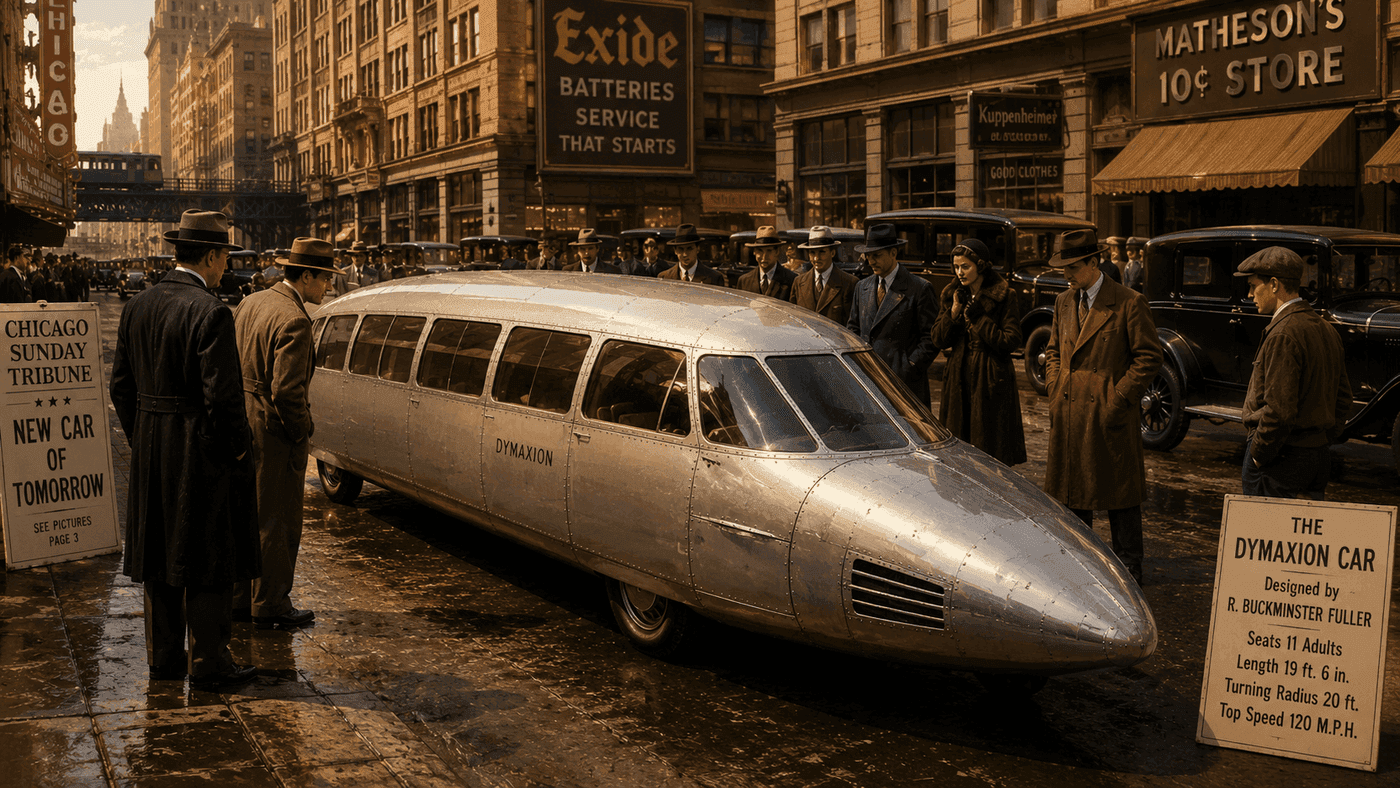
On July 12, 1933, Buckminster Fuller unveiled the first prototype of his Dymaxion automobile outside a Chicago workshop, and the people who saw it were not entirely sure what they were looking at. The car — twenty feet long, shaped like a teardrop, capable of carrying eleven passengers, driven by a rear-mounted Ford V8 engine, and steered by a single rear wheel that allowed it to turn in a radius its contemporaries could not approach — looked like nothing that had ever come off an assembly line. Fuller had designed it on the principle he called "doing more with less": maximum performance, minimum material, aerodynamic efficiency that the boxy automobiles of the era had never considered. He claimed it would eventually reach speeds of 90 miles per hour and achieve extraordinary fuel economy. In 1933, the average American car could barely manage either.
The Dymaxion's commercial future was derailed almost immediately. A fatal accident involving the first prototype near the Chicago World's Fair in July 1933 — whose cause was disputed and whose circumstances were murky — generated negative publicity that investors could not overlook. Fuller built two more prototypes, but financial backing evaporated and the project was abandoned. Only one of the three Dymaxion cars survives today, preserved and restored, a physical record of a vision that the market of 1933 was not prepared to accommodate. Fuller went on to other projects — the geodesic dome most famously — and the Dymaxion passed into the category of history's brilliant near-misses: ideas too far ahead of their time to succeed when they appeared, but whose core insights the world eventually caught up to. Aerodynamic efficiency, fuel economy, tight turning radius — the principles Fuller embedded in his teardrop car in 1933 are the principles that drive automotive design today. The car that looked like the future was simply the future, early.