
1 What It Means
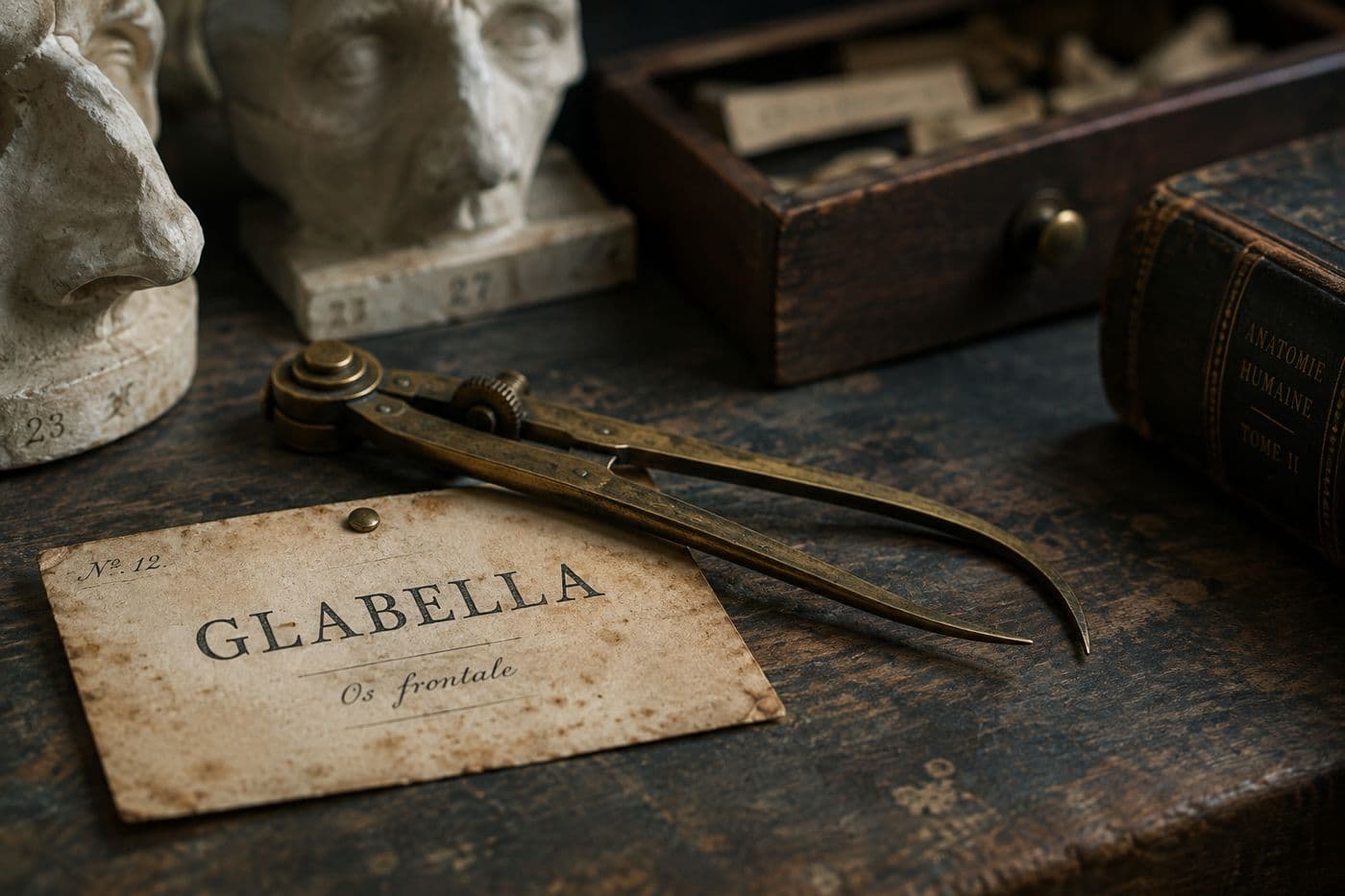
The smooth area of skin on the forehead, located above and between the eyebrows and above the bridge of the nose.
2 Caught in the Wild
The glabella is the smooth elevation on the frontal bone, situated above the root of the nose and between the eyebrows.
Gray's Anatomy · 1918 (20th ed.)
3 Where It Comes From
Glabella comes straight from Latin glabellus, meaning smooth, itself built on glaber, hairless or bald. English anatomists picked it up in the 1700s to name the one patch of the brow ridge that stays clear of hair growth, a useful landmark when you're trying to describe a skull precisely. It never escaped the dissection room because there was already a perfectly good phrase for it in ordinary speech: 'between the eyebrows.' Anatomy needed a fixed point with no ambiguity. Everyday English never did, so the Latin term stayed locked inside textbooks, lab reports, and the occasional cosmetic dermatology consult.
4 The World Behind the Word
Anatomists name landmarks, not just regions, because measurement depends on fixed points. The glabella is one of a set of craniometric landmarks, alongside things like the nasion and the bregma, that let researchers take consistent measurements across different skulls and different studies. Without an agreed-upon point, a claim like 'skull length increased over three generations' means nothing, because two people could be measuring from two different starting spots. The glabella works well for this because it sits on bone, not soft tissue, so it doesn't shift with weight gain, aging, or swelling. Forensic teams still use it today when reconstructing a face from bone alone, and cephalometric orthodontists use it to plan how a jaw or brow will sit once treatment finishes.
5 Use It Yourself
Break this out the next time someone squints at you across a table and you want to sound clinical instead of catty: 'you've got a real glabella crease going on there.' It reads as anatomical, not insulting, mostly because nobody will know what you mean. Works especially well around anyone in dermatology, forensics, or physical therapy, who will actually get the joke.
Try it out loud
My dermatologist pointed at my glabella and asked if the lines there bothered me.
🗝️The Deep Cut File
Forensic anthropologists and facial reconstruction artists lean on the glabella constantly. It's one of the standard craniometric landmarks used to sex a skull: a pronounced, bony glabella tends to run male, while a flatter one tends to run female, though it's only ever one data point among many. The same spot also shows up in Botox marketing copy, where injectors call the vertical lines that form there '11s,' a nickname that has almost entirely replaced the anatomical term in casual conversation, even among people getting the treatment.