
1 What It Means
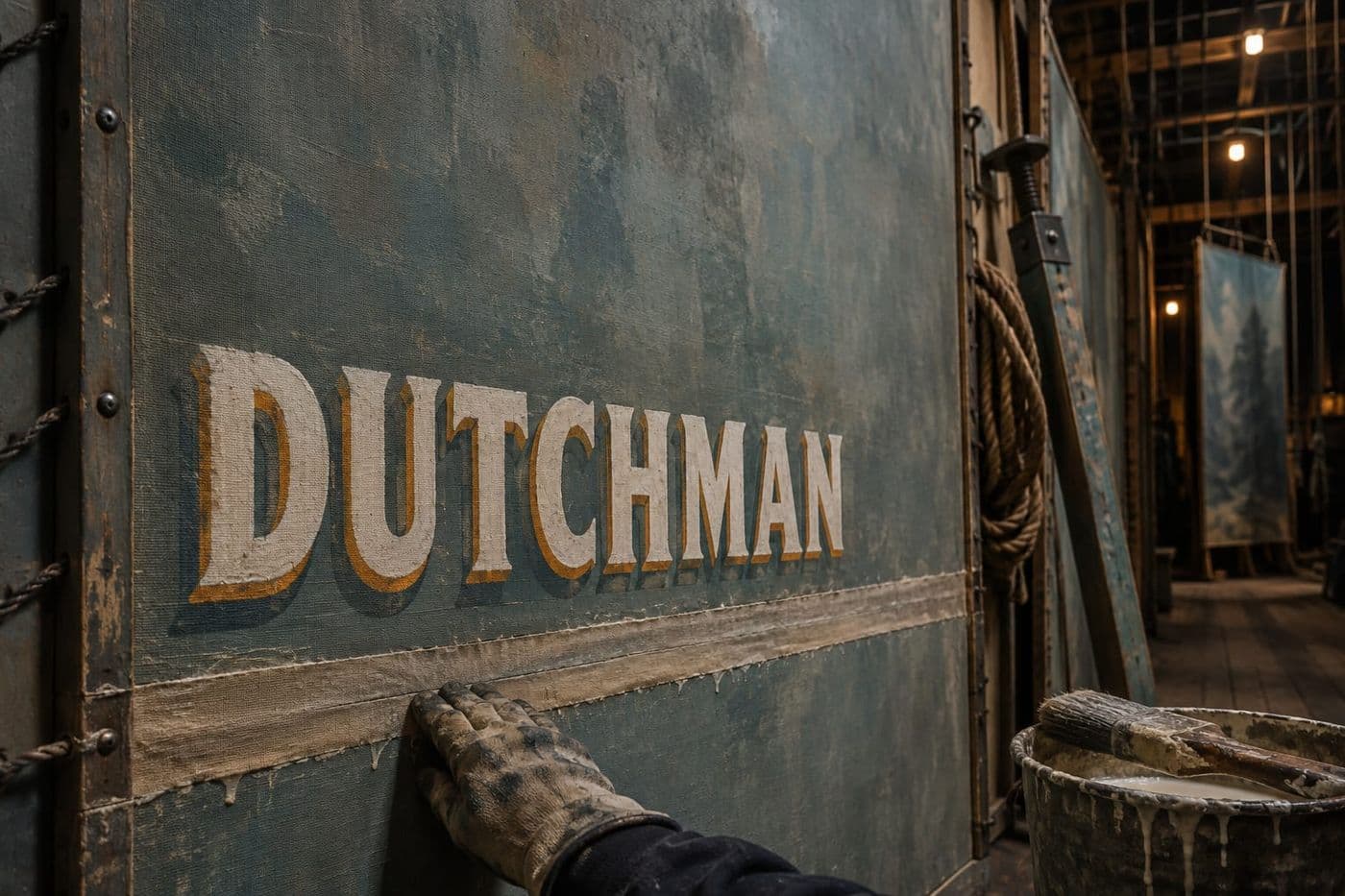
A narrow strip of cloth or tape pasted over the seam between two stage flats so the join disappears and the wall looks like one piece.
2 Caught in the Wild
Once the flats are lashed together, glue a dutchman over the seam, then paint across it so the join vanishes from the house.
Illustrative usage. · Undated.
3 Where It Comes From
Nobody has pinned down exactly why a strip of cloth got this name. The word is simply the common noun Dutchman, and it turns up in several crafts as shop slang for a piece that covers a fault. Whether the label began as a joke about Dutch workmanship or something else, the trail goes cold, and anyone offering a tidy story is guessing. What is clearer is why outsiders never learned it. Scenery is built in private, in scene shops, by small crews who hand the vocabulary down on the job. The audience is supposed to see a room, not a seam. A word whose entire purpose is to be unnoticed has little reason to leave the building.
4 The World Behind the Word
A stage wall is rarely one piece. Scenery is usually built as flats, which are wooden frames covered in canvas or muslin, because a flat can be carried, stacked in a truck, and moved between scenes. That portability creates a problem. Put two flats side by side and a thin vertical gap shows where they meet, and stage lights are good at finding gaps. The fix is the dutchman. The crew joins the flats, then glues a strip of fabric over the seam, with half of it on each flat. Paint goes over the whole surface, and the join sinks into the wall. Paint is the final disguise, which is why the strip has to be fastened before the painters arrive. It also does a second job. A strip across a hinged joint lets two flats fold without a visible break. The trick is a quiet one: cover the flaw so completely that nobody knows it was there.
5 Use It Yourself
Few people have a stage wall to repair, but the idea travels. Any time someone tapes a strip of paper over a gap in a school project, or hides a seam in a cheap bookshelf with a strip of veneer, a theater person would say you just put a dutchman on it. Use it among people who work backstage or build things, since everyone else will hear a surname. It sounds like an insult to a person, but it is only a patch.
Try it out loud
The seam in the set was showing, so Priya cut a long dutchman from muslin and glued it down before paint call.
🗝️The Deep Cut File
The same word turns up in woodworking and stone repair, where a dutchman is a patch let into a piece to replace a damaged or flawed section. A carpenter cuts out the rotten spot, shapes a new piece to fit, and glues it in so the repair blends with the grain around it. The theater strip and the wood patch are different objects, but they share a job: both exist to hide a defect from the eye. That shared purpose is probably why the name stuck across trades. Each is a small piece of craft whose success is measured by the fact that you did not notice it.