
1 What It Means
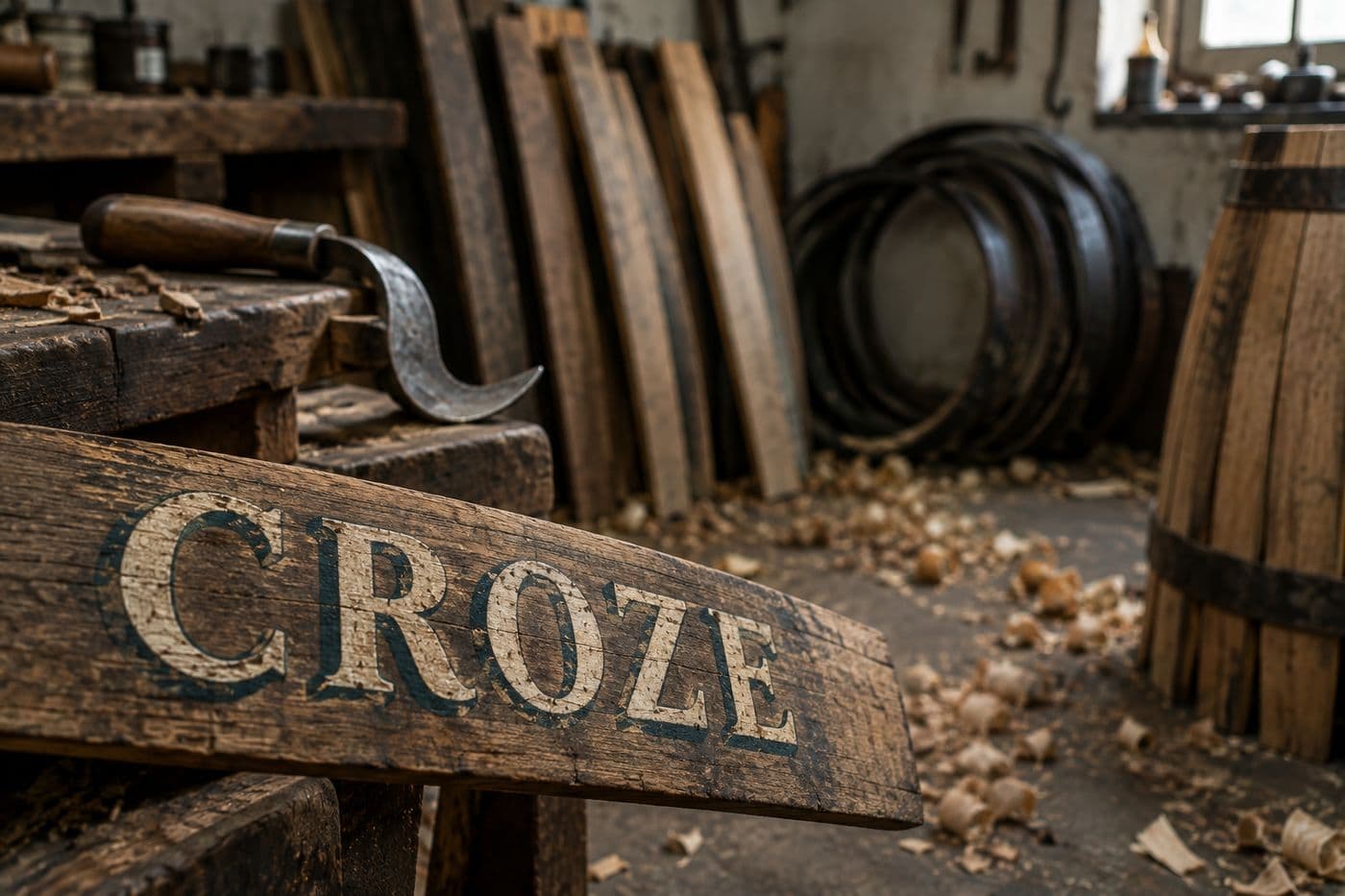
A croze is the groove a cooper cuts inside the rim of a barrel to hold the flat head in place, and also the tool used to cut it.
2 Caught in the Wild
"The croze is set to the exact depth needed so the head seats tight without splitting the stave."
Illustrative usage · Undated
3 Where It Comes From
Croze traces to the Old French crosse, meaning a hook or curved tool, by way of Middle English cooperage terms. The word settled into English barrel-making shops and stayed there because nothing else in the general vocabulary describes this specific groove-and-tool combination. A carpenter has a groove, a joiner has a rabbet, but a cooper needs one word that covers both the cut and the blade that makes it. The trade kept its own compact vocabulary because barrel-making stayed a closed guild practice for centuries, passed hand to hand rather than written into pattern books. When mass production arrived, coopering shrank to a specialty trade, and the word shrank with it, surviving only where barrels are still built one at a time.
4 The World Behind the Word
Cooperage is the craft of building barrels, casks, and kegs from individually shaped wooden staves, and it depends on joints that hold without a single nail or screw. Once a cooper bends and fits the staves into a barrel shape, held by iron hoops, the ends need a way to seat the flat wooden head that seals the container. The cooper cuts a shallow groove, the croze, around the inside of the barrel near each end, using a tool of the same name: a small hand plane with an adjustable blade that scores the groove to a precise depth. The head board drops into that groove and the hoops driven down over the staves lock everything under tension. Cut too shallow, the head pops loose. Cut too deep, the stave weakens and splits. Whiskey and wine barrels still rely on this exact joint today, hand-cut in traditional cooperages.
5 Use It Yourself
You will not drop this into casual conversation, but distillery tours and craft cooperage demonstrations use it constantly, and knowing it makes you the person who asks the good question. It also works as a sly compliment for any tightly engineered joint or seam, the kind of detail a contractor gets right that most people never notice. Say it plainly, not cutesy, and coopers will assume you did your homework.
Try it out loud
The distillery guide pointed at the barrel head and said the croze had been cut by hand, not machine.
🗝️The Deep Cut File
The tool called a croze looks almost like a small plane but drags two spaced cutting blades instead of one, scoring both walls of the groove in a single pass so the depth stays even all the way around the barrel. Coopers historically judged the fit by ear, tapping the head with a mallet and listening for a dull, solid thud rather than a hollow ring, which meant the head had not seated fully into the croze. Modern barrel factories now cut the groove with a rotating router jig, but the part is still called a croze on every production drawing, a quiet holdover from a trade that used to do the whole job by hand.