
1 What It Means
The narrow strip of tissue and cartilage that divides the two nostrils at the bottom of the nose, forming the lower edge of the nasal septum.
2 Caught in the Wild
The surgeon noted that the columella hung slightly below the edge of the nostrils when viewed in profile, and planned to adjust the tip accordingly.
Illustrative usage. · Undated.
3 Where It Comes From
Columella is Latin, a diminutive of columna, meaning column. So the word is literally a little pillar, which is a fair description of a post holding the nose's tip up between two openings. Anatomists wrote in Latin for centuries, and many body parts kept their Latin names long after the textbooks switched to English. This one never got a plain-English rival. Nobody's daily life depends on it. You blow your nose, you wipe it, you say the area is under your nose, and the vocabulary stops. The related word septum took the spotlight because it names the whole divider inside the nose. The columella stayed the property of surgeons, anatomists, and the occasional naturalist.
4 The World Behind the Word
In a rhinoplasty consultation, the columella gets studied like a skyline. Surgeons look at the face from the side and ask how much of the columella shows below the rim of the nostril. Too much looks like a hanging columella. Too little looks retracted. Either can change how the whole nose reads, even when the bridge and the tip are fine. Underneath the skin, the columella is supported by cartilage that forms the nose's tip, along with the lower end of the septum, the wall that separates the two nasal passages. That support is why the area matters in repair work. When cartilage there is weak or removed, the tip can lose its lift and droop. A general word like 'the bit between your nostrils' will not do when a plan has to be written down and measured.
5 Use It Yourself
Use it when someone in the group chat is describing a nose piercing, a cold sore, or a bad sunburn and ends up gesturing vaguely at their face. 'It's on my columella' wins the conversation. It also earns a quiet nod at a dermatologist's office or from a friend who has had a nose job. Register trap: it sounds like a made-up Latin insult, but it is purely anatomical. Drop it into casual talk and expect blank looks, then a quick explanation.
Try it out loud
The sunscreen missed my columella, so now the strip between my nostrils is peeling like a sunburned lizard.
🗝️The Deep Cut File
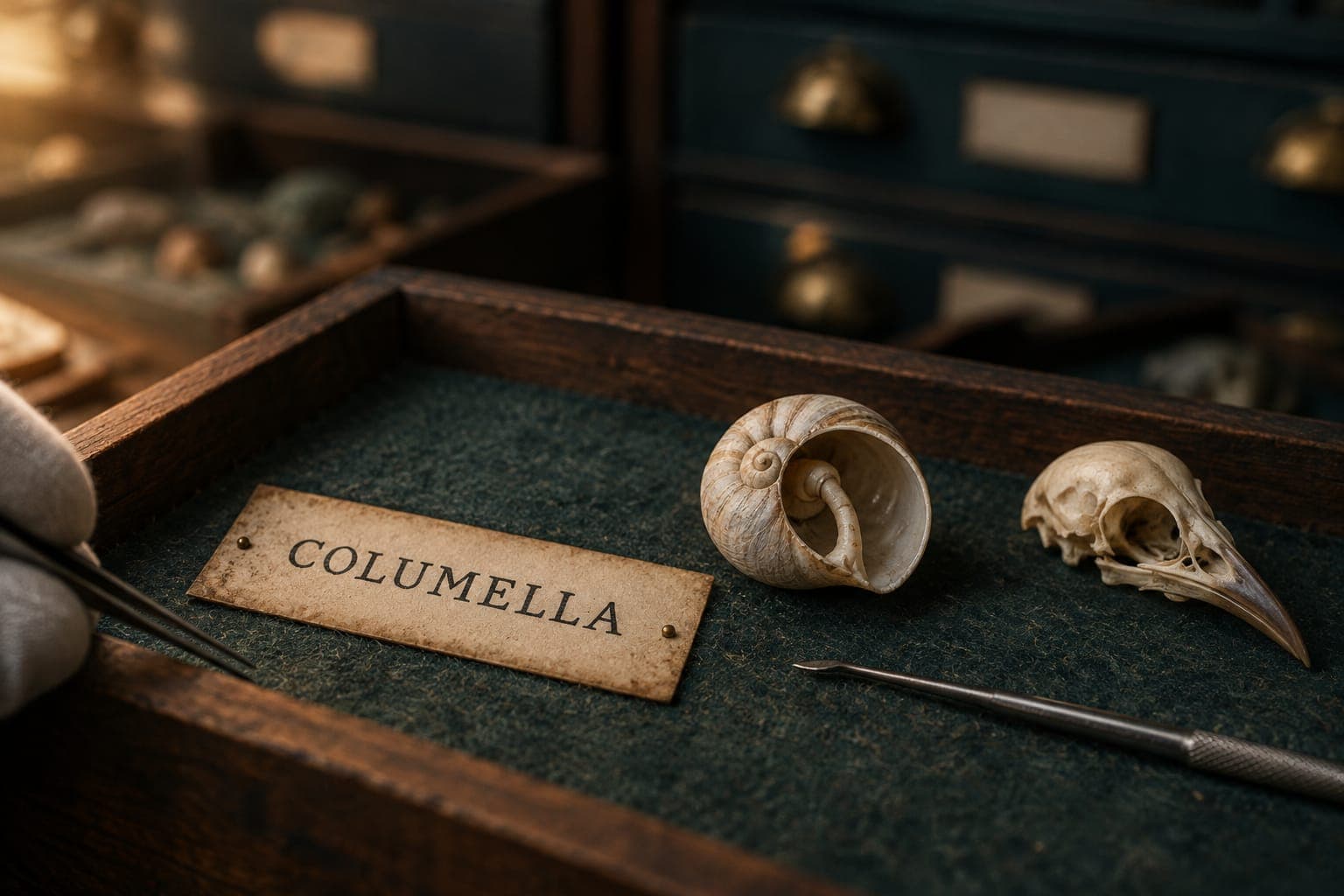
Columella shows up in places far from the face. Look into a spiral seashell and you will find a central pillar that the whole coil winds around. That pillar is also called the columella, and shell collectors use the word when identifying species. Birds, reptiles, and amphibians use the same name for something else entirely, a slender rod of bone that carries sound from the eardrum to the inner ear. In mammals, that job is done by three tiny bones, one of which, the stapes, is thought to be the evolutionary relative of the single rod. Botanists use the word too, for a central column in some fruits and moss capsules. The little pillar turns up whenever nature builds something around a central post.