
The President in the Catering Truck
On the evening of July 8, at Ankara's Esenboğa Airport, President Trump walked up the stairs of the old Air Force One — the familiar blue-and-white Boeing 747 — in full view of television cameras, waved, and disappeared inside. Reporters and senior White House staff settled into their seats for the flight to RAF Mildenhall in the United Kingdom. A Secret Service agent walked through the press section and instructed everyone to close their window shades. They were told this was a security precaution. It was. What they were not told was that the person they believed to be on board had already left the aircraft. Using a hydraulic catering truck — the kind ordinarily used to load meals and supplies through a door on the opposite side of the plane from where passengers board — Trump and a small group of close aides were transferred to a smaller Air Force C-32A jet, whose call sign carried no Air Force One designation. Trump flew to England on that plane. The old Air Force One, with Secretary of State Marco Rubio, Treasury Secretary Scott Bessent, and the rest of the White House travel pool aboard, followed as a decoy. The operation was triggered by a credible Iranian assassination plot — intelligence, provided in part by Israel, that Iran was planning to use a shoulder-fired missile to bring down the presidential aircraft as it departed Turkey. The Washington Post first reported the operation Monday. Trump confirmed it Tuesday night. "I guess there was a threat out there," he said. "I didn't really ask too much about it."
A Tactic as Old as Wartime Presidencies
The use of decoy aircraft to protect an American president is not new — but it has rarely been deployed in the circumstances surrounding July 8. The most celebrated precedent is Franklin Roosevelt's 1943 journey to the Casablanca Conference, where he became the first sitting U.S. president to fly while in office and the first to travel to an active war zone — a trip conducted in such secrecy that even most of his own staff did not know where he was going. FDR flew in a Boeing 314 flying boat — a commercial aircraft pressed into presidential service — and his security team spent considerable effort misdirecting anyone who might have been watching. Dwight Eisenhower traveled under cover during tense Cold War periods. George W. Bush flew secretly to Baghdad on Thanksgiving 2003 to visit troops in Iraq, a trip conducted with such operational security that even the press pool was misled until they were wheels-up and the destination became clear. What distinguishes the July 8 operation is its context: it occurred not during a wartime visit to a foreign country, but during a NATO summit departure from a friendly ally, in a war that is being fought in part over the assassination of Iran's Supreme Leader, with Iranian intelligence actively hunting the American president as a target. The operation succeeded. But the question of whether its success was a testament to American security capabilities or a warning about how directly the Iran conflict has extended to presidential safety is one that congressional Democrats are now formally demanding answers about.
The specific detail that Rubio and Bessent — both in the presidential line of succession — were aboard the decoy plane has drawn particular attention. The White House has not publicly addressed the question of whether they were aware they were flying as decoys for a presidential aircraft that did not contain the president. The mechanics of the operation — the catering truck, the window shades, the 20-minute gap between wheels-down at Mildenhall and the moment the press pool was allowed to set up cameras to capture Trump deplaning — were carefully designed to prevent anyone from knowing, in real time, that the transfer had occurred. Iran has been assessed by U.S. intelligence as having both the motivation and the operational capability to target American aircraft with man-portable air defense systems — the shoulder-fired missiles known as MANPADS that have been a persistent threat to low-flying military and civilian aircraft since the 1970s. The question of which plane — the large, recognizable, call-signed Air Force One, or the smaller, unmarked C-32A — constituted the greater risk is one that Trump himself addressed, somewhat paradoxically, in his confirmation remarks: "I think actually the plane that I flew on was at greater risk. I think it was at greater risk because that would be the plane I think that they would be more likely to go for." He did not elaborate on the logic.
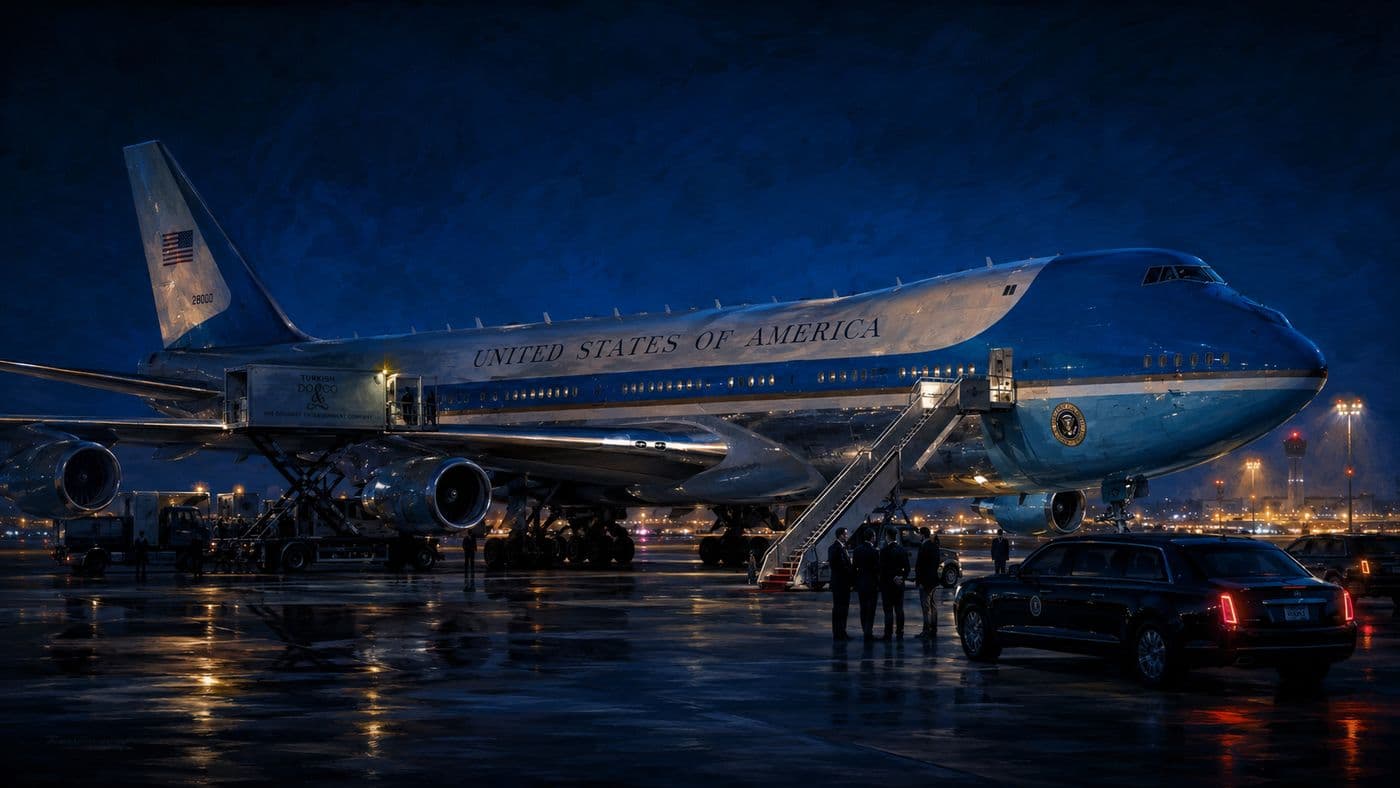
The disclosure of the operation — first by The Washington Post, then confirmed by CNN and NBC News, and finally by Trump himself — comes at a moment when U.S.-Iran tensions remain at their highest point since the war began in February. The Strait of Hormuz remains effectively closed. Iran declared Sunday that there are no ongoing negotiations with Washington. The 60-day MOU deadline established by the June 15 memorandum of understanding has now passed without a permanent settlement. Into this context lands the revelation that, one month ago, Iranian intelligence had developed a specific plan to shoot down the president's aircraft with a shoulder-fired missile as it left a NATO summit — and that the Secret Service and U.S. military responded with a covert operation of sufficient complexity to require a catering truck, three aircraft, and the deliberate misdirection of reporters, senior cabinet members, and the global press corps. The Iran war has been visible in oil prices, in the Strait of Hormuz, in the Ebola outbreak it has overshadowed, and in the geopolitical architecture of every major diplomatic conversation for six months. The catering truck in Ankara is a reminder that it has also been visible, invisibly, in the specific security calculations made every time the American president gets on a plane. The window shades were closed. Nobody on board knew why. Now they do.