
Tomorrow, the Sky Goes Dark Over Spain
Tomorrow evening at approximately 8:28 p.m. local time in A Coruña — on Spain's northwestern Atlantic coast — the moon will slide in front of the setting sun and the world will go strange for one minute and twelve seconds. Stars will appear in the daytime sky. The temperature will drop several degrees in an instant. Animals will behave as though night has come. The sun's outer atmosphere — the corona, normally invisible behind the overwhelming brightness of the solar disc — will become suddenly visible, a ghostly halo of white and silver light radiating into the darkened sky. Then, as quickly as it began, it will end: the diamond ring effect, a single point of brilliant light bursting from the moon's edge, and day will return. The shadow sweeps east across Spain toward Zaragoza, Valencia, and the Balearic Islands before sliding into the Mediterranean at sunset — and one of the most extraordinary astronomical events in recent European memory will be over. It has been 27 years since a total solar eclipse crossed continental Europe. Spain has not experienced one in over a century. After tomorrow, anyone who missed it will wait until 2053 for another chance.
The Most Unlikely Coincidence in Astronomy
That a total solar eclipse is possible at all is one of the most improbable facts in the solar system. The sun is approximately 400 times wider than the moon. It is also approximately 400 times farther away. This geometric coincidence — which has no known physical reason and will not last forever, as the moon is slowly drifting away from Earth at about 1.5 inches per year — means that the two objects appear almost exactly the same size in our sky. When they align precisely, the moon covers the sun almost perfectly, revealing the corona that would otherwise be drowned out by the solar disc's overwhelming light. Ancient civilizations had no framework for understanding what they were seeing. The Babylonians, who kept careful records of celestial events, documented eclipses beginning in the 8th century BCE and eventually learned to predict them using the Saros cycle — an 18-year, 11-day pattern still used by astronomers today. The ancient Chinese believed a solar eclipse was a dragon eating the sun; the traditional response was to make as much noise as possible to frighten the dragon away. The ancient Greeks used eclipses to test theories about the Earth's curvature and the distance to the moon. Thales of Miletus is said to have predicted an eclipse in 585 BCE so accurately that it stopped a battle between the Lydians and the Medes — the soldiers on both sides took the sudden darkness as a divine signal to end the fighting.
What makes tomorrow's eclipse scientifically extraordinary, beyond its rarity and its spectacular setting over Spain's evening sky, is the state of the sun itself. The eclipse occurs during the declining phase of Solar Cycle 25, a period when the sun's magnetic activity is decreasing from its recent peak — meaning the corona will display the elongated, streamlined structure of a sun past its solar maximum rather than the complex, multi-directional corona visible at peak activity. Solar physicists say this will give tomorrow's corona an appearance unlike any eclipse in recent memory, with long equatorial streamers extending far from the solar disc in both directions. The ESA's Proba-3 mission — a pair of satellites designed to create an artificial eclipse by one satellite blocking the sun's disc as seen from the other — will be observing the same corona simultaneously, giving scientists an unprecedented simultaneous ground-and-space view of the solar atmosphere that no single eclipse has provided before. And then, hours after totality ends in the Balearic Islands and darkness finally falls naturally over a Spain that saw artificial darkness at sunset, the Perseid meteor shower — generated annually when Earth passes through the debris trail of Comet Swift-Tuttle — peaks in the moonless sky. A new moon means zero lunar glare. Observers who position themselves in the path of totality tonight may witness, in the space of a single evening, both the most dramatic solar event in a generation and one of the most prolific meteor displays of the year.
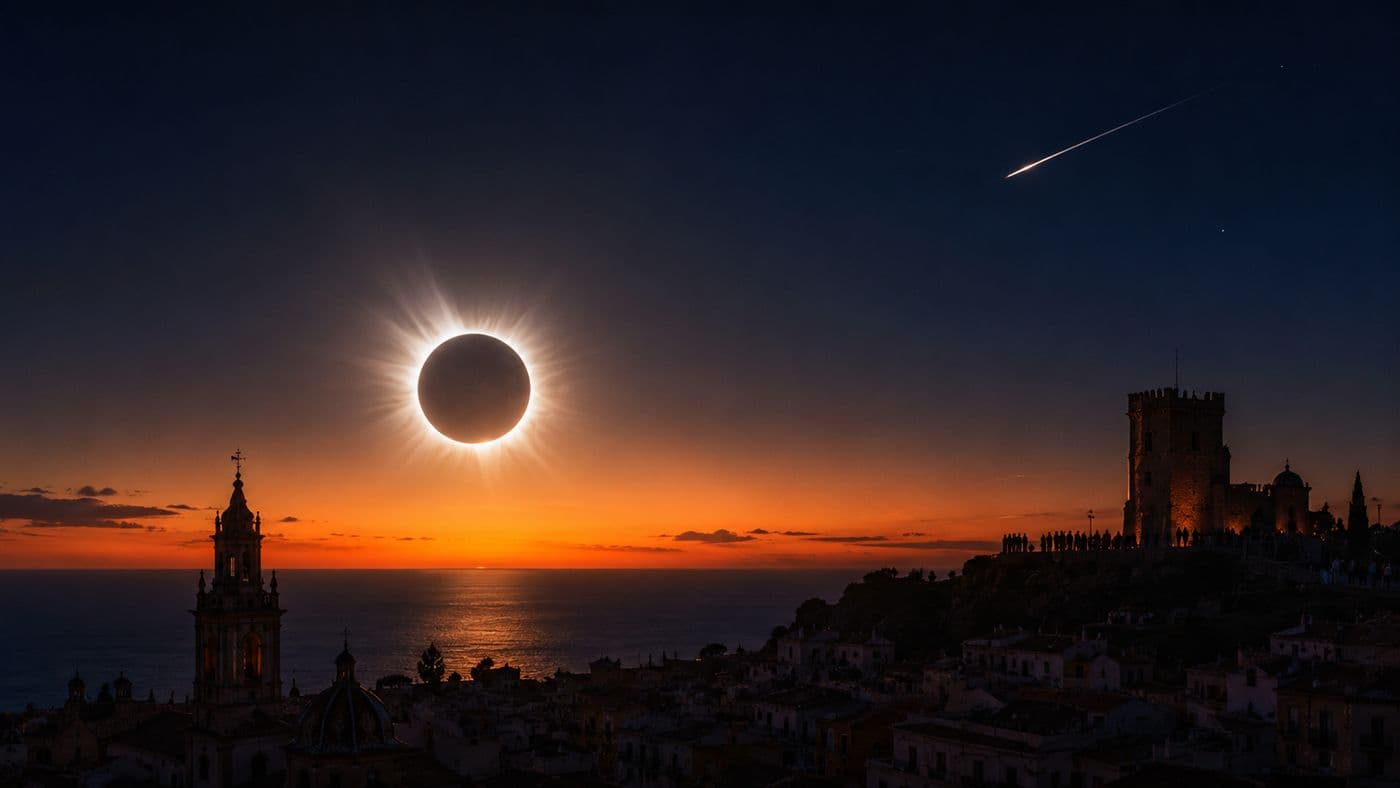
The path of totality tomorrow traces a line from northeastern Greenland — where it begins in a remote Arctic wilderness at sunrise — across Iceland, where Reykjavík will experience 60 seconds of totality at 5:48 p.m. local time, and then across the Atlantic to Spain, where the shadow makes landfall at A Coruña at 8:28 p.m. CEST and sweeps east through Oviedo, León, Bilbao, Burgos, Zaragoza, Valencia, and Palma de Mallorca before reaching the Mediterranean at sunset. The sun will be only 10 to 12 degrees above the horizon in Spain during totality — low enough that an unobstructed western view is essential, and low enough that the eclipse will look like nothing else most observers have ever seen: a darkened sun setting in the west, its corona glowing above the rooftops and the sea, stars visible in the east. In three years, Spain will have another chance — a second total eclipse on August 2, 2027, this one crossing the south of the country. But that eclipse will be higher in the sky, more conventionally dramatic, less strange. Tomorrow's is the one people will remember: the eclipse that came in with the sunset, and left the whole sky to the meteors.