
A Cave That Kept a Secret for 25,000 Years
Deep inside Cloggs Cave, in the traditional lands of the GunaiKurnai people in southeastern Australia, researchers have uncovered evidence of a ritual practice that spans an almost unthinkable stretch of time: 25,000 years, or more than 1,000 human generations. The evidence isn't dramatic to the eye — it's microscopic plant fragments buried in layers of ancient ash. But it may be one of the longest continuously documented cultural traditions ever identified anywhere on Earth.
Reading Ash Like a Library
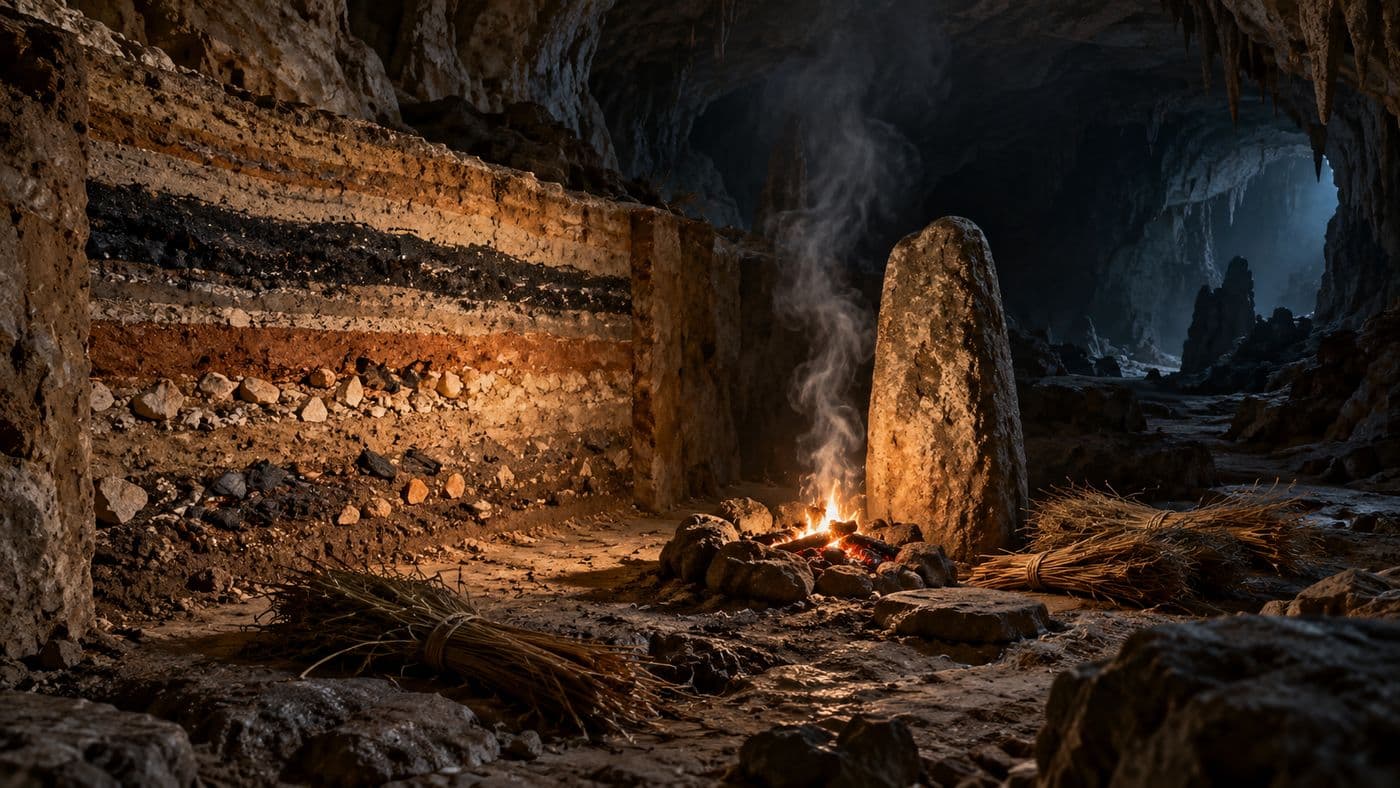
During excavations carried out in 2019 and 2020, a team led by Monash University's Bruno David, working in direct partnership with the GunaiKurnai Land and Waters Aboriginal Corporation, collected sediment samples layer by layer from two deep pits inside the cave, some reaching more than two meters below the surface. Within that sediment, they found thousands of phytoliths — microscopic silica structures that form inside plant tissue and survive essentially forever, long after the plant itself has decomposed. Remarkably, 97% of the phytoliths came from grasses, and nearly a fifth showed signs of burning. That pattern told researchers something specific: people were not simply cooking or keeping warm. They were deliberately gathering whole grass plants, including roots and other inedible parts that no one would bother harvesting for food, carrying them into a dark cave, and burning them there in thin, repeated layers, over and over, for millennia.
The oldest of these burnt layers date to between roughly 25,800 and 24,000 years ago — deep into the last Ice Age, when Australia was cooler, drier, and half-covered by shifting sand dunes. The practice continued, with gaps, all the way into the last few thousand years; around 2,000 years ago, researchers found a 28-centimeter standing stone deliberately placed upright on a bed of ash, with fires burned around it regularly for roughly 400 years afterward. GunaiKurnai oral tradition and 19th-century ethnographic records describe exactly this kind of practice: caves used by mulla-mullung, skilled ritual practitioners, for healing, magic, and cursing, using ash from burnt plants as part of the ceremony. The phytoliths don't just support that oral history — they extend it back tens of thousands of years further than any written or spoken record could reach on its own.
Cloggs Cave has its own complicated history: it was first excavated in the early 1970s without the consent of the GunaiKurnai people who are its traditional custodians. This research marks a different approach, undertaken as a genuine partnership between archaeologists and the GunaiKurnai community, weaving scientific analysis together with living cultural knowledge rather than treating the site as a subject to be studied from a distance. What emerges from that partnership is a striking recalibration of how far back continuous human ritual behavior can be traced — not through myth or guesswork, but through ash, grass, and the patient, careful work of people willing to look at what a cave floor had been holding onto the entire time.